Does sleep affect your running?
The alarm goes off after a night of staring at the ceiling, and the plan says intervals. Most runners know that feeling, and most have heard that sleep is when you recover. Fewer know what one bad night actually costs, whether it matters more than a week of short ones, or what to make of the sleep score on their wrist.
The research is fairly consistent on the first question and thinner on the others. Most of it comes from small lab studies in young men, often after a whole night without sleep, so it describes a harsher night than most runners have. Keep that in mind as you read.
How much does one bad night slow you down?
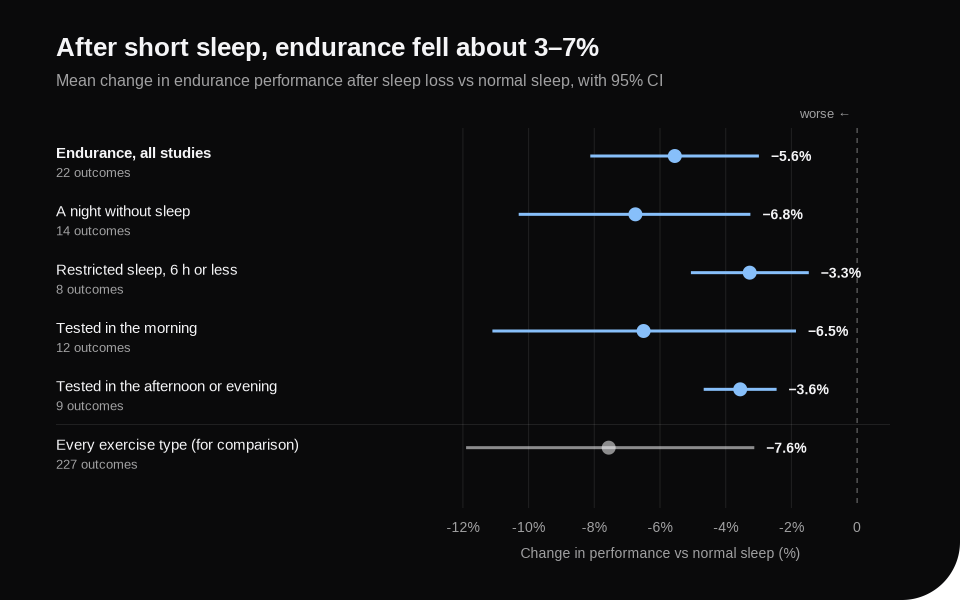
On average, by a few per cent. A 2022 meta-analysis pooled 69 publications (959 participants, 89% of them men) that compared exercise after normal sleep with exercise after 6 hours or less. Across every kind of exercise, performance fell by 7.6% [1]. For endurance tasks (continuous efforts of two minutes or more, from 20 studies), the drop was 5.6%: 6.8% after a night without sleep and 3.3% after restricted sleep of 6 hours or less [1]. The studies varied a lot, so treat these as averages, not predictions for you.
Two other meta-analyses agree. One that looked only at endurance, 31 studies and 478 people, found a moderate effect, larger when the exercise lasted more than 30 minutes [2]. Its authors found partial sleep loss over one or more nights did about as much harm as a whole night without sleep, and noted that the effect on well-trained and professional endurance athletes is still unknown [2]. A 2024 analysis limited to athletes found a similar-sized effect on aerobic endurance [3].
The studies in runners point the same way:
- A night without sleep. In 11 men kept awake for 30 hours, a 30-minute self-paced treadmill run covered 6,037 m against 6,224 m after normal sleep, about 3% less [4].
- A short night. In 10 recreational male runners, a 3-hour sleep window made a morning 10K treadmill time trial 5% slower than an 8-hour window: 51.9 against 49.4 minutes [5].
- Running form. In 16 recreational runners (seven men, nine women), one night without sleep lowered cadence, lengthened ground contact and shortened time to exhaustion in a hard interval by 13.2% [6].
Why does running feel harder after a short night?
In the studies that measured it, the same effort bought less speed. In the 30-hour study, the runners rated their effort the same in both conditions (14.9 against 14.8 on the 6–20 scale); they simply ran less far at that effort [4]. The authors suggested a change in how effort is perceived might explain the slower run [4].
Cycling studies show a similar pattern. In 13 endurance athletes, a cycling time trial after a night without sleep was 10% slower (64 against 59 minutes), and their effort ratings were higher relative to their heart rate [7]. In another study, three nights of restricted sleep slowed a time trial while effort ratings didn’t change [8]. So for what feels like your usual effort, your watch may show a slower pace. That mismatch is information, not a fitness problem; there’s more on reading it in how a run felt.
Does it matter when you run, or how you lost the sleep?
Somewhat, but less for running than for other sports. Across all exercise types, the 2022 meta-analysis found the clearest harm after a whole night awake or after waking early, and little consistent effect when people simply went to bed late [1]. Tasks done in the morning were “largely unaffected” [1]. A 2024 analysis of athletes found the same: losing the end of the night hurt more than losing the start, and afternoon performance suffered more than morning [3].
Endurance is the exception. In the same 2022 analysis, endurance fell after short sleep whether the test was in the morning (6.5%) or the afternoon and evening (3.6%), and the authors wrote that endurance “tended to be affected” regardless of time of day [1]. The endurance-only meta-analysis likewise found that the time of testing didn’t change the effect [2]. Going to bed late was tested in only two endurance outcomes, both in the afternoon, and performance still fell [1]. An early session may limit the cost in other sports; a runner shouldn’t count on it.
Is a run of short nights worse than one bad one?
Probably, and it’s the part of the evidence that matters most for runners with busy lives. In a 2019 study, nine endurance cyclists and triathletes spent three nights with 30% less time in bed, three with their normal time and three with 30% more [8]. Restricted sleep averaged under 5 hours a night. Time-trial performance was slower than normal by the third day; with extra sleep it was faster by the fourth [8].
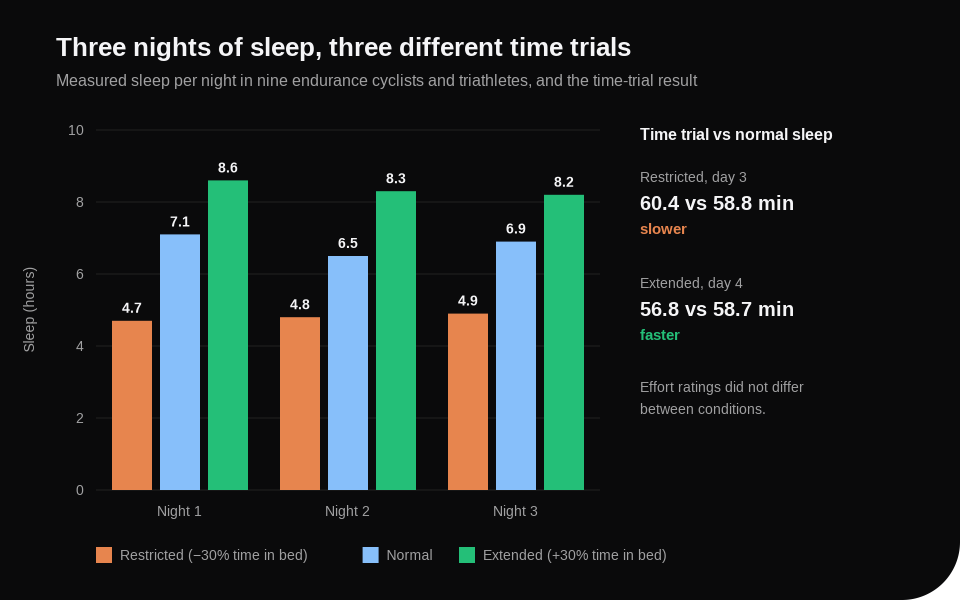
Not everyone reads the evidence the same way. A 2021 expert consensus on athletes’ sleep agreed that a night or more without sleep reduces performance, but said the effect of partial restriction over one to three nights, the realistic case, “remains unclear” [9]. The meta-analyses published since then found that restricted sleep does cost endurance [1, 2], though with few studies and wide ranges.
Short sleep as a habit may matter beyond performance. The same consensus notes that in the wider population, habitually sleeping under 7 hours a night is linked with a higher chance of catching respiratory infections [9]. In adolescent athletes, chronic poor sleep was linked with 58% higher odds of injury in a meta-analysis of observational studies, while the evidence on a single bad night was inconclusive [10]. The injury finding is observational, so it can’t show cause and effect, and neither finding comes from adult runners.
Can extra sleep or a nap make up for it?
Possibly, though the evidence is thinner than its fame. The best-known study, from Stanford in 2011, asked 11 men on the university basketball team to spend at least 10 hours in bed each night for five to seven weeks. They slept nearly two hours more, their sprint time fell from 16.2 to 15.5 seconds and their free-throw percentage rose by 9% [11]. That was basketball, not running, and each player was compared with his own earlier weeks rather than with a control group.
The closest thing for endurance is the cycling study above, where three nights of extra sleep made a time trial faster [8]. A 2021 systematic review found only two sleep-extension studies in athletes that met its criteria, judged the evidence of very low to moderate quality, and called its conclusions “tentative” [12]. A broader 2023 review of 25 studies concluded that more sleep at night, or naps, were the interventions that worked best, again with limited high-quality evidence [13].
Naps have similar support. A review of 37 studies in athletes suggested naps of 20–90 minutes between 13:00 and 16:00, with 30 minutes after waking before training, to let grogginess clear [14]. Another review of 18 studies found naps improved endurance in three of them, and longer nap opportunities (90 minutes) gave the biggest gains, with a warning about the quality of the evidence [15]. The 2021 consensus lists both napping and banking sleep as areas still needing research [9].
Can you trust your watch’s sleep numbers?
For how long you slept, reasonably well; for sleep stages, much less. Apple Watch estimates sleep from its accelerometer, which picks up movement including breathing [16]. In Apple’s own validation (299 nights from 166 people, compared with polysomnography, mostly in a sleep lab), the watch correctly labelled 97.9% of sleep as sleep but only 75.0% of wakefulness as wakefulness [16]. In other words, lying still and awake can be counted as sleep. A 2025 update raised that figure to 78.9% [16].
Independent tests agree on the broad picture. In 35 healthy adults, an Apple Watch Series 8 estimated total sleep close to a lab sleep study, but underestimated deep sleep by 43 minutes and overestimated light sleep by 45 minutes [17]. In 53 adults, an older Series 6 agreed with the lab on sleep versus wake 88% of the time, but on the specific stage only 53% of the time [18]. Use the duration as a rough record; don’t build your training around the stages.
What if it’s the night before a race?
You’re in good company. In a survey of 283 elite Australian athletes, 64% had slept worse before an important competition at least once in the past year, mostly because they couldn’t fall asleep, and mostly because of thoughts about the competition or nerves [19]. In 632 German athletes, 66% had slept badly before a big event at some point, and most said it hadn’t affected their performance, though that was their own judgement, not a measurement [20]. Endurance cyclists wearing activity monitors slept 6.5 hours the night before a race, against 7.4 hours in normal training [21].
Nobody has tested directly whether a well-slept week protects you from a bad last night. What the studies do show is that the cost of short sleep builds over several nights and extra sleep over several nights helps [8], and that lying awake before a race is usually trouble falling asleep rather than a night without sleep [19, 20, 21]. For endurance, even a late bedtime has cost performance in the few tests there are [1], so the last night isn’t irrelevant. But it is the one you can do least about.
What to do with this
- One bad night before a training day: keep the run, but make it easy, or move the hard session a day later. If you do the session, run it by effort and accept a slower pace.
- Several short nights in a row: that’s the stronger signal. Ease the week back and protect your sleep before you add training.
- A nap can help: 20–90 minutes in the early afternoon, with half an hour to wake up properly before you run.
- Before a race: put the effort into the nights earlier in the week. If the last night is restless, that’s normal.
- Treat watch sleep data as approximate: good enough to spot a pattern of short nights, not precise enough to judge one night’s deep sleep.
- If you sleep badly most nights for weeks, or still feel exhausted after enough time in bed, that’s a question for a doctor, not for your training plan.
How Metamorf uses this
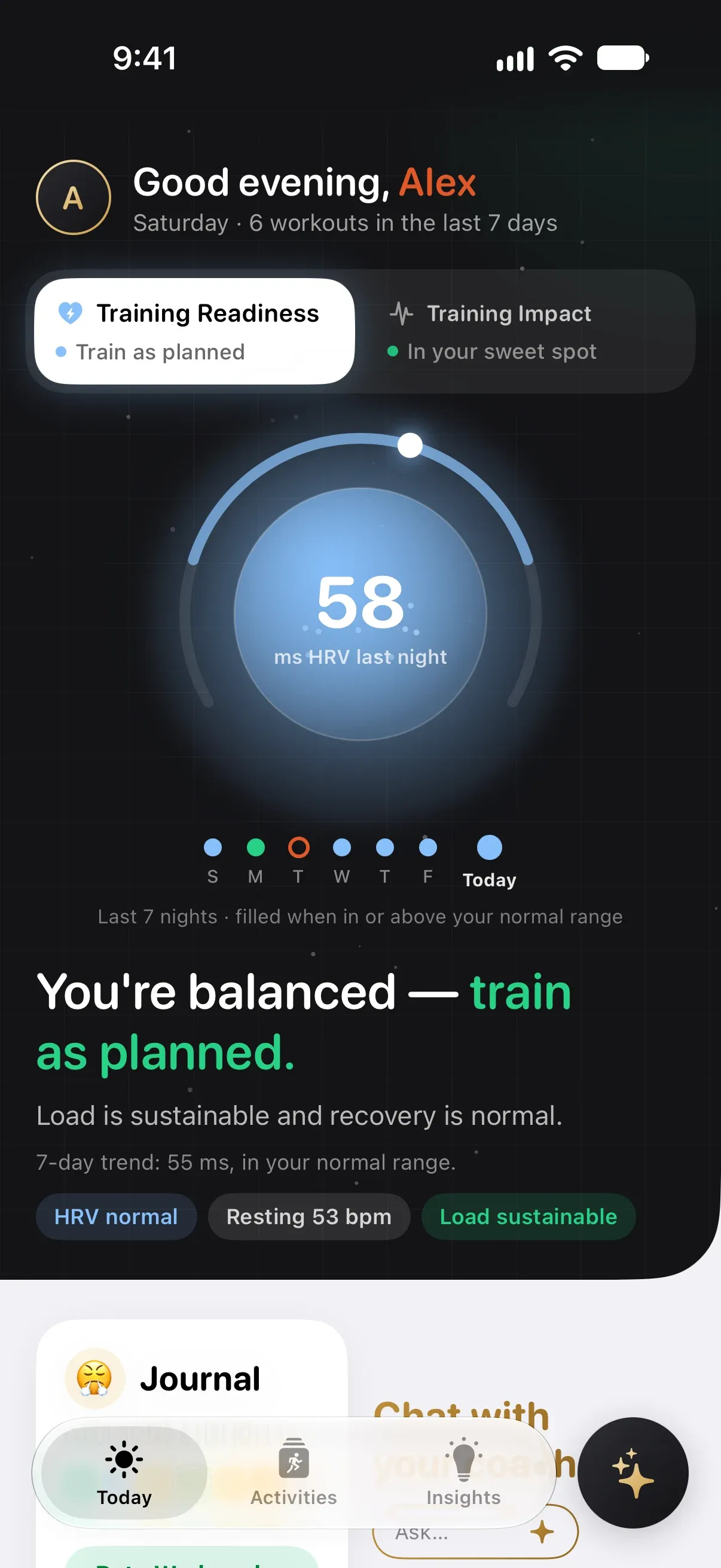
Metamorf doesn’t read your sleep data; Training Readiness works from overnight HRV and resting heart rate. It compares last night’s HRV with your own normal range from the previous 60 nights, uses your 7-day average when there’s no reading from last night, and treats a resting heart rate more than 3 bpm (or one standard deviation, whichever is larger) above your baseline as low recovery; low recovery gives “Keep it easy”, or “Rest today” if your training load is also above your range. A short night shows up there only if it moves your HRV or resting heart rate, and it may not: in a 2025 meta-analysis of sleep-deprivation trials, SDNN, the HRV measure Metamorf reads, fell slightly but not significantly in the four trials that measured it [22] (more on what moves HRV in the post on low HRV).
Sources
- Craven J, McCartney D, Desbrow B, Sabapathy S, Bellinger P, Roberts L, et al. Effects of acute sleep loss on physical performance: a systematic and meta-analytical review. Sports Medicine. 2022;52(11):2669–2690. doi:10.1007/s40279-022-01706-y
- Lopes TR, Pereira HM, Bittencourt LRA, Silva BM. How much does sleep deprivation impair endurance performance? A systematic review and meta-analysis. European Journal of Sport Science. 2023;23(7):1279–1292. doi:10.1080/17461391.2022.2155583
- Gong M, Sun M, Sun Y, Jin L, Li S. Effects of acute sleep deprivation on sporting performance in athletes: a comprehensive systematic review and meta-analysis. Nature and Science of Sleep. 2024;16:935–948. doi:10.2147/NSS.S467531
- Oliver SJ, Costa RJS, Laing SJ, Bilzon JLJ, Walsh NP. One night of sleep deprivation decreases treadmill endurance performance. European Journal of Applied Physiology. 2009;107(2):155–161. doi:10.1007/s00421-009-1103-9
- Tsai YS, Chen TT, Chan YC, Huang CC, Lai TF, Liao Y, et al. Acute caffeine supplementation offsets the impairment in 10-km running performance following one night of partial sleep deprivation: a randomized controlled crossover trial. European Journal of Applied Physiology. 2025;125(3):825–835. doi:10.1007/s00421-024-05638-5
- Seynaeve M, Vanwanseele B, De Beukelaar T. One night of acute sleep deprivation alters running biomechanics and running economy in recreational runners. Medicine and Science in Sports and Exercise. 2026;58(12):2722–2736. doi:10.1249/MSS.0000000000004081
- Roberts SSH, Teo WP, Aisbett B, Warmington SA. Effects of total sleep deprivation on endurance cycling performance and heart rate indices used for monitoring athlete readiness. Journal of Sports Sciences. 2019;37(23):2691–2701. doi:10.1080/02640414.2019.1661561
- Roberts SSH, Teo WP, Aisbett B, Warmington SA. Extended sleep maintains endurance performance better than normal or restricted sleep. Medicine and Science in Sports and Exercise. 2019;51(12):2516–2523. doi:10.1249/MSS.0000000000002071
- Walsh NP, Halson SL, Sargent C, Roach GD, Nédélec M, Gupta L, et al. Sleep and the athlete: narrative review and 2021 expert consensus recommendations. British Journal of Sports Medicine. 2021;55(7):356–368. doi:10.1136/bjsports-2020-102025
- Gao B, Dwivedi S, Milewski MD, Cruz AI. Lack of sleep and sports injuries in adolescents: a systematic review and meta-analysis. Journal of Pediatric Orthopaedics. 2019;39(5):e324–e333. doi:10.1097/BPO.0000000000001306
- Mah CD, Mah KE, Kezirian EJ, Dement WC. The effects of sleep extension on the athletic performance of collegiate basketball players. Sleep. 2011;34(7):943–950. doi:10.5665/SLEEP.1132
- Silva AC, Silva A, Edwards BJ, Tod D, Souza Amaral A, de Alcântara Borba D, et al. Sleep extension in athletes: what we know so far – a systematic review. Sleep Medicine. 2021;77:128–135. doi:10.1016/j.sleep.2020.11.028
- Cunha LA, Costa JA, Marques EA, Brito J, Lastella M, Figueiredo P. The impact of sleep interventions on athletic performance: a systematic review. Sports Medicine – Open. 2023;9(1):58. doi:10.1186/s40798-023-00599-z
- Lastella M, Halson SL, Vitale JA, Memon AR, Vincent GE. To nap or not to nap? A systematic review evaluating napping behavior in athletes and the impact on various measures of athletic performance. Nature and Science of Sleep. 2021;13:841–862. doi:10.2147/NSS.S315556
- Souabni M, Hammouda O, Romdhani M, Trabelsi K, Ammar A, Driss T. Benefits of daytime napping opportunity on physical and cognitive performances in physically active participants: a systematic review. Sports Medicine. 2021;51(10):2115–2146. doi:10.1007/s40279-021-01482-1
- Apple. Estimating sleep stages from Apple Watch. White paper, updated October 2025. apple.com
- Robbins R, Weaver MD, Sullivan JP, Quan SF, Gilmore K, Shaw S, et al. Accuracy of three commercial wearable devices for sleep tracking in healthy adults. Sensors. 2024;24(20):6532. doi:10.3390/s24206532
- Miller DJ, Sargent C, Roach GD. A validation of six wearable devices for estimating sleep, heart rate and heart rate variability in healthy adults. Sensors. 2022;22(16):6317. doi:10.3390/s22166317
- Juliff LE, Halson SL, Peiffer JJ. Understanding sleep disturbance in athletes prior to important competitions. Journal of Science and Medicine in Sport. 2015;18(1):13–18. doi:10.1016/j.jsams.2014.02.007
- Erlacher D, Ehrlenspiel F, Adegbesan OA, Galal El-Din H. Sleep habits in German athletes before important competitions or games. Journal of Sports Sciences. 2011;29(8):859–866. doi:10.1080/02640414.2011.565782
- Lastella M, Roach GD, Halson SL, Martin DT, West NP, Sargent C. Sleep/wake behaviour of endurance cyclists before and during competition. Journal of Sports Sciences. 2015;33(3):293–299. doi:10.1080/02640414.2014.942690
- Zhang S, Niu X, Ma J, Wei X, Zhang J, Du W. Effects of sleep deprivation on heart rate variability: a systematic review and meta-analysis. Frontiers in Neurology. 2025;16:1556784. doi:10.3389/fneur.2025.1556784
Metamorf is for fitness guidance, not medical advice. Talk to a doctor before changing how you train if you have a health condition.