Resting heart rate is up: what it tells a runner
Your watch says your resting heart rate is 6 beats higher than usual. You ran a hard session two days ago, you’ve a race in three weeks, and you feel mostly fine. Is this your body telling you you’ve overdone it, the first sign of a cold, or nothing at all?
Resting heart rate is one of the most useful numbers a runner’s watch collects, and one of the easiest to over-read. It rises for many reasons besides training, it wanders by a few beats on its own, and the research on overtraining is less tidy than its reputation. Here is what it can and can’t tell you.
What does resting heart rate actually measure?
It’s the slowest your heart beats while you’re at rest. In Apple Health, the resting heart rate is Apple’s estimate of your lowest heart rate during periods of rest, built from sedentary heart-rate samples through the day; earlier estimates can be replaced as the day goes on and more data comes in [1]. It isn’t simply the lowest number overnight, and a reading taken while you sit down after a run doesn’t count as resting [1].
What sets the number is a mix of slow and fast factors: the size and shape of your heart, your blood (plasma) volume, the balance of your nervous system, your age and your body position [2]. Endurance training lowers it; a meta-analysis of 191 studies found that regular endurance training reduced resting heart rate in both men and women [3]. That’s why a runner’s absolute number says little on its own. What matters is the change from your own normal.
The good news for Apple Watch owners is that resting heart rate is one of the watch’s more accurate measures. In 39 adults who took a short Breathe-app reading each morning, lying still, for two weeks, the watch’s heart rate at rest differed from a chest strap by −0.08 bpm on average, with an average absolute error of 3.73 bpm [4]. That tested a controlled morning reading, not the all-day resting estimate in Apple Health.
How much does it normally vary from day to day?
By about 3 bpm, and sometimes by much more without anything being wrong. The best picture comes from a 2020 study of 92,457 adults who wore a wrist tracker for a median of 320 days, nearly 33 million daily readings [5]. People’s own averages ranged from about 40 to 109 bpm, but within a person the number was far steadier: the average day-to-day standard deviation was about 3 bpm, and most people’s resting heart rate moved by a median of 3 bpm within a week [5].
Three details from that study matter to a runner:
- Bigger swings happen. One in five people had at least one week in which their resting heart rate moved by 10 bpm or more, and a typical person had about three short spells over two years when it rose well above their recent normal [5]. The researchers had no clinical data, so they couldn’t say what caused them.
- The seasons move it. The population’s average was about 2 bpm higher in early January than at the end of July [5].
- Women of childbearing age vary more than men of the same age, a difference that disappeared by about 50 [5].
A single reading is also noisy. Buchheit’s review of heart-rate monitoring puts the typical error of a single morning resting heart rate at around 10% [2]. In 10 runners who responded to nine weeks of training, a weekly average of resting heart rate tracked their improvement over 10 km far better than a single day’s reading did: a very large correlation (r = 0.73) against a small one (r = −0.21) [6]. So one high morning is a prompt to look again tomorrow, not a verdict.
What else pushes resting heart rate up?
Illness pushes it up most clearly; alcohol, sleep loss and the menstrual cycle push it a little; some usual suspects barely move it.
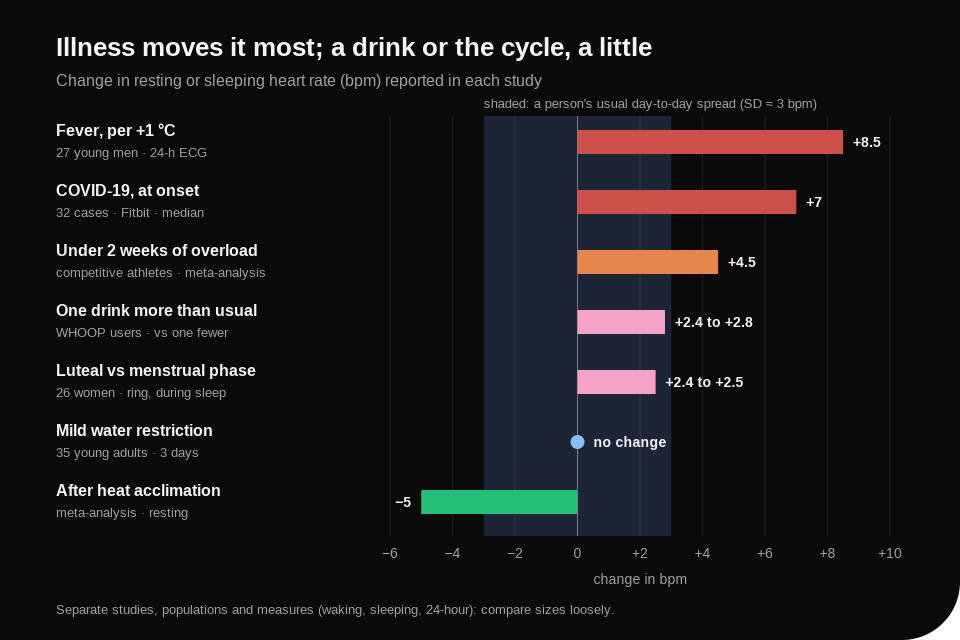
- Infection and fever. In 27 young men with an ordinary feverish infection, heart rate over 24 hours averaged 84 bpm while ill and 66.5 bpm after recovery, rising about 8.5 bpm for every 1 °C of fever, and it stayed high even during sleep [7].
- Alcohol. In data from 20,968 WHOOP users (a WHOOP-funded study), drinking one more drink than usual (compared with one fewer) went with a nocturnal resting heart rate about 2.8 bpm higher in women and 2.4 bpm higher in men, more after more drinks [10]. That study was observational, but a laboratory crossover trial in 31 adults found the same direction: a large evening dose of alcohol raised heart rate through the night [14].
- Lost sleep. After 36 hours without sleep, 70 older adults had a higher heart rate during their recovery sleep [15]. In the big wearable study, people who habitually slept around 7 to 7.5 hours had the lowest resting heart rates, although that is a comparison between people, not proof that a short night raises yours [5].
- The menstrual cycle. In 26 young women tracked with a ring, sleeping heart rate was about 2.4 to 2.5 bpm higher in the mid- and late-luteal phase (after ovulation, before a period) than during menstruation [11].
- Stress and travel. In a smartwatch study of illness, researchers noted that many alerts that weren’t infections could reflect alcohol, travel, medication or emotional stress, and several people’s heart rates stayed raised over the December holidays [8].
And some that matter less than you might expect:
- Mild dehydration. In a randomised crossover trial, 35 young adults cut their water intake over three days and finished with 16 hours without water; their resting heart rate was 58 bpm either way, and night-time heart rate barely changed (57 against 56) [12]. Dehydration after a long run in the heat wasn’t tested.
- Caffeine. In 16 male cyclists, a strong dose (5 mg per kg of body weight) didn’t change resting heart rate significantly 35 minutes later [16]. That says nothing about an evening coffee and your sleep, which it didn’t test.
- Heat. Repeated training in the heat lowers resting heart rate, by about 5 bpm on average across 211 studies, alongside a rise in plasma volume [13]. The wearable study also found the population’s average lowest at the end of July, though it didn’t look at temperature [5].
- Altitude. At a 1,800 m training camp, elite skiers’ resting heart rates didn’t change in any systematic way [17]. At 2,320 m, seven world-class swimmers’ resting heart rates were lower in the third week than in the first, a sign of acclimatisation [18].
Is a raised resting heart rate a sign of overtraining?
Not on its own, and the research disagrees about which way it even moves. Sports scientists separate three states [9]:
- Functional overreaching: a hard block, like a training camp, that temporarily lowers performance and is followed by improvement after recovery. This is normal training.
- Non-functional overreaching: performance stalls or falls for weeks or months, though full recovery comes with enough rest.
- Overtraining syndrome: long-lasting underperformance with mood disturbance, diagnosed only after other causes, including illness, have been ruled out.
The joint consensus statement of the European College of Sport Science and the American College of Sports Medicine is blunt: changes of resting heart rate “are not consistently found” in athletes with overtraining syndrome, and no single marker meets the criteria to diagnose it [9].
The underlying studies pull in different directions:
- A 2008 meta-analysis in competitive athletes found that less than two weeks of overload raised resting heart rate moderately (about 4.5 bpm on average, by the consensus statement’s summary), while longer overload periods left resting values unchanged [9, 19]. The authors warned that changes this size can sit within ordinary day-to-day variation [19].
- When 13 trained male triathletes were pushed into functional overreaching for three weeks, their performance fell 9%, and their resting heart rate went down, not up, while their HRV rose [20].
- In 24 recreational runners given two weeks of heavier training, the eight who became overreached (slower and feeling worse) saw their sleeping heart rate rise by 3.2% on average, while the 12 who adapted saw it fall by 2.8% [21]. Sleeping heart rate, how ready they felt to train and a heart-rate-to-running-power index from their runs each told the two groups apart well [21].
- In the same runners, sleeping heart rate rose the night after a hard 3000 m test [22]. A higher number the night after a race or a big session is an expected response, not a warning.
The practical reading: a small rise during a hard block is common and often harmless. What separates a problem from normal fatigue is how your running goes and how you feel over weeks, with resting heart rate as one clue among several. The same logic applies to HRV; see what a low HRV reading means for a run.
Can a watch spot illness before you feel it?
Sometimes, and that is the most solid use of a rising resting heart rate. In a 2020 study of 47,249 Fitbit users across five US states, the share of people whose weekly resting heart rate sat above their own average (with longer sleep) improved real-time estimates of flu-like illness in every state [23]. That worked at the level of whole populations; it didn’t diagnose individuals.
At the individual level, a Stanford study followed nearly 5,300 people and analysed the Fitbit data of those who caught COVID-19 [8]. Of 32 people with COVID-19 and usable data, 26 had changes in heart rate, steps or sleep, and in 22 of the 25 with a known symptom date the signal came before or at the start of symptoms [8]. The median rise in heart rate at onset was 7 bpm, with a broad range, and an alert based on resting heart rate against each person’s previous four weeks flagged 15 of 24 cases (63%) on or before the day symptoms began [8]. The authors say that figure is likely an overestimate for COVID-19, because people without symptoms weren’t counted [8]. A related study of 333 symptomatic people found that adding sensor data to symptoms told positive from negative tests better than symptoms alone [24].
Two cautions. These were small numbers of confirmed infections, and every case analysed wore a Fitbit, not an Apple Watch. And other alerts in the same study could have come from alcohol, travel or stress [8]. A raised resting heart rate says “something is loading your system”; the context, and how you feel, tell you what.
When is it not a training question?
When it comes with symptoms. The overtraining consensus advises athletes to suspend training or reduce its intensity during an infection, and notes that an infection during heavy training may carry a higher risk of heart complications, including myocarditis [9]. That’s not a reason to worry about every high morning. It is a reason not to “run off” a fever.
If you have chest pain, or you faint or nearly faint, get urgent medical help. If your resting heart rate is raised and you have palpitations, a racing or irregular heartbeat at rest or breathlessness that’s out of proportion, see a doctor; that’s not a question for your training plan. The same goes for a resting heart rate that stays well above your normal for more than a few days with no obvious reason.
What to do with this
- Compare with yourself. A few beats above your own normal is within the everyday noise for most people. Look at your 7-day trend, not one morning.
- Look for the obvious first. Drinks last night, a hard session or race in the last day or two, travel, a stressful week, the time in your cycle. If there’s a clear reason, the number is telling you something you already know.
- Raised and feeling fine: run as planned. If it’s still up tomorrow, keep that day easy.
- Raised for several days, or with HRV also low: swap hard sessions for easy running or rest until it settles.
- Raised with a sore throat, fever, aches or unusual tiredness: rest. Don’t train through a fever.
- Chest pain, fainting or nearly fainting: get urgent medical help.
- Raised with palpitations or breathlessness that’s out of proportion: see a doctor.
How Metamorf uses this
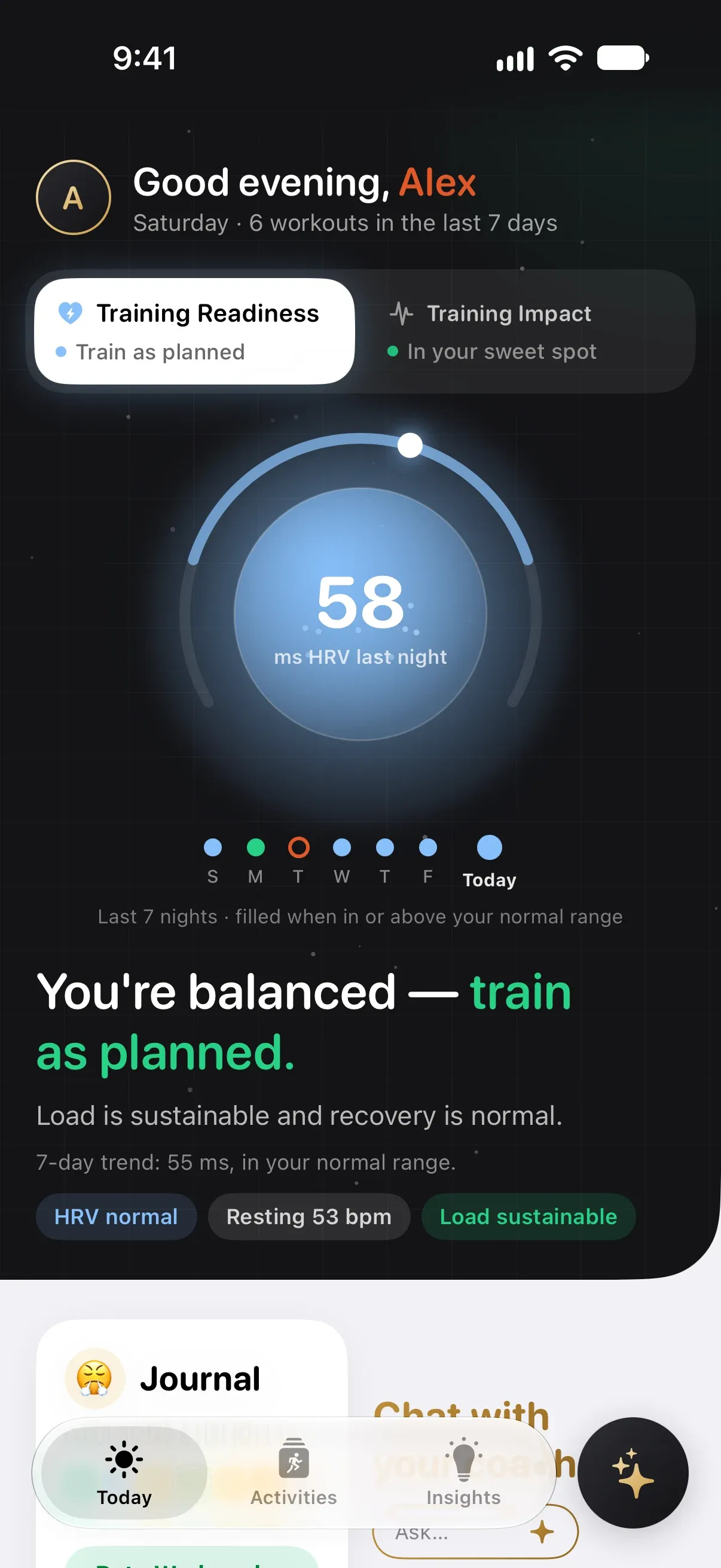
Training Readiness uses resting heart rate from Apple Health as a second check on recovery: it compares today’s value (or, if there isn’t one, the average of the last 7 days, when there are at least 3) with your average over the previous 59 days (once there are at least 14 days of data), and treats it as elevated when it is more than 3 bpm above that baseline, or more than one standard deviation of those days if that is larger. An elevated resting heart rate makes recovery low whatever your HRV says, so the verdict becomes “Keep it easy”, or “Rest today” if your training load is also above your range. The Resting chip on Home shows the value it used and its difference from your baseline (left off when it rounds to zero), in orange when it’s elevated; the app doesn’t try to tell illness from training, so if you feel ill, rest whatever the verdict says.
Sources
- Apple. restingHeartRate. HealthKit, Apple Developer Documentation. developer.apple.com
- Buchheit M. Monitoring training status with HR measures: do all roads lead to Rome? Frontiers in Physiology. 2014;5:73. doi:10.3389/fphys.2014.00073
- Reimers AK, Knapp G, Reimers CD. Effects of exercise on the resting heart rate: a systematic review and meta-analysis of interventional studies. Journal of Clinical Medicine. 2018;7(12):503. doi:10.3390/jcm7120503
- O’Grady B, Lambe R, Baldwin M, Acheson T, Doherty C. The validity of Apple Watch Series 9 and Ultra 2 for serial measurements of heart rate variability and resting heart rate. Sensors. 2024;24(19):6220. doi:10.3390/s24196220
- Quer G, Gouda P, Galarnyk M, Topol EJ, Steinhubl SR. Inter- and intraindividual variability in daily resting heart rate and its associations with age, sex, sleep, BMI, and time of year: retrospective, longitudinal cohort study of 92,457 adults. PLOS ONE. 2020;15(2):e0227709. doi:10.1371/journal.pone.0227709
- Plews DJ, Laursen PB, Kilding AE, Buchheit M. Evaluating training adaptation with heart-rate measures: a methodological comparison. International Journal of Sports Physiology and Performance. 2013;8(6):688–691. doi:10.1123/ijspp.8.6.688
- Karjalainen J, Viitasalo M. Fever and cardiac rhythm. Archives of Internal Medicine. 1986;146(6):1169–1171. doi:10.1001/archinte.1986.00360180179026
- Mishra T, Wang M, Metwally AA, et al. Pre-symptomatic detection of COVID-19 from smartwatch data. Nature Biomedical Engineering. 2020;4(12):1208–1220. doi:10.1038/s41551-020-00640-6
- Meeusen R, Duclos M, Foster C, et al. Prevention, diagnosis, and treatment of the overtraining syndrome: joint consensus statement of the European College of Sport Science and the American College of Sports Medicine. Medicine and Science in Sports and Exercise. 2013;45(1):186–205. doi:10.1249/MSS.0b013e318279a10a
- Grosicki GJ, Robinson AT, Joyner MJ, et al. Real-world effects of alcohol on heart rate, sleep, and physical activity by age and sex. PLOS Digital Health. 2026;5(3):e0001284. doi:10.1371/journal.pdig.0001284
- Alzueta E, de Zambotti M, Javitz H, et al. Tracking sleep, temperature, heart rate, and daily symptoms across the menstrual cycle with the Oura ring in healthy women. International Journal of Women’s Health. 2022;14:491–503. doi:10.2147/IJWH.S341917
- Watso JC, Robinson AT, Babcock MC, et al. Short-term water deprivation does not increase blood pressure variability or impair neurovascular function in healthy young adults. American Journal of Physiology: Regulatory, Integrative and Comparative Physiology. 2020;318(1):R112–R121. doi:10.1152/ajpregu.00149.2019
- McDonald P, Brown HA, Topham TH, et al. Influence of exercise heat acclimation protocol characteristics on adaptation kinetics: a quantitative review with Bayesian meta-regressions. Comprehensive Physiology. 2025;15(3):e70017. doi:10.1002/cph4.70017
- Pabon E, Greenlund IM, Carter JR, de Wit H. Effects of alcohol on sleep and nocturnal heart rate: relationships to intoxication and morning-after effects. Alcoholism: Clinical and Experimental Research. 2022;46(10):1875–1887. doi:10.1111/acer.14921
- Jain N, Lehrer HM, Chin BN, et al. Heart rate and heart rate variability following sleep deprivation in retired night shift workers and retired day workers. Psychophysiology. 2023;60(12):e14374. doi:10.1111/psyp.14374
- Glaister M, Lythgoe D, Kamath S. The effects of caffeine on heart rate and heart rate variability at rest and during submaximal cycling exercise. Research Quarterly for Exercise and Sport. 2025;96(1):155–163. doi:10.1080/02701367.2024.2377303
- Karlsson Ø, Laaksonen MS, McGawley K. Monitoring acclimatization and training responses over 17–21 days at 1,800 m in elite cross-country skiers and biathletes. Frontiers in Sports and Active Living. 2022;4:852108. doi:10.3389/fspor.2022.852108
- Alonso Ramos JF, Del Castillo JA, López-Hernández A, González-Ravé JM. Sleep, chronotype and physiological acclimatisation during a 21-day altitude training camp in world-class swimmers. Sports. 2026;14(10):449. doi:10.3390/sports14100449
- Bosquet L, Merkari S, Arvisais D, Aubert AE. Is heart rate a convenient tool to monitor over-reaching? A systematic review of the literature. British Journal of Sports Medicine. 2008;42(9):709–714. doi:10.1136/bjsm.2007.042200
- Le Meur Y, Pichon A, Schaal K, et al. Evidence of parasympathetic hyperactivity in functionally overreached athletes. Medicine and Science in Sports and Exercise. 2013;45(11):2061–2071. doi:10.1249/MSS.0b013e3182980125
- Nuuttila OP, Uusitalo A, Kokkonen VP, Weerarathna N, Kyröläinen H. Monitoring fatigue state with heart rate-based and subjective methods during intensified training in recreational runners. European Journal of Sport Science. 2024;24(7):857–869. doi:10.1002/ejsc.12115
- Nuuttila OP, Kyröläinen H, Kokkonen VP, Uusitalo A. Morning versus nocturnal heart rate and heart rate variability responses to intensified training in recreational runners. Sports Medicine – Open. 2024;10(1):120. doi:10.1186/s40798-024-00779-5
- Radin JM, Wineinger NE, Topol EJ, Steinhubl SR. Harnessing wearable device data to improve state-level real-time surveillance of influenza-like illness in the USA: a population-based study. Lancet Digital Health. 2020;2(2):e85–e93. doi:10.1016/S2589-7500(19)30222-5
- Quer G, Radin JM, Gadaleta M, et al. Wearable sensor data and self-reported symptoms for COVID-19 detection. Nature Medicine. 2021;27(1):73–77. doi:10.1038/s41591-020-1123-x
Metamorf is for fitness guidance, not medical advice. Talk to a doctor before changing how you train if you have a health condition.