Zone 2 running: what it is, and how to find yours with an Apple Watch
Zone 2 is getting a lot of attention in endurance sport [1]. Your Apple Watch has a zone 2, training plans prescribe hours of it, and popular media presents it as the best way to build mitochondria and burn fat [2]. Ask what heart rate it actually is, though, and you get several answers that don’t agree.
That’s not because runners are confused. The term itself means different things in different systems, and the heart rate that matches it differs a lot from person to person. Here is what zone 2 is, what the research says it does, and how to find yours.
Why does “zone 2” mean different things?
Because at least three numbering systems are in use, and zone 2 sits at a different intensity in each. In a 2025 commentary, a panel of 14 sport scientists and coaches set out to define the term, starting from the fact that coaches, athletes and scientists have no clear consensus on it [1].
- The three-zone research model. Much of the training-intensity research splits effort at two thresholds. Zone 1 is below the first, zone 2 is between the first and second, and zone 3 is above the second [3]. In a 2022 paper on runners, Foster and colleagues wrote that the zone 1–2 boundary can be found with the talk test [4]. So in a research paper, “zone 2” is moderate, threshold-type running: the intensity that elite athletes train “surprisingly little” at [3] (more in our 80/20 post).
- Five-zone scales. In the intensity scale Norwegian elite endurance athletes have used for two decades, zone 2 is 73–82% of maximum heart rate and 1.5–2.5 mmol/L of blood lactate, and it still counts as low-intensity training. The research model’s middle zone corresponds to that scale’s zone 3, at 83–87% [5]. (The Norwegian scale also has a sixth zone for all-out efforts, which has no heart-rate range.)
- Apple Watch. Apple’s zones come in five segments, which Apple describes as “a percentage of your maximum heart rate”, calculated automatically from your health data. They’re only calculated if your date of birth is in the Health app [6]. Apple’s support page doesn’t say how it estimates your maximum or where each boundary falls [6].
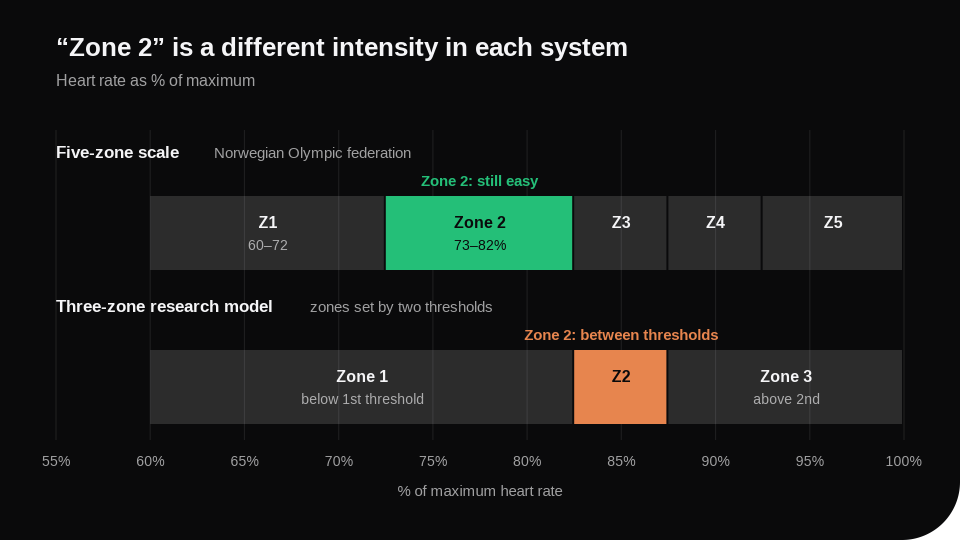
Zone 2 training, in its popular sense, means the five-zone version: the top of the low-intensity range [1, 7]. The rest of this post uses it that way. If you read a study, check which system it uses before comparing numbers.
What is zone 2 in your body?
Zone 2 is the top of your easy running: the expert panel agreed it should preferably sit immediately below your first lactate or ventilatory threshold [1]. The first lactate threshold is where blood lactate starts to climb above its resting level; the first ventilatory threshold is where breathing first deepens. Physiologists call the intensities below this boundary the moderate domain and those above it the heavy domain, and these first-threshold markers are the ones with some evidence for drawing that line [8].
Fat burning is part of zone 2’s appeal, and it does peak around here. In 18 moderately trained cyclists, fat oxidation was highest at about 64% of VO2max, or 74% of maximum heart rate, and stayed within 10% of that peak from about 55% to 72% of VO2max [9]. Above the peak, fat oxidation drops off sharply [9]. In a 2025 study of 50 trained cyclists, maximal fat oxidation came at 72.3% of maximum heart rate on average, and the first ventilatory threshold at 81.4% [7]. On average, then, five-zone zone 2 (73–82%) runs from about where fat burning peaks to about where the first threshold sits. Those are averages in cyclists, though, and the individual spread is large, as the section on heart rate below shows.
Is zone 2 training as good as people say?
It’s a good intensity for running a lot without much cost. The evidence that it’s uniquely good, better than slightly easier or harder running, is thin.
The case for it. Elite endurance athletes do about 80% of their sessions at low intensity [10]. In a cross-sectional study, Iñigo San-Millán and George Brooks compared professional endurance athletes, moderately active people and people with metabolic syndrome. The professionals burned more fat and had lower blood lactate during exercise, and in every group, higher lactate went with lower fat oxidation [11]. That’s a comparison of very different people, not a training study: it shows what fit muscles do, not that zone 2 made them that way.
The case against overselling it. A 2025 review by Kristi Storoschuk and colleagues points out that zone 2 recommendations “largely stem from observational data of elite endurance athletes” [2]. They concluded that the evidence doesn’t support zone 2 as the best intensity for improving mitochondria or fat-burning capacity, and that higher intensities matter for health, particularly for people who train relatively little [2]. Their review was aimed at the general population, not trained runners.
A 2024 trial makes the point sharply. Eighty-four young, healthy adults cycled three times a week for six weeks, in groups set by intensity domain and, apart from a sprint group, matched for total work. The group riding below the first threshold improved VO2max by 1.8 ml/kg/min, not significantly different from the non-exercising control group. Groups training harder gained 3.3 to 6.2 ml/kg/min, with high-intensity intervals gaining most [12]. Six weeks of cycling in young adults is not years of running, and because the groups were matched for work, the easy group didn’t get the extra volume that easy training normally allows.
Volume is the real argument. A review of mitochondrial adaptations concluded that training volume may be a critical factor for how much mitochondria you build, while intensity matters more for how well they work [13]. Easy running is what lets you accumulate volume. But volume alone isn’t enough: in a nine-week study of 48 well-trained runners, cyclists, triathletes and skiers, a high-volume group showed no further improvements in endurance measures, while a polarized group, mixing easy volume with hard intervals, improved most [14]. Even the zone 2 expert panel noted that the adaptations it expected “might not be unique to zone 2” and could come from slightly higher or lower intensities [1].
For a runner, that adds up to something less dramatic than the hype: zone 2 is a sensible ceiling for easy days, which lets you run more, recover sooner and save your energy for one or two harder sessions a week.
What heart rate is zone 2 for you?
In the cyclist study, the first ventilatory threshold averaged 81.4% of maximum heart rate [7]. But the first threshold varies so much between people that any fixed percentage can be well off for you, and each way of estimating it has its own error.
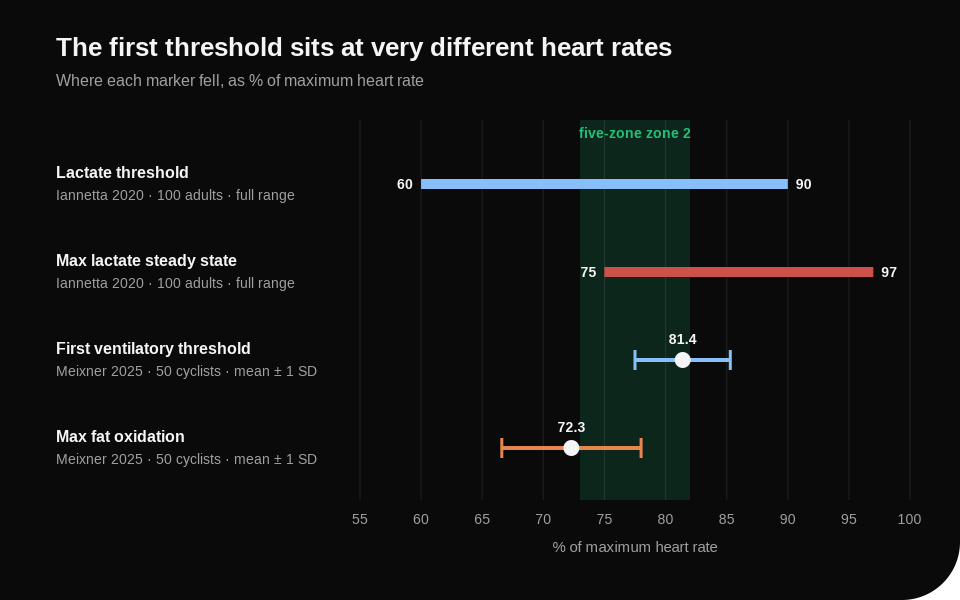
A percentage of maximum heart rate. This is the simplest method and the least precise. In a study of 100 women and men, the lactate threshold fell anywhere from 60% to 90% of maximum heart rate, and the maximal lactate steady state, a marker of the second threshold, anywhere from 75% to 97% [15]. The cyclist study above found wide individual differences for fixed percentages of maximum, and its authors note that a 5% difference can mean about 10 bpm [7]. A review of intensity methods concluded that fixed percentages of a maximum have “little merit” for putting people in the same physiological zone [8]. The same holds for oxygen uptake: in 21 healthy men riding for an hour at 60% of VO2max, blood lactate ranged from 0.7 to 5.6 mmol/L [16].
The maximum itself is a second source of error. If you use an age formula rather than a measured maximum, expect to be off: in 3,320 healthy adults, even a formula fitted to that group (211 − 0.64 × age) had a standard error of 10.8 bpm [17].
A percentage of heart-rate reserve. Heart-rate reserve is the range between resting and maximum heart rate, so this method accounts for your resting rate. It still spreads widely. In 863 lab tests, the ventilatory threshold came at 55.5% of heart-rate reserve on average, with a standard deviation of 12.1 percentage points. In the 181 athletes from aerobic sports among them (cross-country skiers, distance runners and soccer players), it came at 67.8%, give or take 8.0 [18]. (The authors assumed a resting heart rate of 60 bpm for everyone, which they acknowledge as a limitation [18].)
A percentage of threshold heart rate. Anchoring zones to a threshold, rather than a maximum, works better on average. A meta-analysis of individual data from 42 studies and 1,544 people found larger VO2max gains when training was set from physiological thresholds: 4.1 against 1.8 ml/kg/min in controlled studies [19]. In a lab study of 10 people, everyone completed heavy and very hard sessions set from their thresholds, against 30% and 20% when the same sessions were set as a percentage of VO2max. At moderate intensity, the method made no difference [20]. And a threshold heart rate is only as good as its source. If it was estimated from your maximum rather than measured, it carries the maximum’s error with it.
A lab test. Measuring your first threshold directly, with gas analysis or blood lactate, is the reference. Even so, researchers have no agreed framework for validating the methods [8], and different lab markers for zone 2 gave noticeably different answers in the same cyclists [7].
The talk test and perceived effort. A 2022 review found that the “equivocal” stage of the talk test, when you’re no longer sure you can talk comfortably, and a rating of 10–11 on the 6–20 Borg scale reflect the first ventilatory threshold [21]. Sources disagree on the effort rating, though. In the 863 lab tests above, effort at that threshold averaged 12.5 on the same scale [18], and the Norwegian scale lists 13–14 for its zone 2 [5]. The talk test is the more concrete of the two. (We cover how to do it in the 80/20 post.)
How do you set zone 2 on an Apple Watch?
By default, Apple Watch calculates your zones from your health data [6]. You can replace them with your own: open the Settings app on the watch, go to Workout, then Heart Rate Zones, tap Manual, and enter lower and upper limits for zone 2, 3 or 4. On iPhone, the same settings are in the Apple Watch app, under My Watch, then Workout, then Heart Rate Zones [6].
If you don’t have a lab test, the talk test gives you a number to enter. On a few easy runs on flat ground, notice the heart rate at which talking in full sentences stops being comfortable. Set the top of zone 2 a little below it, and keep an eye on it as your fitness changes. During a workout, the Heart Rate Zone view shows your current zone and the time spent in it, and afterwards, in the Fitness app on iPhone, the workout summary shows a graph of the estimated time you spent in each zone [6].
What to do with this
- When you read “zone 2”, check which system it comes from. In research papers it often means threshold-type running; in coaching and popular use it means the top of easy.
- Treat any percentage of maximum heart rate as a first guess. Check it with the talk test, and set your zone from what you find.
- Use zone 2 as a ceiling for easy runs, not a target to chase. Slightly easier is fine.
- Keep some harder running in the week. Easy volume plus some intensity has done better than high volume alone.
How Metamorf uses this
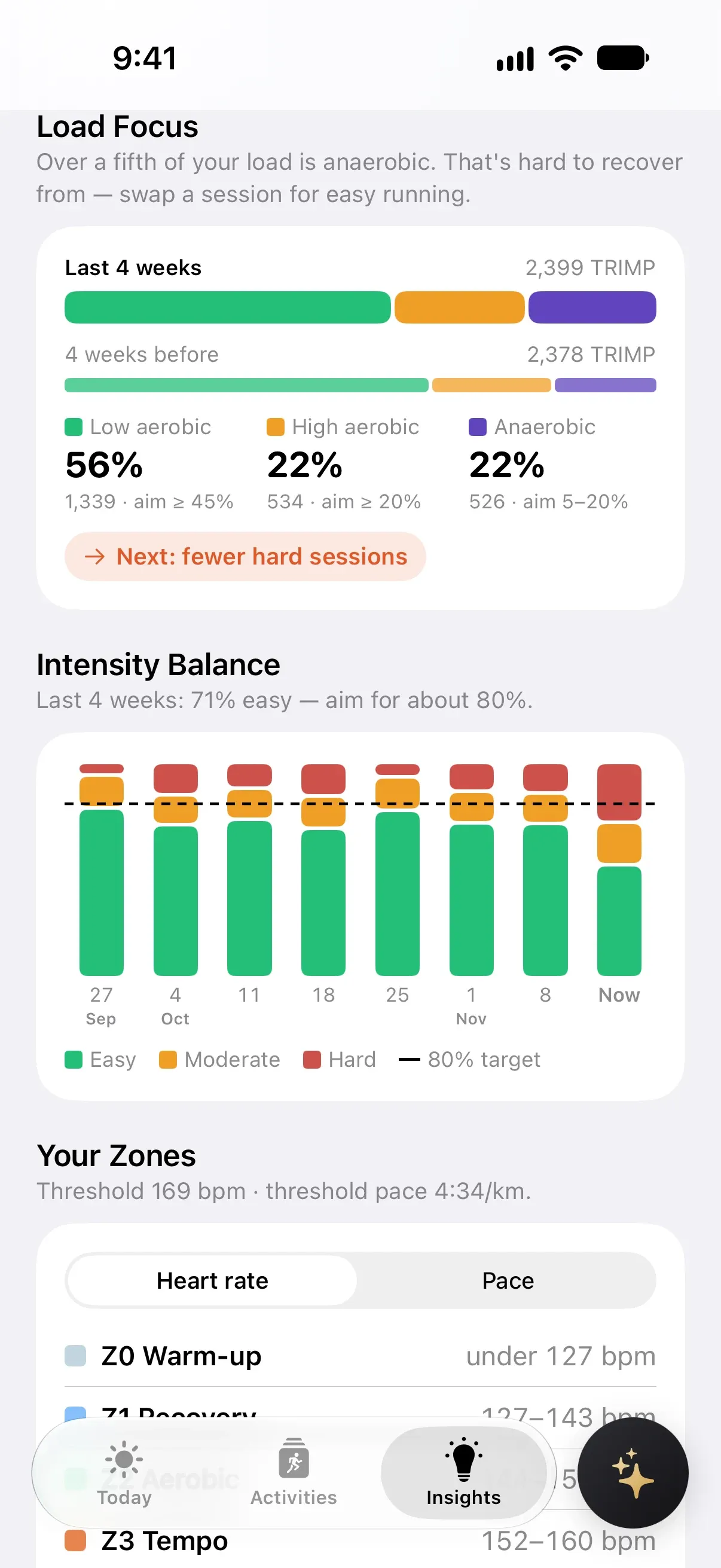
Metamorf’s Your Zones card builds your heart-rate zones from your lactate-threshold heart rate (a second-threshold marker, not the first threshold this post is about): the value you set in Settings, or 0.88 × your maximum heart rate if you haven’t set one. Zones 1 to 5 start at 75%, 85%, 90%, 95% and 100% of that threshold, so Z2, named Aerobic, covers 85–90% of it, about 75–79% of maximum with the default (below 75% is Z0, Warm-up, so Metamorf has six zones where Apple has five, and because Apple doesn’t publish its boundaries, a zone with the same number in the two apps needn’t cover the same heart rates). Separately, the Intensity Balance card counts heart-rate time below 82% of your maximum as easy, shows the last eight weeks as bars against an 80% target line, and gives your easy share of the last four weeks.
Sources
- Sitko S, Artetxe X, Bonnevie-Svendsen M, et al. What is “zone 2 training”?: experts’ viewpoint on definition, training methods, and expected adaptations. International Journal of Sports Physiology and Performance. 2025;20(11):1614–1617. doi:10.1123/ijspp.2024-0303
- Storoschuk KL, Moran-MacDonald A, Gibala MJ, Gurd BJ. Much ado about zone 2: a narrative review assessing the efficacy of zone 2 training for improving mitochondrial capacity and cardiorespiratory fitness in the general population. Sports Medicine. 2025;55(7):1611–1624. doi:10.1007/s40279-025-02261-y
- Seiler KS, Kjerland GØ. Quantifying training intensity distribution in elite endurance athletes: is there evidence for an “optimal” distribution? Scandinavian Journal of Medicine & Science in Sports. 2006;16(1):49–56. doi:10.1111/j.1600-0838.2004.00418.x
- Foster C, Barroso R, Bok D, et al. Simple approach to defining training intensity in endurance runners. International Journal of Sports Physiology and Performance. 2022;17(8):1312–1315. doi:10.1123/ijspp.2022-0018
- Tønnessen E, Sandbakk Ø, Sandbakk SB, Seiler S, Haugen T. Training session models in endurance sports: a Norwegian perspective on best practice recommendations. Sports Medicine. 2024;54(11):2935–2953. doi:10.1007/s40279-024-02067-4
- Apple. View Heart Rate Zones on Apple Watch. Apple Watch User Guide, support page. support.apple.com
- Meixner B, Filipas L, Holmberg HC, Sperlich B. Zone 2 intensity: a critical comparison of individual variability in different submaximal exercise intensity boundaries. Translational Sports Medicine. 2025;2025:2008291. doi:10.1155/tsm2/2008291
- Jamnick NA, Pettitt RW, Granata C, Pyne DB, Bishop DJ. An examination and critique of current methods to determine exercise intensity. Sports Medicine. 2020;50(10):1729–1756. doi:10.1007/s40279-020-01322-8
- Achten J, Gleeson M, Jeukendrup AE. Determination of the exercise intensity that elicits maximal fat oxidation. Medicine and Science in Sports and Exercise. 2002;34(1):92–97. doi:10.1097/00005768-200201000-00015
- Seiler S. What is best practice for training intensity and duration distribution in endurance athletes? International Journal of Sports Physiology and Performance. 2010;5(3):276–291. doi:10.1123/ijspp.5.3.276
- San-Millán I, Brooks GA. Assessment of metabolic flexibility by means of measuring blood lactate, fat, and carbohydrate oxidation responses to exercise in professional endurance athletes and less-fit individuals. Sports Medicine. 2018;48(2):467–479. doi:10.1007/s40279-017-0751-x
- Inglis EC, Iannetta D, Rasica L, et al. Heavy-, severe-, and extreme-, but not moderate-intensity exercise increase V̇O2max and thresholds after 6 wk of training. Medicine and Science in Sports and Exercise. 2024;56(7):1307–1316. doi:10.1249/MSS.0000000000003406
- Granata C, Jamnick NA, Bishop DJ. Training-induced changes in mitochondrial content and respiratory function in human skeletal muscle. Sports Medicine. 2018;48(8):1809–1828. doi:10.1007/s40279-018-0936-y
- Stöggl T, Sperlich B. Polarized training has greater impact on key endurance variables than threshold, high intensity, or high volume training. Frontiers in Physiology. 2014;5:33. doi:10.3389/fphys.2014.00033
- Iannetta D, Inglis EC, Mattu AT, et al. A critical evaluation of current methods for exercise prescription in women and men. Medicine and Science in Sports and Exercise. 2020;52(2):466–473. doi:10.1249/MSS.0000000000002147
- Scharhag-Rosenberger F, Meyer T, Gässler N, Faude O, Kindermann W. Exercise at given percentages of VO2max: heterogeneous metabolic responses between individuals. Journal of Science and Medicine in Sport. 2010;13(1):74–79. doi:10.1016/j.jsams.2008.12.626
- Nes BM, Janszky I, Wisløff U, Støylen A, Karlsen T. Age-predicted maximal heart rate in healthy subjects: the HUNT fitness study. Scandinavian Journal of Medicine & Science in Sports. 2013;23(6):697–704. doi:10.1111/j.1600-0838.2012.01445.x
- Gaskill SE, Skinner JS, Quindry J. Ventilatory threshold related to V̇O2 reserve, heart rate reserve, and rating of perceived exertion in a large varied sample. Medicine and Science in Sports and Exercise. 2023;55(10):1876–1885. doi:10.1249/MSS.0000000000003220
- Meyler SJR, Swinton PA, Bottoms L, et al. Changes in cardiorespiratory fitness following exercise training prescribed relative to traditional intensity anchors and physiological thresholds: a systematic review with meta-analysis of individual participant data. Sports Medicine. 2025;55(2):301–323. doi:10.1007/s40279-024-02125-x
- Meyler S, Bottoms L, Wellsted D, Muniz-Pumares D. Variability in exercise tolerance and physiological responses to exercise prescribed relative to physiological thresholds and to maximum oxygen uptake. Experimental Physiology. 2023;108(4):581–594. doi:10.1113/EP090878
- Bok D, Rakovac M, Foster C. An examination and critique of subjective methods to determine exercise intensity: the Talk Test, Feeling Scale, and Rating of Perceived Exertion. Sports Medicine. 2022;52(9):2085–2109. doi:10.1007/s40279-022-01690-3
Metamorf is for fitness guidance, not medical advice. Talk to a doctor before changing how you train if you have a health condition.