Strength training for runners: what the evidence supports
Every running magazine tells you to lift. Many runners hesitate anyway: the gym takes time from running, it leaves your legs sore for a key session, and there is a lingering worry that muscle is just extra weight to carry for 42 kilometres. The research on this is better than on most training questions. There are dozens of controlled trials and several meta-analyses [1, 2]. Together they answer the speed question fairly clearly, the weight question reassuringly, and the injury question less clearly than you’ve probably been told.
Does lifting make runners faster?
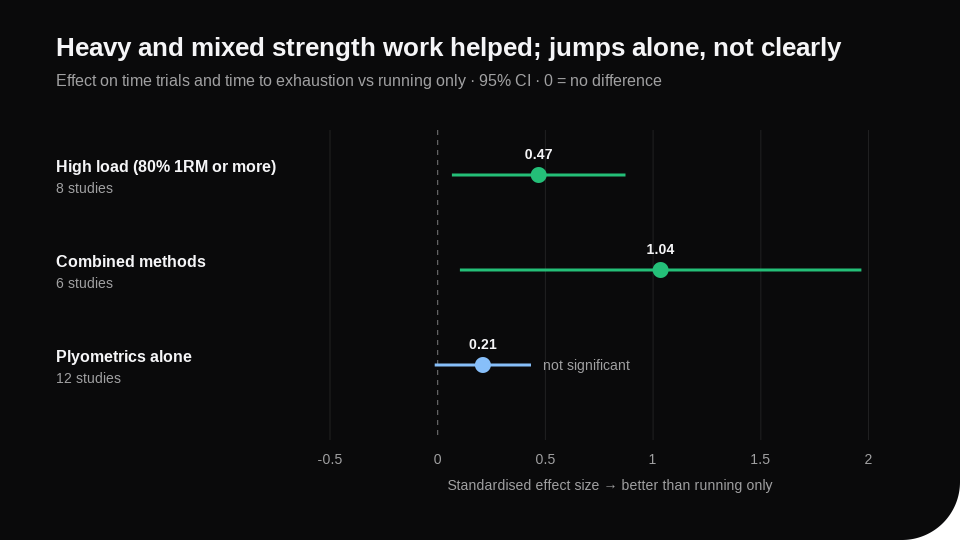
On average, yes, by a moderate amount. A large meta-analysis published in 2024 pooled 38 controlled studies of 894 middle- and long-distance runners aged 17 to 40, from recreational to international level [1]. Twenty-four of the studies measured performance directly, with a time trial or a run to exhaustion. Compared with runners who only ran, heavy strength training (loads of at least 80% of the most you can lift once) had a moderate effect on performance. Combining two or more methods, such as heavy lifting plus jumps, had a large effect, although the results varied a lot between studies. Plyometric (jump) training on its own had a small effect that wasn’t statistically significant [1].
In plainer numbers, a 2018 systematic review of 24 studies found time-trial improvements of about 3–5% over middle distances and 2–4% over long distances up to 10 km [2]. Four of the studies found no difference from running alone, so it isn’t guaranteed [2]. The authors of the 2024 meta-analysis rated the certainty of the evidence as very low to moderate [1]: many studies are small and not all are randomised.
There is a hint that the benefit shows up late in long efforts. In a 2025 trial, 28 well-trained male runners were randomised to keep running as usual or to add maximal strength and plyometric training twice a week for 10 weeks. At the end of a 90-minute run at a hard aerobic pace, the strength group’s running economy had improved by 2.1%, while the controls’ had worsened by 0.6%. Their time to exhaustion at a fast pace after that run rose by 35%, against an 8% fall in the controls [3].
How does strength training make you faster?
Mostly through running economy: how much oxygen you need to hold a given pace. A more economical runner uses less energy at the same speed. Strength training doesn’t seem to raise VO2max at all [1, 2].
Three meta-analyses agree on economy, with different emphases:
- In five studies of 93 high-level runners (VO2max above 60 ml/kg/min), strength programmes of two or three sessions a week for 8–12 weeks had a large effect on running economy [4].
- Across 16 studies, adding strength training improved running economy by about 3.9% more than running alone. Explosive training (about 4.8%) and heavy weights (about 3.7%) worked similarly; isometric training (holding a position against resistance) had no significant effect. Longer programmes gave bigger improvements [5].
- A 2024 analysis split the effect by running speed. Heavy loads gave a small improvement and combined methods a moderate one. Plyometrics helped at speeds of 12 km/h or below (5:00/km, 8:03/mile, or slower). Heavy loads helped more at higher speeds and in runners with a higher VO2max [6].
One frequently cited trial shows what heavy means in practice. Seventeen well-trained runners, men and women, were randomised to carry on as normal or to add half-squats, four sets of four repetitions at the heaviest load they could manage, three times a week for eight weeks. The squatters got 33% stronger, their running economy improved by 5%, and their time to exhaustion at the speed of their VO2max rose by 21%. Their VO2max and body weight didn’t change [7].
Does it work for recreational runners?
Probably, but the evidence is less consistent. In the 2024 meta-analysis, the runners’ level, age, sex and VO2max made no measurable difference to the effect on performance [1]. In the 2018 review, three of the six studies that found no gain in running economy were in recreational or moderately trained runners. About as many studies of recreational runners did find a gain, though, and the authors concluded that training level probably wasn’t the reason [2].
The best-known null result is in recreational marathoners. Twenty-two recreational runners with an average age of 40 trained for eight weeks, and half of them added two strength sessions a week. The lifters’ legs got clearly stronger, but their running economy at marathon pace didn’t improve compared with the half who only ran [8]. The authors thought the study may have been too small or too short to detect a change [8]. And remember that the heavy-load effect on economy was larger in runners with a higher VO2max and at faster speeds [6], which is not where most marathoners spend their time.
There is little evidence at the ends of the age range. In a small trial of postpubertal adolescent runners (18 finished it), 10 weeks of strength training improved running economy by 3.2–3.7% and sprint speed [9]. The large meta-analysis included nobody over 40 [1].
Will lifting make me heavier?
Not in the studies. In the 2018 review, body mass didn’t change in 18 studies; one found a 2% increase [2]. A review of 18 randomised trials in 321 trained runners found no significant increase in body mass [10]. In a 10-week trial of 30 moderately trained runners new to strength training, the lifting group lost about 1 kg of body fat while their total and lean mass stayed the same, and they ran 2 km about 11 seconds faster than the controls [11].
Two caveats. First, most of these studies lasted under 14 weeks, which the review’s authors note may be too short to show muscle growth [2]. Years of lifting are less well studied. Second, the scales are a blunt tool: one study found a 3% gain in lean mass with no meaningful change in body weight [2].
The review’s authors suggest one reason may be the so-called interference effect: endurance training can blunt the gains from strength training [2]. How much it does is disputed. A 2012 meta-analysis of 21 studies found that combining lifting with running, but not with cycling, reduced gains in muscle size and strength [12]. A larger 2022 meta-analysis of 43 studies found no loss of maximal strength or muscle growth, whatever the endurance activity. It did find smaller gains in explosive strength, mainly when both were done in the same session rather than at least three hours apart [13]. In the other direction, strength training didn’t harm VO2max or other aerobic measures [1, 2].
Does strength training prevent running injuries?
Across sport in general, it does. Specifically for running injuries, trials have not shown it yet.
A 2014 meta-analysis of 25 trials with 26,610 participants found that strength training programmes cut sports injuries to less than a third (risk ratio 0.315), while stretching did nothing [14]. A 2018 follow-up of six strength-training trials, with 7,738 participants aged 12 to 40, found a similar effect, and more strength training went with fewer injuries [15]. But a later review of runners points out that those six trials were largely from game sports, several involving throwing, and half were in adolescents [16].
When researchers looked only at runners, the picture changed. A 2024 meta-analysis found nine randomised trials, with 1,904 runners, of exercise programmes added to running [16]. These were mostly mixed programmes, and their strength work was mostly bodyweight. Overall, they did not significantly reduce injury risk or injury rate. Seven of the nine trials were at high risk of bias. In a separate analysis of the three supervised programmes, where at least 88% of sessions were attended, injury risk was lower. In five of the six unsupervised ones, only 47–72% of runners completed the prescribed number of sessions [16].
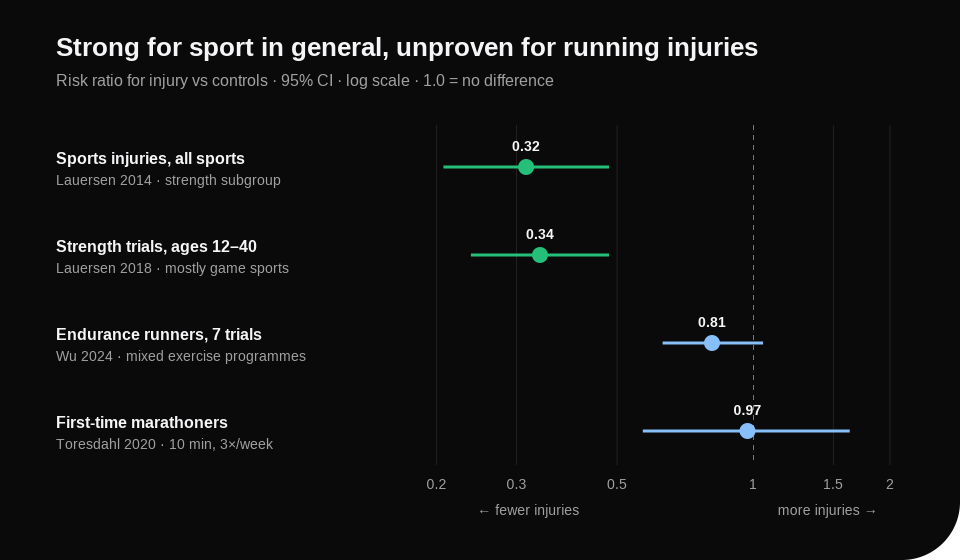
Two of the trials in that review point in opposite directions. In 720 first-time New York City Marathon runners, a 10-minute programme three times a week for 12 weeks, done alone from written and video instructions, made no difference: 7.1% against 7.3% had an overuse injury that stopped them finishing [17]. In 118 recreational runners, eight weeks of foot and ankle strengthening, then remotely supervised training, went with a 2.42-fold lower rate of running injuries over a year [18]. Outside the review, in a Swedish study of 433 recreational runners, twice-weekly strength and foam rolling for 18 weeks did not significantly reduce injuries overall. The runners who did the most sessions were injured far less, but the groups weren’t randomised, and runners who keep up a programme may differ in other ways [19].
So the honest summary is: strength training is one of the best-supported ways to prevent injuries in sport, but whether it prevents the overuse injuries typical of running is still an open question. Doing the sessions consistently seems to matter. If something hurts, that is a question for a doctor or physiotherapist, not for a training plan.
Will lifting hurt tomorrow’s run?
At first, it can. In a six-day study of moderately trained men and women, those who lifted on alternate days alongside daily endurance training became more sore and tired, and their time to exhaustion in maximal running fell [20]. In 12 men who hadn’t lifted before, running was tested in the two days after each of three lower-body sessions. After the third session, easier running had improved compared with after the second, but maximal running was still 12–20% below baseline [21]. The authors suggested avoiding easier running sessions for at least 48 hours after lifting until the third session, and allowing longer before hard running [21].
The trials mostly used two or three sessions a week alongside normal running [2, 4]. The 2022 interference meta-analysis suggests keeping lifting and running at least three hours apart if you do both on one day [13].
How much, and how often?
The studies give a fairly consistent picture:
- Frequency: two to three sessions a week in most programmes [2, 4]; the full range studied runs from one to four [1].
- Duration: 6–14 weeks is enough to see changes [2]; longer programmes improved economy more [5].
- Type: heavy lifting, or heavy lifting combined with jumps, had the clearest effects on performance [1]. Programmes in highly trained runners typically used two to four lower-body exercises, mostly at moderate loads (40–70% of the most you can lift once), plus up to 200 jumps and 5–10 short sprints, two or three times a week [4].
The studies don’t agree on whether more is better. The 2024 meta-analysis found no clear effect of sessions per week or total weeks on performance [1], while an earlier one found that longer programmes improved economy more [5]. Two sessions a week, kept up for months, sits in the middle of what has been tested.
What to do with this
- If you want to run faster, add two strength sessions a week and keep them up for months, not weeks. Heavy lower-body lifting, alone or combined with jumps, has the best evidence.
- Don’t worry about weight gain at a typical runner’s dose. In trials of up to about 14 weeks, body mass didn’t change.
- Start light if you’re new to lifting, and expect your running to feel heavy for a couple of days after the first few sessions. Keep key run sessions away from those days.
- Lift for performance and general robustness, but don’t expect it to protect you from every running injury: the evidence in runners isn’t there yet. In the runner trials, only the supervised programmes, which runners attended consistently, went with fewer injuries, so choose a routine you’ll actually keep up [16].
How Metamorf uses this
Metamorf counts every Apple Health workout type with heart rate towards your training load, strength sessions included, using Banister TRIMP from heart rate and duration; a workout with no heart rate adds no load. A strength session is labelled an “Easy session”, “Steady session” or “Hard session” from the share of its heart-rate time in your zones 3–5 (under 10% easy, under 50% steady, otherwise hard; a session with no heart rate shows as an Easy session), and you can change the label and rate how hard it felt on a 1–10 scale, though the load itself still comes only from heart rate and duration. Heart rate is a measure of your heart’s work, and researchers who monitor lifting use the weight lifted or how hard the session felt [22, 23], so read a lifting day’s load as a rough guide rather than the full cost to your legs.
Sources
- Llanos-Lagos C, Ramirez-Campillo R, Moran J, Sáez de Villarreal E. The effect of strength training methods on middle-distance and long-distance runners’ athletic performance: a systematic review with meta-analysis. Sports Medicine. 2024;54(7):1801–1833. doi:10.1007/s40279-024-02018-z
- Blagrove RC, Howatson G, Hayes PR. Effects of strength training on the physiological determinants of middle- and long-distance running performance: a systematic review. Sports Medicine. 2018;48(5):1117–1149. doi:10.1007/s40279-017-0835-7
- Zanini M, Folland JP, Wu H, Blagrove RC. Strength training improves running economy durability and fatigued high-intensity performance in well-trained male runners: a randomized control trial. Medicine and Science in Sports and Exercise. 2025;57(7):1546–1558. doi:10.1249/MSS.0000000000003685
- Balsalobre-Fernández C, Santos-Concejero J, Grivas GV. Effects of strength training on running economy in highly trained runners: a systematic review with meta-analysis of controlled trials. Journal of Strength and Conditioning Research. 2016;30(8):2361–2368. doi:10.1519/JSC.0000000000001316
- Denadai BS, de Aguiar RA, de Lima LC, Greco CC, Caputo F. Explosive training and heavy weight training are effective for improving running economy in endurance athletes: a systematic review and meta-analysis. Sports Medicine. 2017;47(3):545–554. doi:10.1007/s40279-016-0604-z
- Llanos-Lagos C, Ramirez-Campillo R, Moran J, Sáez de Villarreal E. Effect of strength training programs in middle- and long-distance runners’ economy at different running speeds: a systematic review with meta-analysis. Sports Medicine. 2024;54(4):895–932. doi:10.1007/s40279-023-01978-y
- Støren Ø, Helgerud J, Støa EM, Hoff J. Maximal strength training improves running economy in distance runners. Medicine and Science in Sports and Exercise. 2008;40(6):1087–1092. doi:10.1249/MSS.0b013e318168da2f
- Ferrauti A, Bergermann M, Fernandez-Fernandez J. Effects of a concurrent strength and endurance training on running performance and running economy in recreational marathon runners. Journal of Strength and Conditioning Research. 2010;24(10):2770–2778. doi:10.1519/JSC.0b013e3181d64e9c
- Blagrove RC, Howe LP, Cushion EJ, et al. Effects of strength training on postpubertal adolescent distance runners. Medicine and Science in Sports and Exercise. 2018;50(6):1224–1232. doi:10.1249/MSS.0000000000001543
- Alcaraz-Ibañez M, Rodríguez-Pérez M. Effects of resistance training on performance in previously trained endurance runners: a systematic review. Journal of Sports Sciences. 2018;36(6):613–629. doi:10.1080/02640414.2017.1326618
- Trowell D, Fox A, Saunders N, Vicenzino B, Bonacci J. Effect of concurrent strength and endurance training on run performance and biomechanics: a randomized controlled trial. Scandinavian Journal of Medicine & Science in Sports. 2022;32(3):543–558. doi:10.1111/sms.14092
- Wilson JM, Marin PJ, Rhea MR, Wilson SM, Loenneke JP, Anderson JC. Concurrent training: a meta-analysis examining interference of aerobic and resistance exercises. Journal of Strength and Conditioning Research. 2012;26(8):2293–2307. doi:10.1519/JSC.0b013e31823a3e2d
- Schumann M, Feuerbacher JF, Sünkeler M, et al. Compatibility of concurrent aerobic and strength training for skeletal muscle size and function: an updated systematic review and meta-analysis. Sports Medicine. 2022;52(3):601–612. doi:10.1007/s40279-021-01587-7
- Lauersen JB, Bertelsen DM, Andersen LB. The effectiveness of exercise interventions to prevent sports injuries: a systematic review and meta-analysis of randomised controlled trials. British Journal of Sports Medicine. 2014;48(11):871–877. doi:10.1136/bjsports-2013-092538
- Lauersen JB, Andersen TE, Andersen LB. Strength training as superior, dose-dependent and safe prevention of acute and overuse sports injuries: a systematic review, qualitative analysis and meta-analysis. British Journal of Sports Medicine. 2018;52(24):1557–1563. doi:10.1136/bjsports-2018-099078
- Wu H, Brooke-Wavell K, Fong DTP, Paquette MR, Blagrove RC. Do exercise-based prevention programs reduce injury in endurance runners? A systematic review and meta-analysis. Sports Medicine. 2024;54(5):1249–1267. doi:10.1007/s40279-024-01993-7
- Toresdahl BG, McElheny K, Metzl J, Ammerman B, Chang B, Kinderknecht J. A randomized study of a strength training program to prevent injuries in runners of the New York City Marathon. Sports Health. 2020;12(1):74–79. doi:10.1177/1941738119877180
- Taddei UT, Matias AB, Duarte M, Sacco ICN. Foot core training to prevent running-related injuries: a survival analysis of a single-blind, randomized controlled trial. American Journal of Sports Medicine. 2020;48(14):3610–3619. doi:10.1177/0363546520969205
- Desai P, Jungmalm J, Börjesson M, Karlsson J, Grau S. Effectiveness of an 18-week general strength and foam-rolling intervention on running-related injuries in recreational runners. Scandinavian Journal of Medicine & Science in Sports. 2023;33(5):766–775. doi:10.1111/sms.14313
- Doma K, Deakin G. The acute effect of concurrent training on running performance over 6 days. Research Quarterly for Exercise and Sport. 2015;86(4):387–396. doi:10.1080/02701367.2015.1053104
- Doma K, Schumann M, Leicht AS, Heilbronn BE, Damas F, Burt D. The repeated bout effect of traditional resistance exercises on running performance across 3 bouts. Applied Physiology, Nutrition, and Metabolism. 2017;42(9):978–985. doi:10.1139/apnm-2017-0214
- Scott BR, Duthie GM, Thornton HR, Dascombe BJ. Training monitoring for resistance exercise: theory and applications. Sports Medicine. 2016;46(5):687–698. doi:10.1007/s40279-015-0454-0
- Day ML, McGuigan MR, Brice G, Foster C. Monitoring exercise intensity during resistance training using the session RPE scale. Journal of Strength and Conditioning Research. 2004;18(2):353–358. doi:10.1519/R-13113.1
Metamorf is for fitness guidance, not medical advice. Talk to a doctor before changing how you train if you have a health condition.