Max heart rate: why 220 minus age is probably wrong for you
Almost every heart-rate zone you’ve ever been given starts from one number: your maximum heart rate. Watches, gym posters and training plans usually fill it in for you with 220 minus your age. If you’re 40, that’s 180 bpm, and your “zone 2” follows from it.
The trouble is that the formula has a strange history and a large error for any one person. Here is where it came from, how far it can be off, how to find your own number, and how much it matters if you get it wrong.
Where does 220 minus age come from?
Not from a study. In 2002, the exercise physiologists Robert Robergs and Roberto Landwehr tried to trace the formula to its source [1]. Textbooks mostly printed it without a citation. Karvonen, whose heart-rate reserve method is often taught alongside it, told them he had never published research on the formula; Åstrand, another name often attached to it, said he hadn’t either [1].
The trail ended at a 1971 review of physical activity and heart disease by Fox and colleagues. It contained a figure of about 35 data points from earlier studies, with no regression line fitted. The legend said the formula 220 − age “defines a line not far from many of the data points” [1]. When Robergs and Landwehr fitted a line to those same points, they got 215.4 − 0.91 × age, with a typical error of 21 bpm [1]. Their verdict: the formula “has no scientific merit” [1].
That doesn’t mean 220 − age gives absurd answers. It means it was an eyeballed rule of thumb that became a standard by repetition.
Is there a better formula?
Yes, for groups. Several studies have since fitted age to measured maximum heart rate properly, and they land in roughly the same place:
- Tanaka, 208 − 0.7 × age. A 2001 meta-analysis pooled 351 studies covering 18,712 people, then checked the result in a laboratory study of 514 healthy adults, which gave an almost identical 209 − 0.7 × age [2].
- Gellish, 207 − 0.7 × age. This one followed the same 132 people through 908 maximal exercise tests over 25 years, so it tracks how the same people’s maximum fell as they aged rather than comparing different people [3].
- Nes, 211 − 0.64 × age. From 3,320 healthy Norwegian adults in the HUNT study, all with a verified maximal effort [4].
These newer formulas share a shallower slope than 220 − age: they fall by 0.64–0.7 bpm a year rather than 1. The two most quoted give the same answer at 40, but 220 − age comes out higher for younger runners and lower for older ones: at 60, it says 160 bpm where Tanaka’s formula says 166. Tanaka’s group concluded that 220 − age underestimates maximum heart rate in older adults [2], and the HUNT study found the older formulas underestimated it in people over 30 [4].
Men and women are where the research disagrees. Tanaka’s meta-analysis found no difference between the sexes, and the HUNT study found only minor ones [2, 4]. A study of 5,437 women without symptoms who had exercise stress tests found a steeper decline, 206 − 0.88 × age, and argued that formulas built on men overestimate women’s maximum [5]. In a study of 130 young endurance athletes and 135 others, the women’s maximum was more steeply lower with age than the men’s (a cross-sectional comparison) [6]. No single formula settles it.
How wrong can a formula be for you?
Typically by 10 to 12 bpm, and sometimes by more than 20. The formulas above describe the average person of your age. Real people scatter widely around that average.
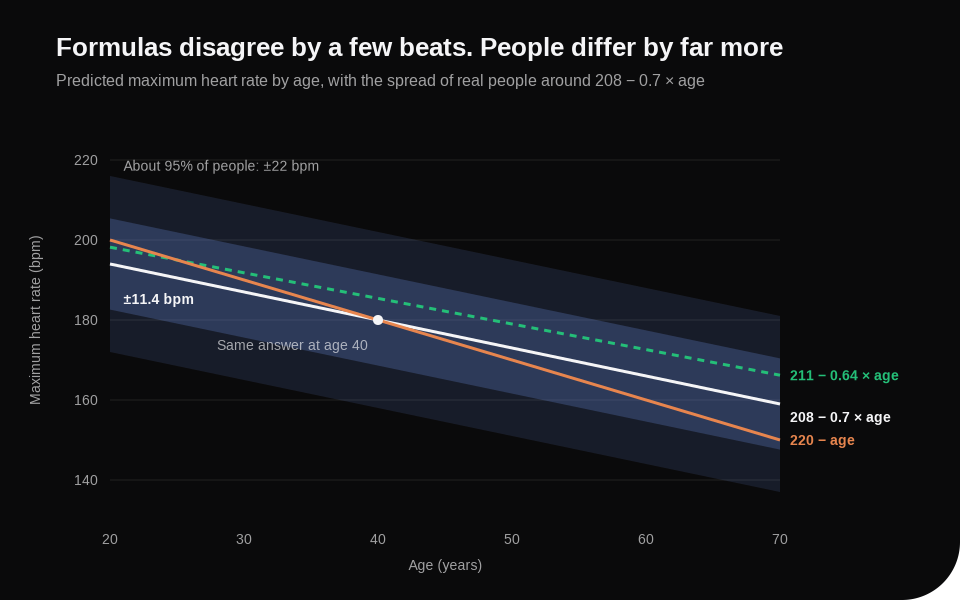
- HUNT: even the study’s own formula had a standard error of 10.8 bpm, which the authors say “must be taken into account” [4].
- HERITAGE: in 762 sedentary adults tested on a bike, the standard error was 12.4 bpm for 220 − age and 11.4 bpm for Tanaka’s formula. About 95% of people fell within 22 bpm of the prediction, and with 220 − age, individual misses ran as high as 49 bpm [7].
- A US treadmill study: in 99 fairly fit adults (average age 38), the general formulas were within 5 bpm of the measured maximum on average, but every one had 95% limits of agreement of roughly 20 bpm either side [8].
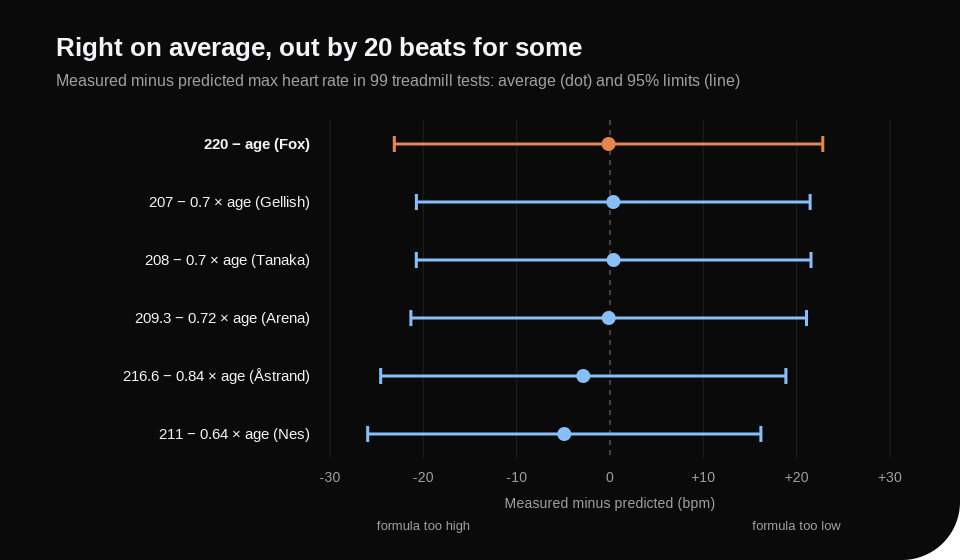
That last study is also a useful caution about “best formula” claims. Its authors suggested 220 − age might be the best option for a general population, because, unlike the others, its error didn’t depend on whether a person’s maximum was high or low [8]. Robergs and Landwehr preferred yet another equation, while still calling its error “unacceptably large” [1]. With an average age of 38, the treadmill sample sat close to the age at which 220 − age and 208 − 0.7 × age agree, where the two give almost the same answer. Which formula looks best depends partly on who is in the sample; none of them is accurate for one person.
Does getting fitter change your max heart rate?
Training doesn’t raise it; if anything, endurance training may lower it by a few percent. Age is the main known influence on it, though people of the same age still differ widely. Tanaka’s analysis found the age relation was not influenced by habitual activity [2], and in the HUNT study there was no interaction with activity or VO2max [4].
Where differences show up, they go the opposite way to what many runners hope. In the study of young athletes, endurance-trained men and women had an average maximum of 190 bpm against 195 bpm in sedentary people of the same age (23 years) [6]. A review of training studies concluded that maximum heart rate can fall by roughly 3–7% with endurance training and rise again with tapering or time off, while warning that the evidence was thin [9].
So a lower maximum is not a sign of lost fitness. It’s mostly a fixed characteristic that declines slowly with age, by about 0.7 bpm a year in the longitudinal study [3].
How can you find your real max?
By running very hard while wearing a reliable heart-rate sensor, and looking at the highest value you reach and hold. A lab test is the reference; if you genuinely reach exhaustion, it is likely accurate to within about 2 bpm [1]. But lab tests aren’t always the highest number you’ll see.
- In 20 US college distance runners, the maximum in a session of 400 m repeats (207 bpm) and in a race (206 bpm) was well above the maximum from a treadmill test (194 bpm) [10]. The study didn’t report formal checks that the lab tests were truly maximal.
- In 15 recreational athletes who ran at least 20 km a week, doing the same incremental test on a treadmill and on a track, the maximums were practically identical (189 and 188 bpm), though individuals differed by up to 11 bpm between the two [11].
- A German study with identical protocols on the treadmill and the track found the track maximum higher by less than 2 bpm, which the authors called negligible [12].
The practical reading: the highest heart rate you’ve reached at the end of a hard race or a demanding interval session is a reasonable estimate, and often as good as a lab number. Your highest values from recent hard efforts are a better guide than any formula.
Mind the sensor. Wrist sensors are good on average but least reliable exactly where your maximum lives. In a treadmill study of 50 athletic adults, the wrist devices’ agreement with an ECG fell as speed rose, and at 8 and 9 mph (about 4:40/km and 4:09/km) none of them reached a concordance of 0.70 with the ECG, although the Apple Watch did best in every condition [13]. In another study, a chest strap agreed with an ECG almost perfectly, and the authors recommended chest straps when accuracy matters [14]. A single implausible spike in a watch graph is more likely a glitch than a new maximum; look for a value you held for a while.
Be careful with all-out efforts. A maximal effort is, by design, as hard as your heart can work. The American College of Sports Medicine’s screening advice weighs how active you are now, whether you have symptoms or known heart, metabolic or kidney disease, and how hard you plan to go, and it notes that exercise-related cardiac events are often preceded by warning signs [15]. If you have a condition, symptoms such as chest pain, fainting or palpitations, or you’re simply unsure, talk to a doctor before any maximal effort. If you’re not used to hard running, build up to it over several weeks first, and stop at once if you feel chest pain, dizziness or unusual breathlessness.
Why does an error of 10 beats matter?
Because almost everything heart-rate-based is scaled to it. Zones are usually percentages of maximum heart rate, or of heart-rate reserve (the range between resting and maximum). Training-load scores such as TRIMP use heart-rate reserve too (see training load explained), and so do many fitness estimates. Heart rate together with resting and maximum heart rate is widely used to estimate VO2max [1]; on a treadmill, the percentage of heart-rate reserve closely tracks the percentage of the range between resting and maximal oxygen uptake [16].
How much a wrong maximum matters depends on what you use it for:
- Zones: fairly forgiving for small errors. In Robergs and Landwehr’s example, a 25-year-old with a true maximum of 192 bpm and a resting rate of 50 has a 60–80% reserve range of 135–164 bpm. If the formula underestimates the maximum by 6 bpm, the range becomes 132–159 [1]; the authors judged errors up to about 8 bpm acceptable for training ranges [1]. By the same arithmetic, a 12 bpm underestimate, typical rather than unusual, gives 128–154. An overestimate pushes every zone up instead, so “easy” can turn into steady work.
- Fitness estimates: much less forgiving. In the same paper, a 6 bpm underestimate changed a heart-rate-based VO2max estimate from a standard cycle test by 8.3% [1]. In a Danish study of 46 well-trained men, estimating VO2max from the ratio of maximum to resting heart rate had an error of 2.7 ml/kg/min with a measured maximum, rising to 4.7 when an age-predicted maximum was used instead [17].
The 80/20 post uses heart-rate percentages to define easy running, and the Apple Watch VO2max post looks at heart-rate-based fitness estimates. Both rest on a maximum that’s roughly right.
What to do with this
- Treat any age formula as a first guess with an error of about 10–12 bpm either way. If you must use one, 208 − 0.7 × age is better supported than 220 − age, especially if you’re over 40.
- Replace the guess with your own data: the highest heart rate you’ve held near the end of hard races or interval sessions, ideally from a chest strap.
- Ignore single spikes. A reading far above anything you’ve seen before, especially for a second or two, is more likely a sensor glitch.
- Don’t expect training to raise your maximum, and don’t read a lower one as lost fitness.
- Re-check every year or two; your maximum falls slowly with age.
- If you have a health condition or symptoms, ask a doctor before any all-out effort.
How Metamorf uses this
Unless you set it yourself, Metamorf takes your maximum heart rate as the higher of two numbers: 208 − 0.7 × your age, and the highest heart rate you’ve spent at least 15 seconds in total at or above in any workout in Apple Health, ignoring readings above 225 bpm so a brief optical spike doesn’t count (with neither available, it uses 190). Because it takes the higher of the two, the automatic value can’t fall below the age formula when Health has your date of birth, so if your real maximum is lower, set it in Settings under Maximum heart rate (120 to 230 bpm while resting heart rate is automatic). That number drives your training load, your heart-rate zones (through a threshold that defaults to 0.88 × your maximum) and Metamorf’s fitness estimate from your runs.
Sources
- Robergs RA, Landwehr R. The surprising history of the “HRmax=220-age” equation. Journal of Exercise Physiology online. 2002;5(2):1–10. asep.org
- Tanaka H, Monahan KD, Seals DR. Age-predicted maximal heart rate revisited. Journal of the American College of Cardiology. 2001;37(1):153–156. doi:10.1016/s0735-1097(00)01054-8
- Gellish RL, Goslin BR, Olson RE, McDonald A, Russi GD, Moudgil VK. Longitudinal modeling of the relationship between age and maximal heart rate. Medicine & Science in Sports & Exercise. 2007;39(5):822–829. doi:10.1097/mss.0b013e31803349c6
- Nes BM, Janszky I, Wisløff U, Støylen A, Karlsen T. Age-predicted maximal heart rate in healthy subjects: the HUNT fitness study. Scandinavian Journal of Medicine & Science in Sports. 2013;23(6):697–704. doi:10.1111/j.1600-0838.2012.01445.x
- Gulati M, Shaw LJ, Thisted RA, Black HR, Bairey Merz CN, Arnsdorf MF. Heart rate response to exercise stress testing in asymptomatic women: the St. James Women Take Heart Project. Circulation. 2010;122(2):130–137. doi:10.1161/CIRCULATIONAHA.110.939249
- Whyte GP, George K, Shave R, Middleton N, Nevill AM. Training induced changes in maximum heart rate. International Journal of Sports Medicine. 2008;29(2):129–133. doi:10.1055/s-2007-965783
- Sarzynski MA, Rankinen T, Earnest CP, et al. Measured maximal heart rates compared to commonly used age-based prediction equations in the Heritage Family Study. American Journal of Human Biology. 2013;25(5):695–701. doi:10.1002/ajhb.22431
- Shookster D, Lindsey B, Cortes N, Martin JR. Accuracy of commonly used age-predicted maximal heart rate equations. International Journal of Exercise Science. 2020;13(7):1242–1250. doi:10.70252/XFSJ6815
- Zavorsky GS. Evidence and possible mechanisms of altered maximum heart rate with endurance training and tapering. Sports Medicine. 2000;29(1):13–26. doi:10.2165/00007256-200029010-00002
- Semin K, Stahlnecker AC IV, Heelan K, Brown GA, Shaw BS, Shaw I. Discrepancy between training, competition and laboratory measures of maximum heart rate in NCAA division 2 distance runners. Journal of Sports Science and Medicine. 2008;7(4):455–460. PubMed 24149950
- Mugele H, Plummer A, Baritello O, Towe M, Brecht P, Mayer F. Accuracy of training recommendations based on a treadmill multistage incremental exercise test. PLoS One. 2018;13(10):e0204696. doi:10.1371/journal.pone.0204696
- Meyer T, Welter JP, Scharhag J, Kindermann W. Maximal oxygen uptake during field running does not exceed that measured during treadmill exercise. European Journal of Applied Physiology. 2003;88(4–5):387–389. doi:10.1007/s00421-002-0718-x
- Pasadyn SR, Soudan M, Gillinov M, et al. Accuracy of commercially available heart rate monitors in athletes: a prospective study. Cardiovascular Diagnosis and Therapy. 2019;9(4):379–385. doi:10.21037/cdt.2019.06.05
- Gillinov S, Etiwy M, Wang R, et al. Variable accuracy of wearable heart rate monitors during aerobic exercise. Medicine & Science in Sports & Exercise. 2017;49(8):1697–1703. doi:10.1249/MSS.0000000000001284
- Riebe D, Franklin BA, Thompson PD, et al. Updating ACSM’s recommendations for exercise preparticipation health screening. Medicine & Science in Sports & Exercise. 2015;47(11):2473–2479. Erratum: Medicine & Science in Sports & Exercise. 2016;48(3):579. doi:10.1249/MSS.0000000000000664
- Swain DP, Leutholtz BC, King ME, Haas LA, Branch JD. Relationship between % heart rate reserve and % VO2 reserve in treadmill exercise. Medicine & Science in Sports & Exercise. 1998;30(2):318–321. doi:10.1097/00005768-199802000-00022
- Uth N, Sørensen H, Overgaard K, Pedersen PK. Estimation of VO2max from the ratio between HRmax and HRrest: the Heart Rate Ratio Method. European Journal of Applied Physiology. 2004;91(1):111–115. Erratum: European Journal of Applied Physiology. 2005;93(4):508–509. doi:10.1007/s00421-003-0988-y
Metamorf is for fitness guidance, not medical advice. Talk to a doctor before changing how you train if you have a health condition.