Tapering: how much to cut before a race, and for how long
The hard work is done. Your longest run is behind you, the race is a few weeks away, and the plan says to run less. It feels wrong: every instinct built over months of training says that fitness comes from doing more. The taper asks you to trust that it comes, at the end, from doing less. Here is what the research says about how long that should last, how much to cut, and what not to cut.
What does a taper actually do?
A taper lets fatigue clear faster than fitness fades. Training builds adaptations and leaves fatigue behind; for a few weeks, reducing the load removes much of the fatigue while most of the adaptations stay [1, 2]. Reviews describe it as restoring capacities that hard training had temporarily impaired, while the body keeps responding to the training that remains [1].
The changes measured during tapers are spread across many body systems. A review of the physiology lists possible increases in blood and red cell volume, muscle glycogen that rises progressively, markedly greater muscular strength and power, higher oxidative enzyme activity, less mood disturbance, a lower sense of effort and better sleep [1]. In seven collegiate distance runners, a three-week taper increased the diameter of their type IIa (fast-twitch) muscle fibres by 7% and raised those fibres’ power by 9%, with no change in citrate synthase activity or cardiovascular measures, and they raced 8 km 3% faster [3]. VO2max may rise during a taper, but it doesn’t have to for performance to improve [1]; a 2023 meta-analysis found no significant change in VO2max or economy overall, yet clear gains in time trials [4].
If you have read our explainer on training load, this is the fitness-fatigue model at work. Short-term (acute) load reacts within days; long-term (chronic) load moves slowly. As a worked example using the 7-day and 28-day exponentially weighted averages described there: halve a steady daily load for 14 days and the acute average falls by about 49%, the chronic average by only about 32%. Modelling studies built on this idea found that tapers which cut load quickly at first (exponentially) beat a single step down, in simulations and in cycling tests of triathletes, though the difference in a 5 km run was not significant [5], and that the best taper depends on how hard you trained before it [2].
How much faster will a taper make you?
A few percent. A widely cited review put the usual gain at about 3%, with a range of 0.5–6% [6]. Trials and real competitions land in the same place:
- In a 1994 study of distance runners, a seven-day taper with an 85% cut in volume and high-intensity intervals improved 5 km time by 3%, from 1,036 to 1,007 seconds, in a group of eight; neither a cycling taper nor normal training changed it [7].
- Seven collegiate runners raced 8 km 3% faster after a three-week taper [3].
- Olympic swimmers improved by 2.2% on average over the final three weeks before the Sydney 2000 Games [8].
For a 3:45 marathon, 3% would be nearly seven minutes.
Not every trial found a gain. Seven male runners who cut their weekly volume by 85% for a week ran a treadmill half marathon no faster than before (85.6 minutes, then 85.4), and no faster than seven who kept training normally, though a blood marker of muscle damage rose less after the race [9]. Six-day tapers with 50% or 75% cuts didn’t significantly improve 800 m times in eight middle-distance runners [10]. Small studies, short tapers and the noise of a single time trial all make the gains hard to see.
How long should a marathon taper be?
About two weeks, and up to three, is where most of the evidence points for a marathon.
- The 2007 meta-analysis. Laurent Bosquet and colleagues pooled 27 studies of competitive athletes and found the largest effect from a taper of two weeks [11]. Swimmers made up most of the athletes; runners and cyclists were the rest [4].
- The 2023 meta-analysis. In 14 studies of 174 endurance athletes, mostly runners and cyclists, every taper length up to 21 days improved time trials. Tapers of 8–14 days showed the biggest effect, but that rested on only 18 athletes; most of the data came from tapers of a week or less, and tapers of 22 days or more showed no clear gain [4].
- What elite marathoners do. In a survey of elite British runners, marathoners tapered for a median of 14 days, against about 6 days for runners from 800 m to 10,000 m [12].
- What recreational marathoners do. In Strava data, three-week tapers in which weekly distance fell steadily went with the best finish times; four-week tapers were no better (more on this below) [13].
Others argue for a wider range. A 2003 review put the optimal taper anywhere from 4 to more than 28 days [6], and a computer model fitted to six people found the best taper lasted about 19 days after normal training and about 28 days after a block of heavier training [2]. The harder the training before it, the longer the taper the model needed.
For shorter races, shorter tapers. Elite runners from 800 m to 10,000 m tapered for about six days [12], and a seven-day taper improved 5 km times in one trial [7].
How much should you cut, and what should you keep?
Cut volume by roughly 40–60%, keep the intensity, and keep running about as often. That was the combination with the largest effects in both meta-analyses [4, 11].
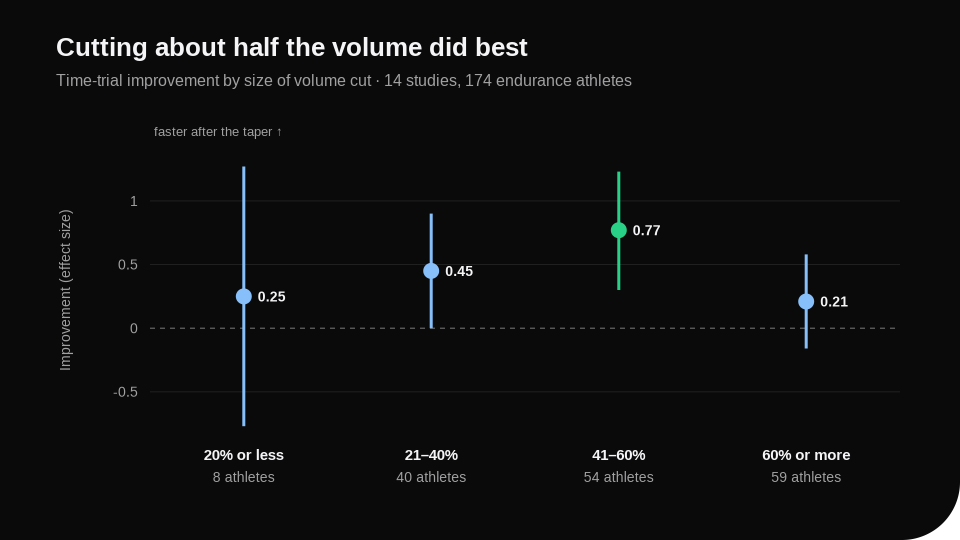
Volume. In the 2023 meta-analysis, cutting volume by 41–60% gave the largest and clearest improvement in time trials; cuts of 60% or more showed no clear improvement [4]. Bosquet’s analysis found the same 41–60% band, with volume reduced exponentially, falling faster early on [11]. Elite British marathoners did roughly this in practice, cutting their continuous running to 53% of normal [12].
Here the research disagrees. The 2003 review recommended reducing volume by up to 60–90% [6], and some of the trials that worked used bigger cuts, including the 85% reduction that improved 5 km times [7]. The same 85% cut didn’t help a half marathon [9]. A computer model went the other way, putting the best reduction at about 30–40% of load [2]. The fair reading: about half is the best-supported figure, and bigger cuts have worked in some short trials but not consistently.
Intensity. Keep some fast running. In a 1992 study, nine male middle-distance runners tried three week-long tapers. After a low-volume taper with high-intensity intervals, they ran 22% longer before exhaustion at their 1,500 m pace; after a moderate-volume taper of easy running, 6% longer (not significant); after a week of rest, 3% less (not significant) [14]. In the 2023 meta-analysis, tapers that lowered intensity didn’t improve time trials, while those that kept it did [4]. One of the field’s leading researchers puts it plainly: load “should not be reduced at the expense of intensity” [15]. Elite marathoners’ fastest taper intervals were above race speed, at about 114% of it [12]. How fast the very last session should be is unsettled: in two small trials in 1,500 m runners, a final session faster than race pace helped in one and gave “highly variable” results in the other [16, 17].
Frequency. Keep most of your runs. Both meta-analyses found the best results when the number of sessions stayed the same [4, 11]; the 2003 review suggested cutting frequency by no more than 20% [6]. In practice, that usually means shorter runs rather than fewer of them.
What do ordinary marathoners’ tapers show?
The largest look at real tapers comes from Barry Smyth and Aonghus Lawlor at University College Dublin, who analysed Strava training data from 158,117 recreational runners who ran a marathon between 2014 and 2017 [13]. They defined each runner’s taper from weekly distance in the four weeks before the race, compared with weeks five and six. A strict taper meant weekly distance fell every week from its first down week to race day, with no week going back up. A relaxed taper had at least one week where distance went back up after a drop. About two-thirds of runners did this, and only about 31% tapered strictly [13].
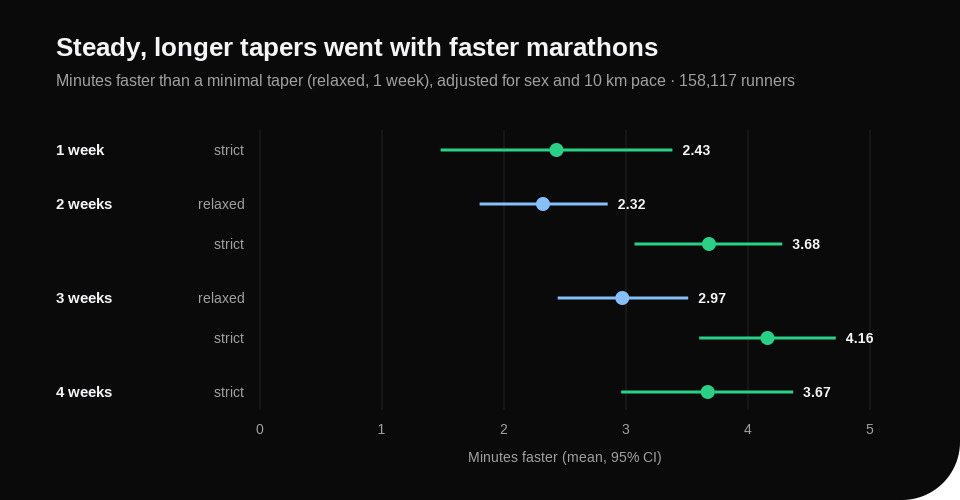
Strict tapers went with faster marathons than relaxed tapers of the same length, and longer tapers up to three weeks beat shorter ones. Taking each runner’s fastest 10 km in training as a measure of ability, and adjusting for sex, a strict three-week taper was associated with finishing about 4.2 minutes faster on average than a minimal (relaxed one-week) taper; a strict two-week taper about 3.7 minutes; a strict four-week taper also about 3.7 [13]. Measured another way, runners with strict three-week tapers had a median gain of 5 minutes 32 seconds, or 2.6%, over the time expected after a minimal taper [13]. Women gained more than men from the same type of taper, up to three weeks [13].
Treat this as strong evidence of a pattern, not proof of cause. It compares different runners, not the same runner trying different tapers. Runners with strict tapers also ran more at their peak, which suggests experience may be part of the story. The study had no data on weather, courses, age or injury, and it kept only each runner’s fastest marathon of the year, which the authors note could overestimate the benefit of tapering [13]. Still, it fits the controlled studies: the gains it finds, about 1.3–2.4% across taper types and 2.6% for strict three-week tapers, sit inside the range from trials.
Why doesn’t the same taper suit everyone?
Because people arrive at the taper in different states and respond differently to the same cut. Even among Olympic swimmers, 8 of 99 swims were slower after the final three weeks, and the changes ranged from 1.1% slower to 6.0% faster [8].
How tired you are going in matters. In a study of 33 trained male triathletes, three weeks of heavy training pushed 11 of 23 into functional overreaching, a state where performance drops along with high fatigue. Those who were only acutely tired gained more during the following four-week taper than those who had been overreached, and 70% of the overreached athletes caught an infection during the study, against 20% of the acutely tired and 10% of those training normally [18]. A meta-analysis found that tapers following a block of heavier training improved time trials more than tapers after normal training [4], but the triathlete study suggests there is a limit: being pushed into overreaching before a taper blunted the gain and came with more infections. A model study points the same way: the harder the training before the taper, the larger and longer the reduction it needed [2].
In nine male marathon runners who reduced training by about a third after three weeks of overload, time to exhaustion in a running test didn’t change during the overload, but rose from about 614 to 727 seconds in the second week of the taper [19]. In the triathlete study, too, most athletes reached their best performance within the first two weeks of the taper [18].
What to do with this
- For a marathon, plan a taper of two to three weeks. If your last block was especially heavy, the evidence leans towards the longer end.
- Cut weekly distance by roughly 40–60% over the taper, more quickly at first, mostly by shortening runs rather than dropping them.
- Keep some race-pace and faster running each week. Shorter sessions, same speed.
- Let the weeks go steadily down. In the Strava data, a week where distance climbed back up went with slower finishes.
- For a half marathon there is little direct research; the general finding of about two weeks is the best guide. For a 5K or 10K, about a week.
- If you’re carrying pain or illness into the taper, that’s a question for a doctor or physiotherapist, not for the taper plan.
How Metamorf uses this
When you set a goal race, the Race Readiness card on the Insights tab projects your form (chronic training load minus acute load, both from heart-rate TRIMP) to race day, assuming you keep training at your average daily load of the last 28 days and then halve it for the taper. It picks the taper length, at least 14 days for a marathon, 10 for a half, 7 for a 10K and 4 for shorter races (or every remaining day, if the race is closer than that minimum), and at most 21, that brings race-day form closest to +15, the middle of its race-ready range of 5 to 25, and gives you the date in a line such as “Start tapering on 5 Dec to arrive with form +15.” It suggests when to start the taper, assuming you halve your load from then on; it doesn’t tell you which sessions to keep, and its form target comes from the model rather than from a study of race results.
Sources
- Mujika I, Padilla S, Pyne D, Busso T. Physiological changes associated with the pre-event taper in athletes. Sports Medicine. 2004;34(13):891–927. doi:10.2165/00007256-200434130-00003
- Thomas L, Busso T. A theoretical study of taper characteristics to optimize performance. Medicine & Science in Sports & Exercise. 2005;37(9):1615–1621. doi:10.1249/01.mss.0000177461.94156.4b
- Luden N, Hayes E, Galpin A, et al. Myocellular basis for tapering in competitive distance runners. Journal of Applied Physiology. 2010;108(6):1501–1509. doi:10.1152/japplphysiol.00045.2010
- Wang Z, Wang YT, Gao W, Zhong Y. Effects of tapering on performance in endurance athletes: a systematic review and meta-analysis. PLoS One. 2023;18(5):e0282838. doi:10.1371/journal.pone.0282838
- Banister EW, Carter JB, Zarkadas PC. Training theory and taper: validation in triathlon athletes. European Journal of Applied Physiology and Occupational Physiology. 1999;79(2):182–191. doi:10.1007/s004210050493
- Mujika I, Padilla S. Scientific bases for precompetition tapering strategies. Medicine & Science in Sports & Exercise. 2003;35(7):1182–1187. doi:10.1249/01.MSS.0000074448.73931.11
- Houmard JA, Scott BK, Justice CL, Chenier TC. The effects of taper on performance in distance runners. Medicine & Science in Sports & Exercise. 1994;26(5):624–631. PubMed 8007812
- Mujika I, Padilla S, Pyne D. Swimming performance changes during the final 3 weeks of training leading to the Sydney 2000 Olympic Games. International Journal of Sports Medicine. 2002;23(8):582–587. doi:10.1055/s-2002-35526
- Child RB, Wilkinson DM, Fallowfield JL. Effects of a training taper on tissue damage indices, serum antioxidant capacity and half-marathon running performance. International Journal of Sports Medicine. 2000;21(5):325–331. doi:10.1055/s-2000-3778
- Mujika I, Goya A, Padilla S, et al. Physiological responses to a 6-d taper in middle-distance runners: influence of training intensity and volume. Medicine & Science in Sports & Exercise. 2000;32(2):511–517. doi:10.1097/00005768-200002000-00038
- Bosquet L, Montpetit J, Arvisais D, Mujika I. Effects of tapering on performance: a meta-analysis. Medicine & Science in Sports & Exercise. 2007;39(8):1358–1365. doi:10.1249/mss.0b013e31806010e0
- Spilsbury KL, Fudge BW, Ingham SA, Faulkner SH, Nimmo MA. Tapering strategies in elite British endurance runners. European Journal of Sport Science. 2015;15(5):367–373. doi:10.1080/17461391.2014.955128
- Smyth B, Lawlor A. Longer disciplined tapers improve marathon performance for recreational runners. Frontiers in Sports and Active Living. 2021;3:735220. doi:10.3389/fspor.2021.735220
- Shepley B, MacDougall JD, Cipriano N, Sutton JR, Tarnopolsky MA, Coates G. Physiological effects of tapering in highly trained athletes. Journal of Applied Physiology. 1992;72(2):706–711. doi:10.1152/jappl.1992.72.2.706
- Mujika I. Intense training: the key to optimal performance before and during the taper. Scandinavian Journal of Medicine & Science in Sports. 2010;20(Suppl 2):24–31. doi:10.1111/j.1600-0838.2010.01189.x
- Spilsbury KL, Nimmo MA, Fudge BW, Pringle JSM, Orme MW, Faulkner SH. Effects of an increase in intensity during tapering on 1500-m running performance. Applied Physiology, Nutrition, and Metabolism. 2019;44(7):783–790. doi:10.1139/apnm-2018-0551
- Spilsbury KL, Fudge BW, Nimmo MA, Faulkner SH. Lower volume throughout the taper and higher intensity in the last interval session prior to a 1500 m time trial improves performance. Applied Physiology, Nutrition, and Metabolism. 2021;46(11):1345–1353. doi:10.1139/apnm-2021-0103
- Aubry A, Hausswirth C, Louis J, Coutts AJ, Le Meur Y. Functional overreaching: the key to peak performance during the taper? Medicine & Science in Sports & Exercise. 2014;46(9):1769–1777. doi:10.1249/MSS.0000000000000301
- Hug B, Heyer L, Naef N, Buchheit M, Wehrlin JP, Millet GP. Tapering for marathon and cardiac autonomic function. International Journal of Sports Medicine. 2014;35(8):676–683. doi:10.1055/s-0033-1361184
Metamorf is for fitness guidance, not medical advice. Talk to a doctor before changing how you train if you have a health condition.