Low HRV this morning: should you still run?
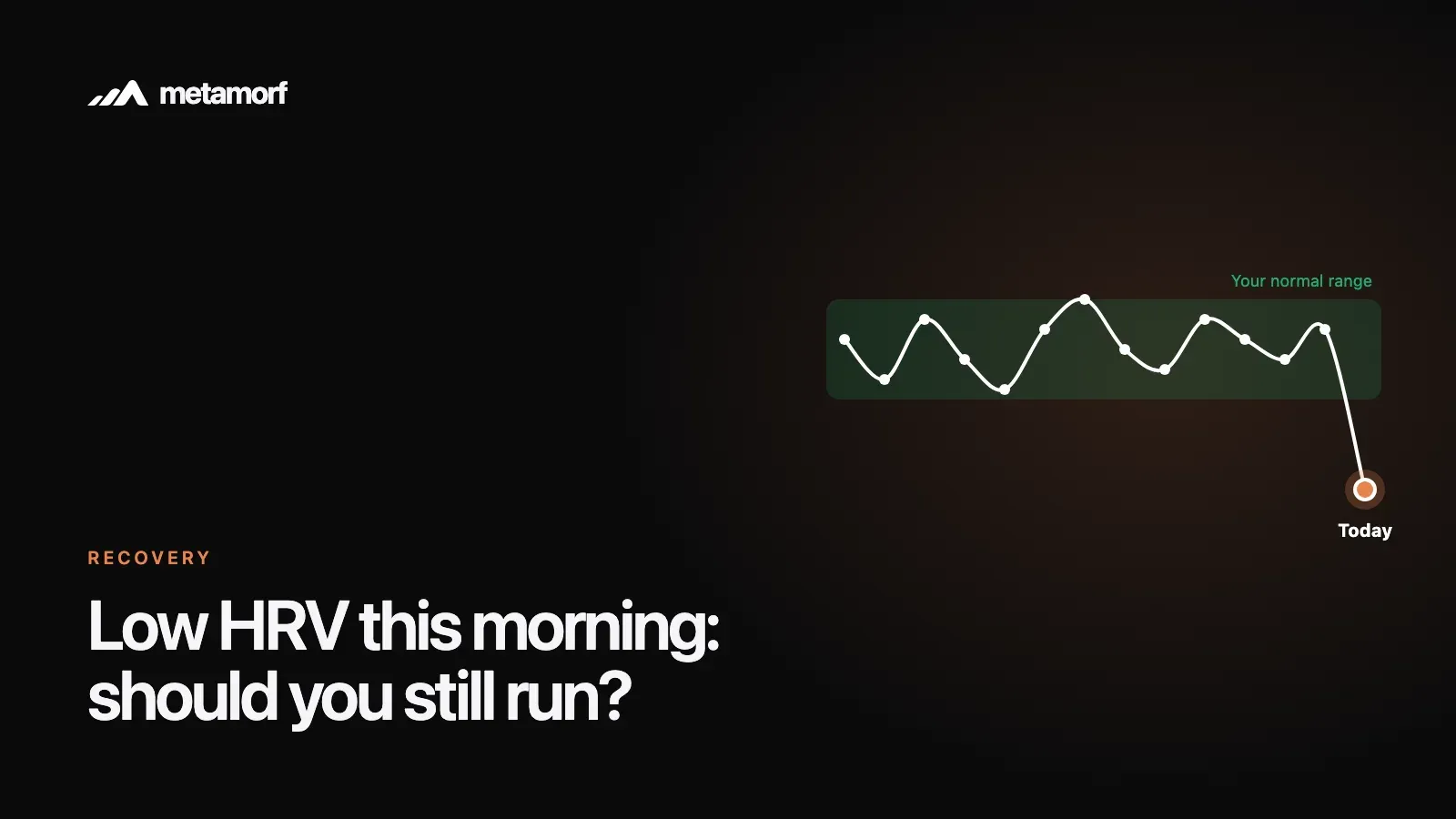
You wake up, check your watch, and your heart-rate variability is well below where it usually sits. You had a tempo run planned. Do you go, go easy, or go back to bed? This is one of the most common questions runners with a wearable ask, and the research gives a better answer than most apps do: an HRV reading is worth acting on, but the action is usually “make it easy”, not “skip it”, and only once you know what else might be behind it.
What does HRV actually measure?
Heart-rate variability is the variation in time between heartbeats. A healthy heart at rest doesn’t tick like a metronome: the gaps between beats lengthen and shorten, mostly with your breathing, under the control of the vagus nerve, the main nerve of the “rest and digest” side of your nervous system. More of that variation generally means more parasympathetic (recovery-side) activity [1].
There are several ways to calculate it. Sports scientists studying training almost always use rMSSD, a measure of beat-to-beat change, usually on a log scale, recorded first thing in the morning [2, 3]. Apple Health stores HRV as SDNN, the standard deviation of the intervals between heartbeats, and Apple Watch records the samples automatically [4]. The two are related but not interchangeable [1]. That matters in two ways: you can’t compare your Apple Watch number with someone else’s rMSSD from another device or study, and the rules tested in research were built on vagal measures such as rMSSD, not on SDNN [5].
What does carry over is the logic: compare yourself with yourself.
Is one low reading a problem?
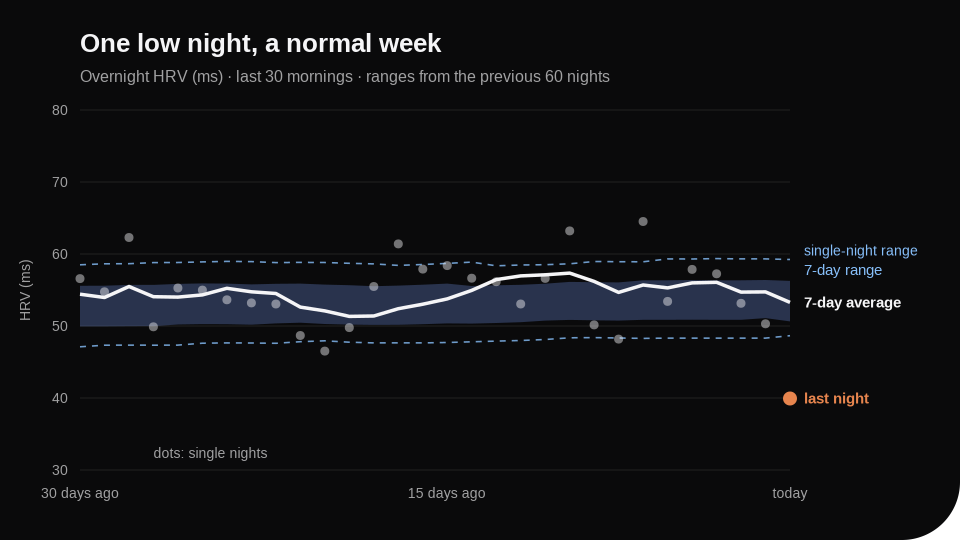
On its own, not necessarily. In athletes in training, morning HRV typically swings by 10–20% from one day to the next [2]. In a study of 10 runners over a nine-week training block, single-day HRV values had only a weak relationship with how much their 10 km performance changed (r = −0.17), while weekly averages had a very strong one (r = −0.76) [3]. A follow-up in triathletes found that averaging at least three readings a week was enough for the weekly picture to behave like a full seven-day average [6]. Buchheit, one of the field’s leading researchers, recommends recording on waking at least three or four times a week [2].
So the useful question isn’t “is today low?” but “is today low compared with my normal range, and is my trend low too?”
What did HRV-guided training studies do on a low day?
They didn’t tell people to stop running. They changed the intensity.
- In the first well-known trial, from Finland in 2007, 17 moderately fit men ran 40-minute sessions for four weeks (with nine more as non-training controls). In the HRV-guided group, a morning reading that held steady or rose meant a hard session; a clear drop meant an easy session or rest [8].
- A 2010 follow-up in 53 moderately active men and women (including controls) used the same idea; one HRV-guided group of women trained hard only when HRV rose, and did about two hard sessions a week instead of three, with similar fitness gains [9].
- The most relevant trial for runners, from 2016, involved 40 recreational endurance runners over an eight-week hard training block [7]. The HRV-guided group took a 7-day rolling average of their morning HRV and compared it with a personal band (their 4-week baseline average, ±0.5 standard deviations) [5]. Inside the band: do the planned moderate or hard session. Outside it: run easy [5, 7]. The band was two-sided, so an unusually high average also meant an easy day [5].
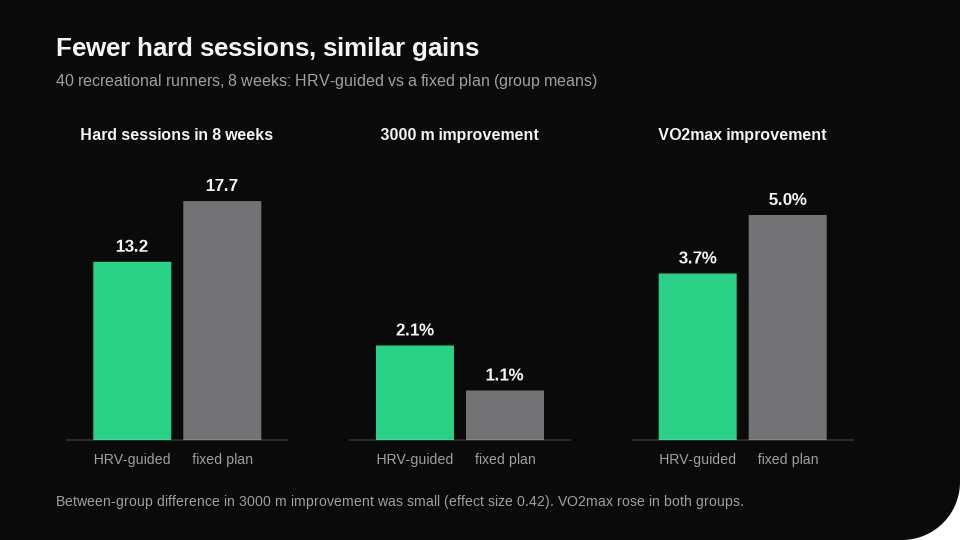
In that runners’ trial, the HRV-guided group did fewer hard sessions (13.2 against 17.7) and improved their 3000 m time by 2.1%, against a non-significant 1.1% in the fixed-plan group, although the difference between groups was small [7]. VO2max rose in both groups, slightly more with the fixed plan [7].
Does HRV-guided training work better than a fixed plan?
A little, maybe, and mostly by doing less. Two meta-analyses that compared HRV-guided and predefined training directly found a small advantage for performance that wasn’t statistically significant (a standardised difference of 0.20 [5], and 0.08 in the other [10]). The clearer benefits were elsewhere: better submaximal fitness markers [10], higher resting vagal HRV [5], and fewer people who failed to improve or got worse [5, 10]. A third meta-analysis reported a significant VO2max advantage, but it compared before-and-after changes within each group rather than the groups against each other, and judged the overall risk of bias unclear in every included study [11].
The honest summary: guiding hard sessions by HRV gets you about the same fitness with fewer hard days, and probably fewer bad outcomes. Those studies were small, short and mostly in men, and none was designed to measure injury or illness.
What else lowers HRV?
Almost anything that loads your nervous system, which is exactly why a low number deserves a moment’s thought before you blame your training.
- Alcohol. In a laboratory trial, an evening drink or two reduced overnight vagal HRV, more so at higher doses [12]. In data from over 20,000 wearable users (5.1 million person-days), drinking one more than usual rather than one fewer was associated with about 3.3–3.8 ms lower HRV that night [13]. That study was funded by a wearable maker.
- Lost sleep. A meta-analysis of sleep-deprivation trials found a small drop in rMSSD (pooled from 4 of its 11 trials). Interestingly for Apple Watch wearers, SDNN didn’t change significantly [14]. These were lab trials of a night or more without sleep, not ordinary short nights.
- Altitude. Going above 2,500 m lowers HRV in the first days [15].
- Mental stress. Most studies of induced stress found lower parasympathetic activity [16].
- Illness. In health-care workers wearing Apple Watch, the daily pattern of SDNN changed around a COVID-19 diagnosis [17]. In one recreational runner’s diary, rMSSD fell from 40 to 24 ms the day before flu symptoms appeared [18].
If HRV is low and you also feel unwell, the question isn’t really about training. Rest, and if symptoms are more than mild, talk to a doctor.
Is high HRV always good?
No, and this is where “higher is better” breaks down. When 13 trained triathletes were deliberately overloaded for three weeks, their performance fell by about 9%, yet their averaged vagal HRV rose; it came back down as they tapered and recovered [19]. Recreational runners showed rising nightly HRV during a two-week overload block too, although there the rise went with better 3000 m times and the authors read it as positive adaptation [20]. A rise can mean either, which is why context matters. In elite athletes, researchers describe the opposite puzzle, “saturation”, where HRV falls even as resting heart rate falls and fitness improves [21].
That’s why researchers recommend reading HRV alongside other signals: resting heart rate, how the last few sessions felt, and what you’ve been doing [2]. When a low HRV comes with a clearly raised resting heart rate, the two point the same way, which makes the signal harder to dismiss.
How good is Apple Watch at measuring HRV?
Less well studied than you might think. A 2026 living systematic review of Apple Watch accuracy found 38 studies of heart rate but only one of HRV [22]. In that study, 39 adults took a five-minute reading each morning for up to two weeks (316 readings); Apple Watch SDNN came out 8.31 ms lower on average than a chest strap, with an average error of about 29%, while resting heart rate was accurate to about 6% [23]. In an overnight lab comparison, Apple Watch HRV tended to overestimate low values and underestimate high ones [24]. Earlier work found the raw beat-to-beat intervals agreed well with a chest strap at rest, but with gaps [25].
Two practical consequences follow. Your absolute number matters less than your trend on the same device. And the decision rules from the trials, built on morning vagal measures such as rMSSD, are being applied to overnight or opportunistic SDNN: a reasonable extrapolation, but an extrapolation. On recent models, Apple’s own Vitals app builds your typical overnight range from seven nights of wear [26], much shorter than the three-to-four-week baselines used in research.
What to do with this
- A slightly low reading, trend normal, feeling fine: train as planned, or make the hard part a little shorter.
- Clearly low reading or low 7-day trend: swap intensity for an easy run, or rest. That’s what the trials did.
- Low HRV plus raised resting heart rate, or you feel unwell: rest. If symptoms are more than mild, see a doctor.
- Look for a reason: alcohol, a short night, travel, stress or a hard block of training. If there’s an obvious one, the number is telling you something you already know.
- Measure consistently: wear the watch to bed, and judge by your own range on the same device, never by someone else’s number.
How Metamorf uses this
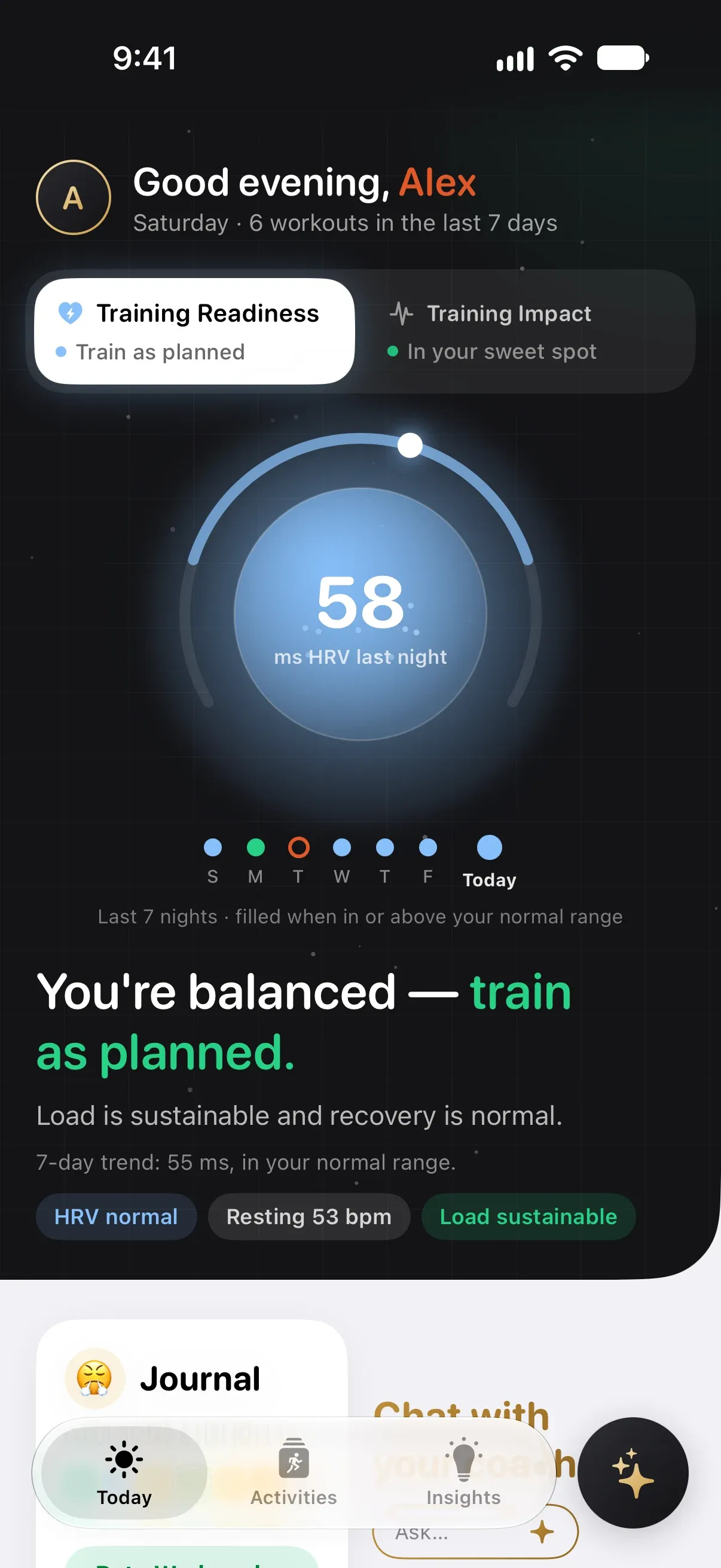
Training Readiness compares last night’s HRV with your own normal range from the previous 60 nights, uses your 7-day average when there’s no reading from last night, and treats a resting heart rate more than 3 bpm (or one standard deviation, whichever is larger) above your baseline as a sign of low recovery, whatever HRV says. It then combines recovery with where your training load sits: low recovery gives “Keep it easy”, or “Rest today” if your load is also above your range; normal recovery gives “Good day to push”, “Train as planned” or “Hold back” as your load goes from below your range to above it; high recovery leans one step further towards pushing. It needs at least 14 nights of HRV, including 3 of the last 7, before it shows a verdict.
Sources
- Shaffer F, Ginsberg JP. An overview of heart rate variability metrics and norms. Frontiers in Public Health. 2017;5:258. doi:10.3389/fpubh.2017.00258
- Buchheit M. Monitoring training status with HR measures: do all roads lead to Rome? Frontiers in Physiology. 2014;5:73. doi:10.3389/fphys.2014.00073
- Plews DJ, Laursen PB, Kilding AE, Buchheit M. Evaluating training adaptation with heart-rate measures: a methodological comparison. International Journal of Sports Physiology and Performance. 2013;8(6):688–691. doi:10.1123/ijspp.8.6.688
- Apple. heartRateVariabilitySDNN. HealthKit, Apple Developer Documentation. developer.apple.com
- Manresa-Rocamora A, Sarabia JM, Javaloyes A, Flatt AA, Moya-Ramón M. Heart rate variability-guided training for enhancing cardiac-vagal modulation, aerobic fitness, and endurance performance: a methodological systematic review with meta-analysis. International Journal of Environmental Research and Public Health. 2021;18(19):10299. doi:10.3390/ijerph181910299
- Plews DJ, Laursen PB, Le Meur Y, et al. Monitoring training with heart-rate variability: how much compliance is needed for valid assessment? International Journal of Sports Physiology and Performance. 2014;9(5):783–790. doi:10.1123/ijspp.2013-0455
- Vesterinen V, Nummela A, Heikura I, et al. Individual endurance training prescription with heart rate variability. Medicine and Science in Sports and Exercise. 2016;48(7):1347–1354. doi:10.1249/MSS.0000000000000910
- Kiviniemi AM, Hautala AJ, Kinnunen H, Tulppo MP. Endurance training guided individually by daily heart rate variability measurements. European Journal of Applied Physiology. 2007;101(6):743–751. doi:10.1007/s00421-007-0552-2
- Kiviniemi AM, Hautala AJ, Kinnunen H, et al. Daily exercise prescription on the basis of HR variability among men and women. Medicine and Science in Sports and Exercise. 2010;42(7):1355–1363. doi:10.1249/mss.0b013e3181cd5f39
- Düking P, Zinner C, Trabelsi K, et al. Monitoring and adapting endurance training on the basis of heart rate variability monitored by wearable technologies: a systematic review with meta-analysis. Journal of Science and Medicine in Sport. 2021;24(11):1180–1192. doi:10.1016/j.jsams.2021.04.012
- Granero-Gallegos A, González-Quílez A, Plews D, Carrasco-Poyatos M. HRV-based training for improving VO2max in endurance athletes: a systematic review with meta-analysis. International Journal of Environmental Research and Public Health. 2020;17(21):7999. doi:10.3390/ijerph17217999
- de Zambotti M, Forouzanfar M, Javitz H, et al. Impact of evening alcohol consumption on nocturnal autonomic and cardiovascular function in adult men and women: a dose-response laboratory investigation. Sleep. 2021;44(1):zsaa135. doi:10.1093/sleep/zsaa135
- Grosicki GJ, Robinson AT, Joyner MJ, et al. Real-world effects of alcohol on heart rate, sleep, and physical activity by age and sex. PLOS Digital Health. 2026;5(3):e0001284. doi:10.1371/journal.pdig.0001284
- Zhang S, Niu X, Ma J, Wei X, Zhang J, Du W. Effects of sleep deprivation on heart rate variability: a systematic review and meta-analysis. Frontiers in Neurology. 2025;16:1556784. doi:10.3389/fneur.2025.1556784
- Li H, Chen X, Huang C, Du W. Effects of acute high-altitude exposure on heart rate variability: a systematic review and meta-analysis. Frontiers in Physiology. 2025;16:1696346. doi:10.3389/fphys.2025.1696346
- Kim HG, Cheon EJ, Bai DS, Lee YH, Koo BH. Stress and heart rate variability: a meta-analysis and review of the literature. Psychiatry Investigation. 2018;15(3):235–245. doi:10.30773/pi.2017.08.17
- Hirten RP, Danieletto M, Tomalin L, et al. Use of physiological data from a wearable device to identify SARS-CoV-2 infection and symptoms and predict COVID-19 diagnosis: observational study. Journal of Medical Internet Research. 2021;23(2):e26107. doi:10.2196/26107
- Boullosa D, Medeiros AR, Flatt AA, Esco MR, Nakamura FY, Foster C. Relationships between workload, heart rate variability, and performance in a recreational endurance runner. Journal of Functional Morphology and Kinesiology. 2021;6(1):30. doi:10.3390/jfmk6010030
- Le Meur Y, Pichon A, Schaal K, et al. Evidence of parasympathetic hyperactivity in functionally overreached athletes. Medicine and Science in Sports and Exercise. 2013;45(11):2061–2071. doi:10.1249/MSS.0b013e3182980125
- Nuuttila OP, Kyröläinen H, Kokkonen VP, Uusitalo A. Morning versus nocturnal heart rate and heart rate variability responses to intensified training in recreational runners. Sports Medicine – Open. 2024;10(1):120. doi:10.1186/s40798-024-00779-5
- Plews DJ, Laursen PB, Stanley J, Kilding AE, Buchheit M. Training adaptation and heart rate variability in elite endurance athletes: opening the door to effective monitoring. Sports Medicine. 2013;43(9):773–781. doi:10.1007/s40279-013-0071-8
- Lambe R, Baldwin M, O’Grady B, et al. The accuracy of Apple Watch measurements: a living systematic review and meta-analysis. npj Digital Medicine. 2026;9(1):63. doi:10.1038/s41746-025-02238-1
- O’Grady B, Lambe R, Baldwin M, Acheson T, Doherty C. The validity of Apple Watch Series 9 and Ultra 2 for serial measurements of heart rate variability and resting heart rate. Sensors. 2024;24(19):6220. doi:10.3390/s24196220
- Miller DJ, Sargent C, Roach GD. A validation of six wearable devices for estimating sleep, heart rate and heart rate variability in healthy adults. Sensors. 2022;22(16):6317. doi:10.3390/s22166317
- Hernando D, Roca S, Sancho J, Alesanco Á, Bailón R. Validation of the Apple Watch for heart rate variability measurements during relax and mental stress in healthy subjects. Sensors. 2018;18(8):2619. doi:10.3390/s18082619
- Apple. Track your overnight and daytime vitals with Apple Watch. Apple Support. support.apple.com
Metamorf is for fitness guidance, not medical advice. Talk to a doctor before changing how you train if you have a health condition.