Why how a run felt matters as much as the data
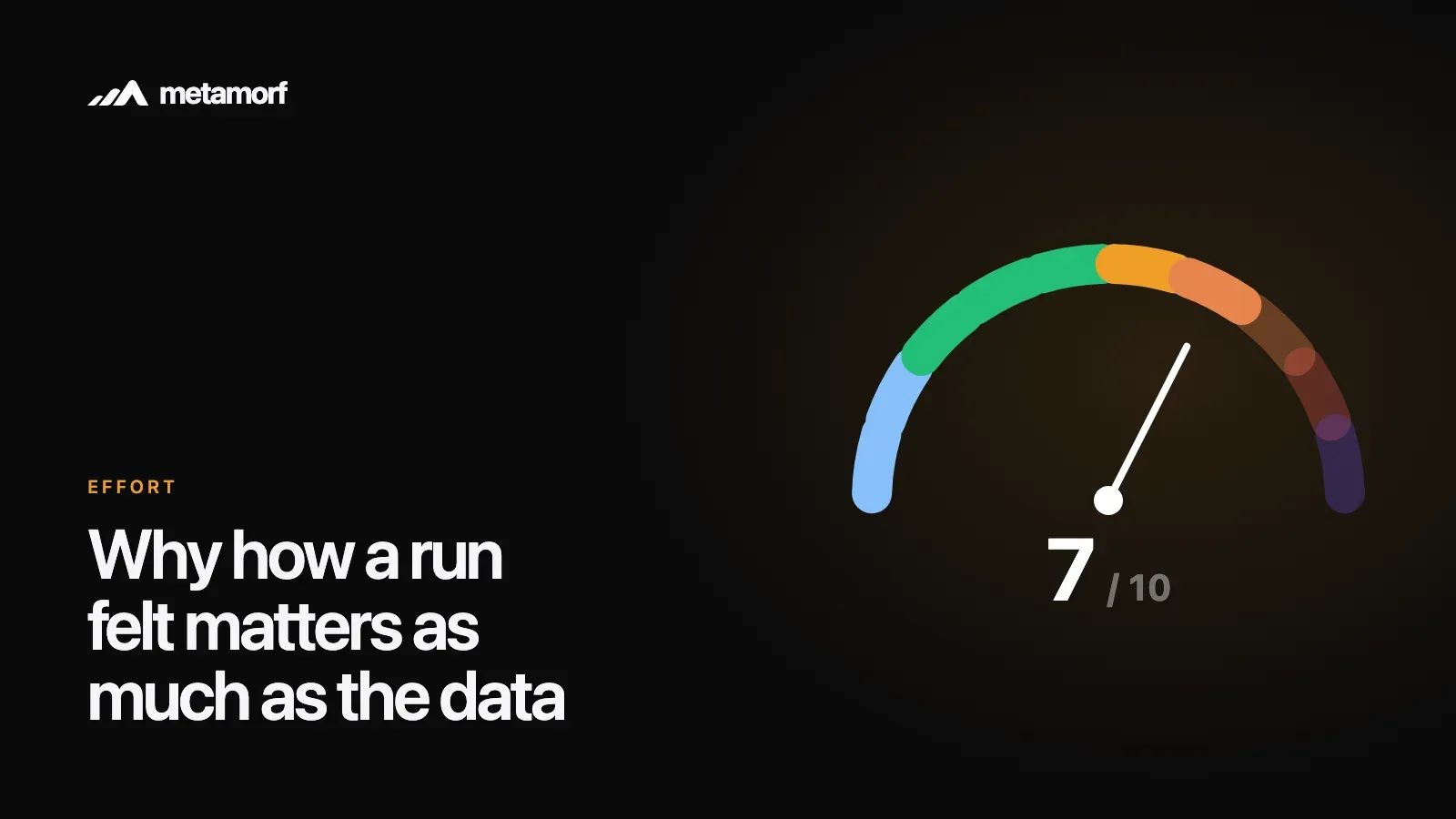
Your watch knows your pace, your heart rate and how long you were out. It doesn’t know you slept five hours, sat through a difficult meeting, or ran into a headwind on the way home. You do. Since watchOS 11, Apple Watch asks you after each workout how hard it was, on a scale from 1 to 10. It’s tempting to skip the question. The research suggests that one tap carries more information than it looks, as long as you know what it can and can’t tell you.
What does “how hard it felt” actually measure?
It measures perceived exertion: your overall sense of how hard your body worked. Sports science has taken it seriously for decades. The Swedish psychologist Gunnar Borg built the scales most researchers still use, and argued in 1982 that effort ratings are an important complement to physiological measures, not a replacement for them [1].
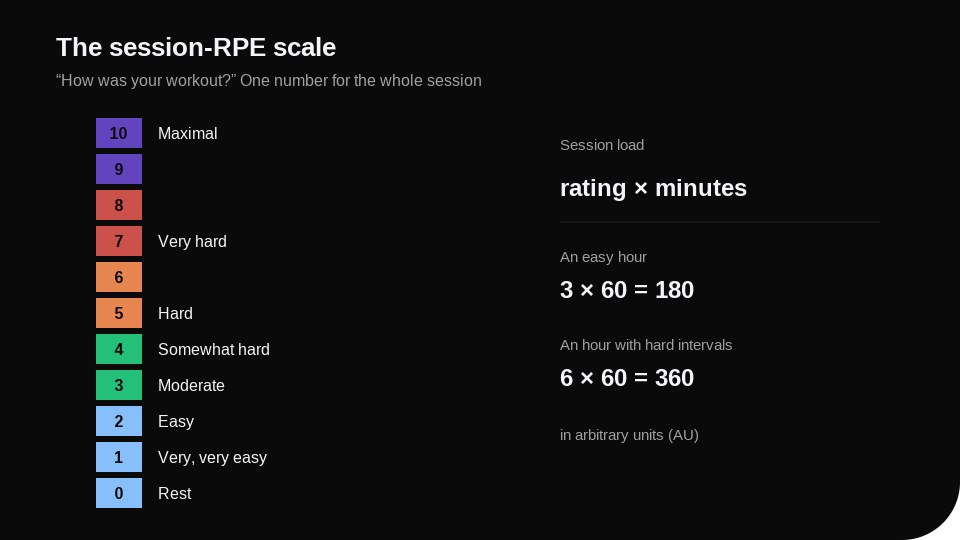
The version used for training is session RPE (rating of perceived exertion), which Carl Foster had used to track athletes’ training in the late 1990s [2] and which he and colleagues described and validated in 2001 [3]. After a session you answer one question, “How was your workout?”, on a 0–10 scale with verbal anchors, from “rest” through “easy”, “moderate” and “hard” to “maximal” [4]. You then multiply the rating by the session’s length in minutes. An 87-minute session rated 4 gives a load of 348 arbitrary units [4]. That number, added up across days and weeks, is a training load built from how training felt rather than from a sensor.
Does a feeling really measure training?
Surprisingly well, though not perfectly. The standard test is to compare session-RPE load with load calculated from heart rate (the TRIMP family of methods, which weight minutes by how high your heart rate was).
In Foster’s 2001 study the two were “highly consistent” in cycling and consistent in basketball, although session RPE gave systematically higher numbers [3]. In 19 young soccer players followed over 479 sessions, each player’s session-RPE load correlated with three heart-rate-based loads at r = 0.50 to 0.85 [5]. In 21 Australian footballers the correlation with two heart-rate methods was 0.83 [6]. Closest to our readers, in 15 adolescent distance runners, session RPE and ratings of leg and breathing effort correlated with heart-rate measures at r = 0.74 to 0.89 when given straight after the session [7]. And in seven trained runners followed for 15 weeks, a performance model built on session RPE predicted their 1,500 m improvement about as well as one built on heart rate (r = 0.60 against 0.65) [8].
A review of 36 validation studies concluded that session RPE is valid and reliable across sports, ages and levels, and could even be used on its own [4]. It also listed the exceptions: in intermittent taekwondo, the correlations with heart-rate load were weak and not significant [4]. And one of the heart-rate methods it’s usually checked against, Edwards’ TRIMP, has never itself been validated against a known physiological response [4].
So the fair summary is: across many studies, how hard training felt moves in the same direction as what heart rate says, most of the time.
Why does the same run sometimes feel much harder?
Because effort is shaped by more than your heart and legs. That is the point of measuring it.
- Mental fatigue. In a 2009 experiment, 16 people did 90 minutes of a demanding computer task or watched documentaries, then cycled to exhaustion. After the mental work they gave up sooner (640 against 754 seconds on average), with higher perceived effort, while heart rate and other physiology were “largely unaffected” [9]. A systematic review of 11 studies reached the same conclusion [10]. But a later meta-analysis that corrected for publication bias found the effect may be much smaller than reported, and no longer significant [11]. It’s a real idea with contested size.
- Short sleep. After 36 hours awake, eight people walking on a treadmill rated the same work harder while their heart rate and oxygen use were unchanged [12]. One sleepless night raised effort ratings in 12 active men cycling [13]. In a running study, though, 30 hours awake did not change ratings at an easy fixed pace; the runners simply covered less ground in a self-paced test at the same perceived effort [14].
- Heat. At the same workload, 14 men rated cycling harder in 40 °C than in 8 °C, with heart rates more than 20 bpm higher in the heat [15]. When people choose their own pace, the heat can show up as lower output rather than higher effort: in a self-paced 20 km cycling trial, 10 men’s power began to fall early in 35 °C heat while their effort ratings matched the cool trial [16].
- Altitude. At an altitude training camp, elite middle-distance runners rated sessions harder when they kept their sea-level pace (by training lower down or taking more recovery), and ran slower in their hardest sessions [17].
Two lessons follow. First, a run that felt harder than its numbers isn’t a failure of willpower; something else in your life may be taking a share of your capacity. Second, the effect often shows up as slower running at the same feeling, rather than the same pace feeling harder. Both are information.
Is how you feel better than what your watch measures?
For tracking how training is affecting you over weeks, self-reports hold up remarkably well. A 2016 systematic review of 56 studies compared athletes’ self-reported well-being (mood, stress and recovery questionnaires) with objective markers such as heart rate, blood tests and hormones [18]. The two generally did not agree, and the self-reports reflected changes in training load “with superior sensitivity and consistency” [18].
One caution matters here, because the review is often quoted loosely: it deliberately excluded effort ratings, and studied how athletes felt day to day, not how hard a session felt [18]. It supports listening to yourself in general; it isn’t direct proof for the post-run number.
How much can you trust a single rating?
Not very much. This is the honest weak spot. When 10 recreational athletes repeated identical lab sessions, their heart rate varied by 3.9% from one repeat to the next, while session-RPE load varied by 28.1% [19]. Heart-rate-based loads weren’t steady either, varying by 10.7–15.6% [19]. In 10 teenage athletes doing short bouts of intermittent running, session RPE varied by 31.9% [6].
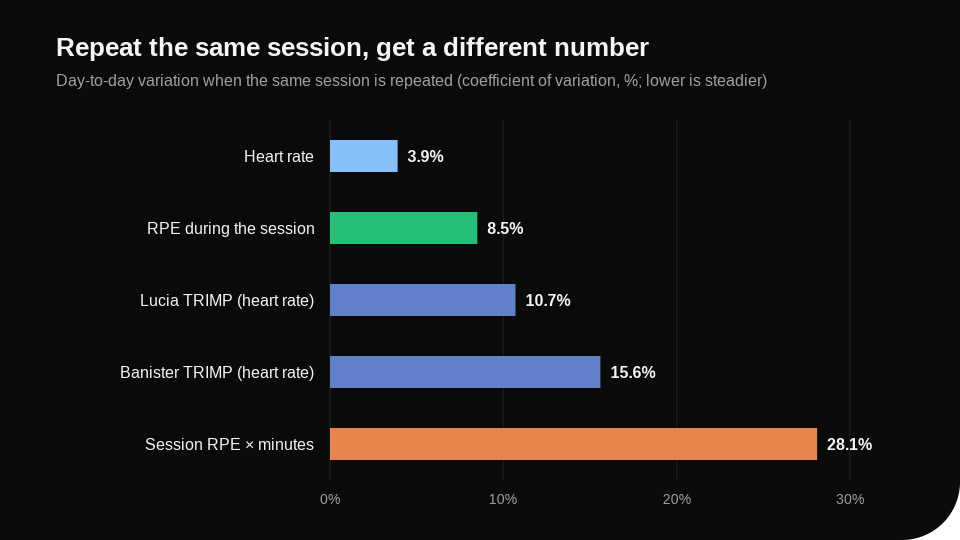
Whatever the cause, one rating proves little. Ratings earn their keep as a pattern: a week where everything felt a point harder than usual, or a run of sessions where feel and heart rate keep disagreeing. Foster’s earlier work used exactly that kind of pattern: in 25 athletes logging session RPE, a high percentage of illnesses came when athletes went past their own individual thresholds, mostly of training “strain”, a measure built from those ratings [2].
When should you rate it?
The research convention is to rate about 30 minutes after the session [20]. The evidence that timing matters is mixed. In 15 well-trained people cycling, ratings didn’t change from 5 minutes to 24 hours after the session [20], and in boxers, ratings at 10 and 30 minutes were the same [21]. But in adolescent distance runners, ratings at 30 minutes were about 26.5% lower than straight afterwards, and the immediate ratings agreed best with heart rate [7].
The practical answer: rate it whenever you reliably will, and do it the same way each time. Consistency matters more than the exact minute.
Is there a simpler anchor than a number?
Yes: the talk test. In a study of 16 people on a treadmill and a bike, the point at which speaking first became difficult sat almost exactly at the ventilatory threshold [22], which three-zone training models treat as the top of easy running (more in the 80/20 rule). A review calls the talk test valid, reliable and inexpensive, though probably not practical for hard intervals [23]. If you’re unsure whether a run was a 3 or a 5, ask whether you could have held a conversation the whole way.
What does Apple’s effort score do?
Apple introduced effort ratings in watchOS 11. You rate a workout “on a scale from 1 to 10” [24]. For popular cardio workouts, Apple Watch also makes its own estimate, using your age, height and weight along with workout data such as GPS, heart rate and elevation [24]; Apple’s user guide also names VO2max [25]. Apple says you can adjust the estimate for things “such as stress or soreness” [24], which is exactly the information only you have.
Those ratings feed Apple’s Training Load, which compares your last seven days with the previous 28, using a weighted average of effort and duration, and labels the result from “well below” to “well above” [24, 26]. That is the same idea as session RPE, applied over weeks.
What we couldn’t find is any published study comparing Apple’s estimated effort with runners’ own ratings, so treat the estimate as a starting point. If you remember one thing from the research above, it’s that the estimate is built from the same signals the watch already has, and your rating is the one input that isn’t.
What to do with this
- Rate every run, quickly and the same way each time. Use the whole scale; an easy run should be a 2 or 3, not a polite 5.
- Rate the whole session, warm-up to cool-down, not the hardest interval.
- Don’t read much into one rating. Look for patterns over a week or two.
- When a run feels clearly harder than its heart rate suggests, look at sleep, stress, heat and illness before you look at your fitness. If it keeps happening, ease off. If you also feel unwell, that’s a question for a doctor, not for your training log.
How Metamorf uses this
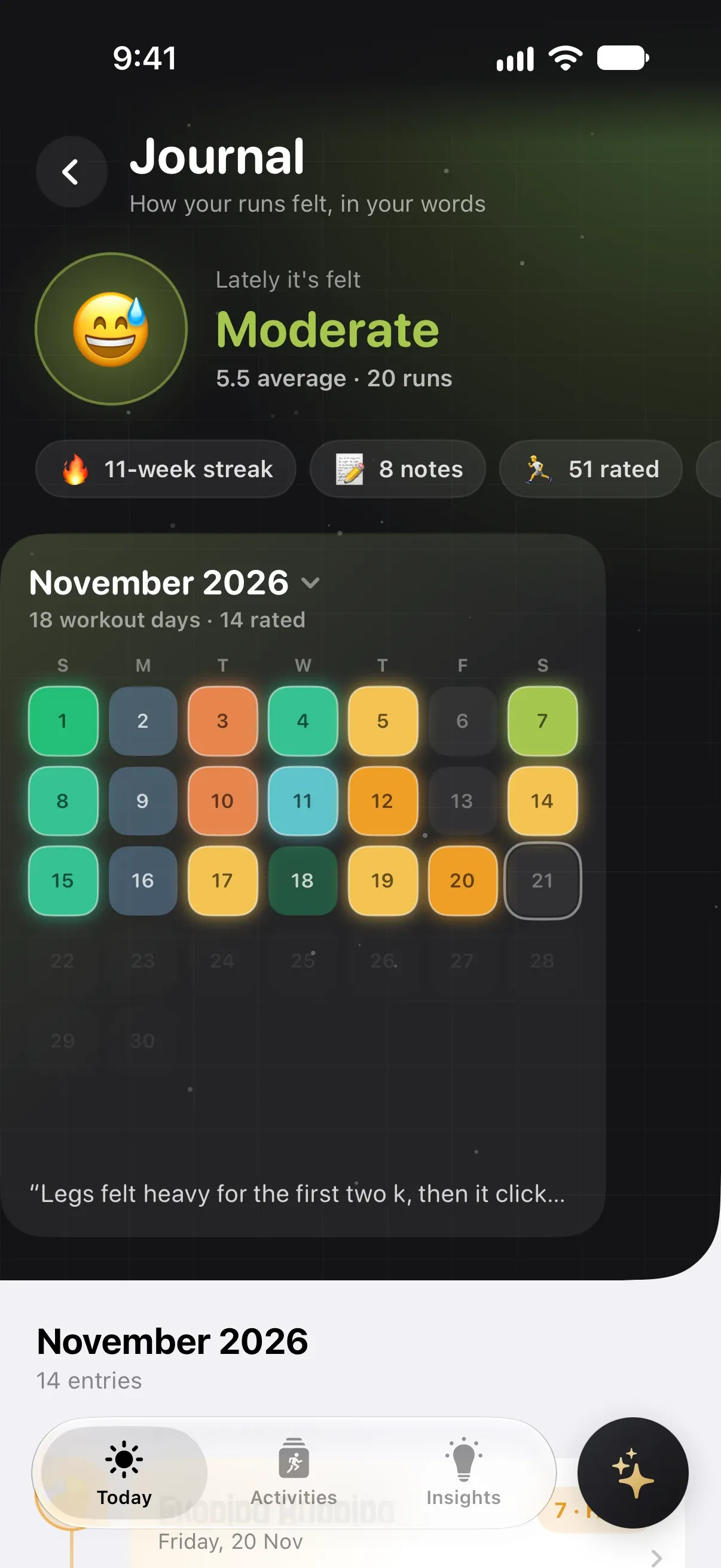
After each run, Metamorf asks how it felt on a 1–10 dial, starting from your Apple Watch rating or Apple’s estimate if there is one, or otherwise from a suggestion based on how much of your heart-rate reserve the run used, how long it was and how much hard running it had (or, without heart rate, on the type of run). On iOS 18 and later, with your permission, your rating is saved to Apple Health as the workout’s effort score. Once you’ve rated at least three workouts that had a suggestion in the past 14 days, the Journal tells you whether runs have been feeling harder or easier than Metamorf’s suggested effort (usually based on heart rate), or about the same.
Sources
- Borg GA. Psychophysical bases of perceived exertion. Medicine and Science in Sports and Exercise. 1982;14(5):377–381. doi:10.1249/00005768-198205000-00012
- Foster C. Monitoring training in athletes with reference to overtraining syndrome. Medicine and Science in Sports and Exercise. 1998;30(7):1164–1168. doi:10.1097/00005768-199807000-00023
- Foster C, Florhaug JA, Franklin J, et al. A new approach to monitoring exercise training. Journal of Strength and Conditioning Research. 2001;15(1):109–115. PubMed 11708692
- Haddad M, Stylianides G, Djaoui L, Dellal A, Chamari K. Session-RPE method for training load monitoring: validity, ecological usefulness, and influencing factors. Frontiers in Neuroscience. 2017;11:612. doi:10.3389/fnins.2017.00612
- Impellizzeri FM, Rampinini E, Coutts AJ, Sassi A, Marcora SM. Use of RPE-based training load in soccer. Medicine and Science in Sports and Exercise. 2004;36(6):1042–1047. doi:10.1249/01.mss.0000128199.23901.2f
- Scott TJ, Black CR, Quinn J, Coutts AJ. Validity and reliability of the session-RPE method for quantifying training in Australian football: a comparison of the CR10 and CR100 scales. Journal of Strength and Conditioning Research. 2013;27(1):270–276. doi:10.1519/JSC.0b013e3182541d2e
- Mann RH, Williams CA, Clift BC, Barker AR. The validation of session rating of perceived exertion for quantifying internal training load in adolescent distance runners. International Journal of Sports Physiology and Performance. 2019;14(3):354–359. doi:10.1123/ijspp.2018-0120
- Wallace LK, Slattery KM, Coutts AJ. A comparison of methods for quantifying training load: relationships between modelled and actual training responses. European Journal of Applied Physiology. 2014;114(1):11–20. doi:10.1007/s00421-013-2745-1
- Marcora SM, Staiano W, Manning V. Mental fatigue impairs physical performance in humans. Journal of Applied Physiology. 2009;106(3):857–864. doi:10.1152/japplphysiol.91324.2008
- Van Cutsem J, Marcora S, De Pauw K, et al. The effects of mental fatigue on physical performance: a systematic review. Sports Medicine. 2017;47(8):1569–1588. doi:10.1007/s40279-016-0672-0
- Holgado D, Sanabria D, Perales JC, Vadillo MA. Mental fatigue might be not so bad for exercise performance after all: a systematic review and bias-sensitive meta-analysis. Journal of Cognition. 2020;3(1):38. doi:10.5334/joc.126
- Martin BJ. Effect of sleep deprivation on tolerance of prolonged exercise. European Journal of Applied Physiology and Occupational Physiology. 1981;47(4):345–354. doi:10.1007/BF02332962
- Temesi J, Arnal PJ, Davranche K, et al. Does central fatigue explain reduced cycling after complete sleep deprivation? Medicine and Science in Sports and Exercise. 2013;45(12):2243–2253. doi:10.1249/MSS.0b013e31829ce379
- Oliver SJ, Costa RJ, Laing SJ, Bilzon JL, Walsh NP. One night of sleep deprivation decreases treadmill endurance performance. European Journal of Applied Physiology. 2009;107(2):155–161. doi:10.1007/s00421-009-1103-9
- Maw GJ, Boutcher SH, Taylor NA. Ratings of perceived exertion and affect in hot and cool environments. European Journal of Applied Physiology and Occupational Physiology. 1993;67(2):174–179. doi:10.1007/BF00376663
- Tucker R, Rauch L, Harley YX, Noakes TD. Impaired exercise performance in the heat is associated with an anticipatory reduction in skeletal muscle recruitment. Pflügers Archiv. 2004;448(4):422–430. doi:10.1007/s00424-004-1267-4
- Sharma AP, Saunders PU, Garvican-Lewis LA, et al. The effect of training at 2100-m altitude on running speed and session rating of perceived exertion at different intensities in elite middle-distance runners. International Journal of Sports Physiology and Performance. 2017;12(Suppl 2):S2147–S2152. doi:10.1123/ijspp.2016-0402
- Saw AE, Main LC, Gastin PB. Monitoring the athlete training response: subjective self-reported measures trump commonly used objective measures: a systematic review. British Journal of Sports Medicine. 2016;50(5):281–291. doi:10.1136/bjsports-2015-094758
- Wallace LK, Slattery KM, Impellizzeri FM, Coutts AJ. Establishing the criterion validity and reliability of common methods for quantifying training load. Journal of Strength and Conditioning Research. 2014;28(8):2330–2337. doi:10.1519/JSC.0000000000000416
- Christen J, Foster C, Porcari JP, Mikat RP. Temporal robustness of the session rating of perceived exertion. International Journal of Sports Physiology and Performance. 2016;11(8):1088–1093. doi:10.1123/ijspp.2015-0438
- Uchida MC, Teixeira LF, Godoi VJ, et al. Does the timing of measurement alter session-RPE in boxers? Journal of Sports Science and Medicine. 2014;13(1):59–65. PubMed 24570606
- Persinger R, Foster C, Gibson M, Fater DC, Porcari JP. Consistency of the talk test for exercise prescription. Medicine and Science in Sports and Exercise. 2004;36(9):1632–1636. PubMed 15354048
- Reed JL, Pipe AL. The talk test: a useful tool for prescribing and monitoring exercise intensity. Current Opinion in Cardiology. 2014;29(5):475–480. doi:10.1097/HCO.0000000000000097
- Apple. watchOS 11 brings powerful health and fitness insights, and even more personalization and connectivity. Apple Newsroom, 10 June 2024. apple.com
- Apple. Start a workout on Apple Watch. Apple Watch User Guide. support.apple.com
- Apple. Track your training load on Apple Watch. Apple Watch User Guide. support.apple.com
Metamorf is for fitness guidance, not medical advice. Talk to a doctor before changing how you train if you have a health condition.