How fast do you lose fitness when you stop running?
A cold that wouldn’t shift, a fortnight on holiday, an Achilles that needed rest. However it happened, you’ve had two weeks without running, and the first run back felt dreadful: heart rate high, legs heavy, your usual easy pace suddenly not easy. It’s natural to wonder whether months of work have gone.
They haven’t. The research on “detraining”, what happens when trained people stop, is old, small and mostly in men, but it is consistent on the big picture: the first losses are modest and largely a matter of blood volume, the deeper ones take weeks, and fitness built over years doesn’t disappear. Here is what goes, in what order, and how much.
What happens first when you stop running?
The first thing to go is blood volume, specifically the plasma, the fluid part of your blood. In 15 male competitive distance runners who stopped for 10 days, estimated plasma volume fell by 5% within the first two days and then stayed there [1]. Reviews describe this rapid loss of blood volume as one of the first features of detraining in highly trained athletes [2].
That matters because blood volume helps fill the heart. With less of it, each beat pumps out less blood (a lower stroke volume), and your maximum oxygen uptake, VO2max, falls with it. In a 1986 study of eight endurance-trained men who stopped for two to four weeks, blood volume fell 9%, plasma volume 12%, stroke volume during exercise 12% and VO2max 6% [3]. The researchers then topped up the men’s blood volume with an infusion, and stroke volume and VO2max came back to within 2–4% of their trained values [3]. In other words, most of the early loss was about blood volume, not about a weaker heart or weaker muscles. A 1989 review of the field reached the same view: the early drop in VO2max runs through stroke volume, and later losses come more from less oxygen being taken out of each litre of blood, though the review says it isn’t clear whether less reaches the muscles or they extract less [4].
The muscles’ aerobic machinery goes next, but more slowly. In seven endurance-trained people followed after they stopped, two mitochondrial enzymes (markers of how much aerobic “engine” the muscle has) fell with a half-time of 12 days, then levelled off about 50% above the levels of people who had never trained [5]. In 12 distance runners, the enzyme citrate synthase was down 25% after 14 days [6]; in six well-trained runners, another such enzyme was down 24% after 15 days [7].
Capillaries, the tiny vessels that deliver blood to muscle fibres, are where the research disagrees. In the 1984 study, capillary supply didn’t decline at all over 84 days and stayed 50% above untrained levels [5]. The best-known reviews of detraining describe capillary density as falling, in the short term and the long term [2, 8]. Small samples and different methods probably explain some of the gap; either way, capillaries are not the first thing you lose.
How much fitness do you lose after one, two, four and eight weeks?
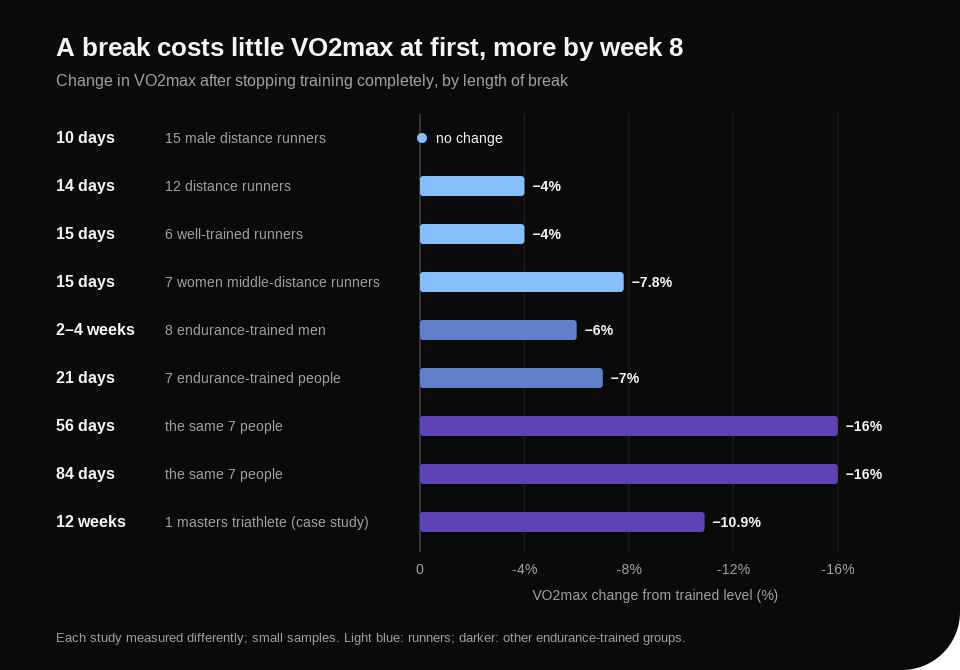
After one week, probably very little that anyone has measured. After two, a few per cent of VO2max. By eight weeks, more like a sixth, and then the losses level off.
- About one week. In a randomised study of 15 women middle-distance runners, those who stopped showed no significant change at day 5 [9].
- 10 days. Here the studies split. The 15 male distance runners had no change in VO2max after 10 days [1]. The seven women who stopped had a significant drop by day 10, which didn’t grow by day 15 and was reported as a 7.8% decrease; by day 15 their 2,400 m time was 21.5 seconds slower [9].
- Two weeks. In 12 distance runners, VO2max fell from 61.6 to 58.7 ml/kg/min after 14 days, reported as about 4% [6]. In six well-trained runners, it fell 4% after 15 days [7]. In 15 endurance-trained young men, two weeks off significantly reduced VO2max, maximal stroke volume and time to exhaustion [11].
- Three to five weeks. The eight men in the blood-volume study lost 6% after two to four weeks [3], and the seven people in the 1984 study lost 7% in 21 days [5]. In 14 top-level kayakers randomly assigned to five weeks of complete rest or reduced training, complete rest cost 10.1% of VO2max [12].
- Eight weeks and beyond. The 1984 group stabilised after 56 days at 16% below their trained VO2max, and was still there at 84 days [5]. A highly trained masters triathlete who stopped for 12 weeks lost 10.9% of his running VO2max [10].
A 2022 meta-analysis of 21 studies of trained athletes agrees on the shape. Stopping for 30 days or less had a moderate effect on VO2max and stopping for longer a large one, but there was no difference between 30–90 days and more than 90 days [13]. The authors also quote the classic reviews by Iñigo Mujika and Sabino Padilla as putting the loss at 4–14% for breaks under four weeks and 6–20% for longer ones in highly trained athletes [13].
There is a floor, and it depends on how long you’ve been training. After 84 days off, the 1984 group still had a higher VO2max than sedentary people who had never trained (50.8 against 43.3 ml/kg/min) [5]. Mujika and Padilla note that athletes’ VO2max stays above untrained values even after long breaks, but that recently gained VO2max is lost completely [8]. Years of running leave a lasting base; the last few months’ gains are the most fragile.
Why does running feel so much harder than the numbers suggest?
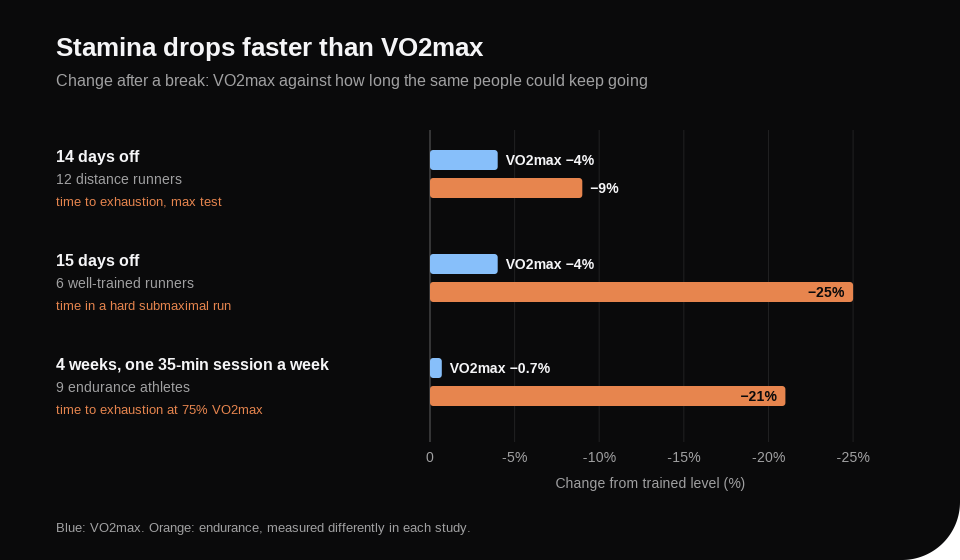
Because stamina at a steady pace drops faster than VO2max, and your heart rate rises at every pace.
After 14 days off, the 12 distance runners’ VO2max was down about 4%, but how long they lasted in the incremental VO2max test fell 9%, and their heart rate at the same running speeds was 11 bpm higher, even though their running economy hadn’t changed [6]. In the six well-trained runners, a 4% drop in VO2max came with a 25% drop in how long they could hold a hard pace [7]. In nine endurance athletes who cut to one 35-minute hard session a week for four weeks, VO2max didn’t change at all, yet time to exhaustion at 75% of VO2max fell 21%, from 79 to 62 minutes [14].
Over longer breaks, heart rate, breathing and blood lactate at the same workload kept rising for about 56 days before levelling off [15]. Maximum heart rate tends to go up a little too: by about 9 bpm in two of the runner studies [1, 6].
This is the practical point. A VO2max number, from a lab or from a watch, can look almost unchanged after two weeks while your long runs feel much harder. The feeling is real; it just isn’t a measure of how much fitness you’ve lost for good.
Is running less better than stopping completely?
Yes, and by a lot, as long as you keep some intensity. A series of studies by Robert Hickson between 1981 and 1985 is still the clearest evidence. Volunteers trained for 10 weeks, cycling and running 40 minutes a day, six days a week, then cut back for 15 weeks:
- Fewer days. Training two or four days a week at the same intensity and duration kept VO2max essentially at trained levels [16].
- Shorter sessions. Cutting sessions to 26 or 13 minutes kept VO2max, though endurance in a test of two hours or more fell 10% in the 13-minute group [17].
- Easier sessions. Cutting intensity by a third or two-thirds did not keep VO2max, and long endurance fell 21% and 30% [18].
These were recently trained volunteers, not seasoned runners, but runner studies point the same way. When 10 well-conditioned runners cut their weekly distance by 70%, from 81 to 24 km, for three weeks, keeping about 7 km a week of intervals and races, their 5 km race times and VO2max didn’t change [19]. The kayakers on reduced training lost 4.8% of their VO2max over five weeks, against 10.1% for those who stopped completely [12]. A 2021 review concluded that intensity “seems to be the key variable” for holding fitness, with endurance performance in general populations kept for up to 15 weeks on as little as two sessions a week [20].
One caution: the 2022 meta-analysis found that exercising during a long break reduced the loss, but its comparison of partial against complete stops was not statistically significant [13]. The direct, randomised comparisons favour reduced training [12]; the pooled data are less clear-cut.
If running itself is off the table, the reviews suggest cross-training can help [8]. In 16 trained male runners, six weeks of deep-water running kept VO2max, threshold and running economy level with treadmill running [21]. In 32 trained young adults, water running, cycling and running all gave the same small dip in VO2max and no change in 2-mile time over six weeks [22]. Neither study was in injured runners, and whether an injury allows any of this is a question for a doctor or physiotherapist.
Does fitness come back faster than it went?
Probably not faster in any dramatic sense, but you start from well above zero. The popular idea that fitness returns twice as fast as it was lost isn’t something we could find in the research.
In the six well-trained runners, 15 days of retraining brought VO2max back up by about as much as it had fallen, but the muscle enzymes hadn’t recovered and performance was still 9% below where it started [7]. The masters triathlete regained his VO2max over 12 weeks of structured retraining after 12 weeks off, but not all of his running economy [10]. And in a study where 23 young, healthy volunteers (not athletes) trained one leg for three months, nine months later there was no coherent evidence of an endurance “memory” in the muscle’s gene activity [23].
What the evidence does support is the floor. Long-trained people kept muscle enzymes and capillaries well above untrained levels even after 84 days off [5], and their VO2max stayed above untrained values [5, 8]. Coming back from two weeks, you are rebuilding a few per cent, not starting again.
What to do with this
- After a short break, don’t panic and don’t chase it. Two weeks off costs a few per cent of VO2max at most, so there’s nothing to win back in a hurry.
- Run your first runs by effort, not pace. Expect your heart rate to be higher at your usual pace for a while [6]. In the six runners who retrained, their heart rates in hard running came back down within 15 days [7].
- Rebuild your long run gradually. In a study of 5,205 runners, single runs more than 10% longer than their longest of the previous 30 days were linked with higher injury rates (observational data) [24]. After a break, your body isn’t where your training log says. More on load spikes in training load explained.
- If you can’t run normally, keep some intensity. Two sessions a week at your usual intensity, or cross-training at a similar effort, held VO2max in the studies above, and in the one direct comparison reduced training lost about half as much as stopping completely [12].
- If you’re off because you’re ill or injured, when and how to start again is a question for a doctor or physiotherapist, not a training plan.
How Metamorf uses this
Metamorf’s Fitness tab estimates VO2max from your runs with heart rate: a month gets a value once it has at least 2 qualifying runs, and “Now” is the median of your runs in the last 42 days, which needs at least 3; with fewer, it falls back to the most recent month that has a value, however old, and still calls it “Now”. So during a break and for a while after it, “Now” reflects your runs from before the break, and it won’t show any detraining until new runs replace the old ones. On Training Impact, your acute load (a 7-day weighted average) and chronic load (a 28-day weighted average) both decay towards zero while you rest, so after a long break your first workouts will usually show “Above your range”: a sign you’re doing more than your body is currently used to, not an injury forecast.
Sources
- Cullinane EM, Sady SP, Vadeboncoeur L, Burke M, Thompson PD. Cardiac size and VO2max do not decrease after short-term exercise cessation. Medicine & Science in Sports & Exercise. 1986;18(4):420–424. PubMed 3747802
- Mujika I, Padilla S. Detraining: loss of training-induced physiological and performance adaptations. Part I: short term insufficient training stimulus. Sports Medicine. 2000;30(2):79–87. doi:10.2165/00007256-200030020-00002
- Coyle EF, Hemmert MK, Coggan AR. Effects of detraining on cardiovascular responses to exercise: role of blood volume. Journal of Applied Physiology. 1986;60(1):95–99. doi:10.1152/jappl.1986.60.1.95
- Neufer PD. The effect of detraining and reduced training on the physiological adaptations to aerobic exercise training. Sports Medicine. 1989;8(5):302–320. doi:10.2165/00007256-198908050-00004
- Coyle EF, Martin WH 3rd, Sinacore DR, Joyner MJ, Hagberg JM, Holloszy JO. Time course of loss of adaptations after stopping prolonged intense endurance training. Journal of Applied Physiology. 1984;57(6):1857–1864. doi:10.1152/jappl.1984.57.6.1857
- Houmard JA, Hortobágyi T, Johns RA, et al. Effect of short-term training cessation on performance measures in distance runners. International Journal of Sports Medicine. 1992;13(8):572–576. doi:10.1055/s-2007-1024567
- Houston ME, Bentzen H, Larsen H. Interrelationships between skeletal muscle adaptations and performance as studied by detraining and retraining. Acta Physiologica Scandinavica. 1979;105(2):163–170. doi:10.1111/j.1748-1716.1979.tb06328.x
- Mujika I, Padilla S. Detraining: loss of training-induced physiological and performance adaptations. Part II: long term insufficient training stimulus. Sports Medicine. 2000;30(3):145–154. doi:10.2165/00007256-200030030-00001
- Doherty RA, Neary JP, Bhambhani YN, Wenger HA. Fifteen-day cessation of training on selected physiological and performance variables in women runners. Journal of Strength and Conditioning Research. 2003;17(3):599–607. doi:10.1519/1533-4287(2003)017<0599:fcotos>2.0.co;2
- Lepers R, Mater A, Assadi H, Zanou N, Gremeaux V, Place N. Effect of 12 weeks of detraining and retraining on the cardiorespiratory fitness in a competitive master athlete: a case study. Frontiers in Physiology. 2024;15:1508642. doi:10.3389/fphys.2024.1508642
- Chen YT, Hsieh YY, Ho JY, Lin TY, Lin JC. Two weeks of detraining reduces cardiopulmonary function and muscular fitness in endurance athletes. European Journal of Sport Science. 2022;22(3):399–406. doi:10.1080/17461391.2021.1880647
- García-Pallarés J, Carrasco L, Díaz A, Sánchez-Medina L. Post-season detraining effects on physiological and performance parameters in top-level kayakers: comparison of two recovery strategies. Journal of Sports Science and Medicine. 2009;8(4):622–628. PubMed 24149605
- Zheng J, Pan T, Jiang Y, Shen Y. Effects of short- and long-term detraining on maximal oxygen uptake in athletes: a systematic review and meta-analysis. BioMed Research International. 2022;2022:2130993. doi:10.1155/2022/2130993
- Madsen K, Pedersen PK, Djurhuus MS, Klitgaard NA. Effects of detraining on endurance capacity and metabolic changes during prolonged exhaustive exercise. Journal of Applied Physiology. 1993;75(4):1444–1451. doi:10.1152/jappl.1993.75.4.1444
- Coyle EF, Martin WH 3rd, Bloomfield SA, Lowry OH, Holloszy JO. Effects of detraining on responses to submaximal exercise. Journal of Applied Physiology. 1985;59(3):853–859. doi:10.1152/jappl.1985.59.3.853
- Hickson RC, Rosenkoetter MA. Reduced training frequencies and maintenance of increased aerobic power. Medicine & Science in Sports & Exercise. 1981;13(1):13–16. PubMed 7219129
- Hickson RC, Kanakis C Jr, Davis JR, Moore AM, Rich S. Reduced training duration effects on aerobic power, endurance, and cardiac growth. Journal of Applied Physiology. 1982;53(1):225–229. doi:10.1152/jappl.1982.53.1.225
- Hickson RC, Foster C, Pollock ML, Galassi TM, Rich S. Reduced training intensities and loss of aerobic power, endurance, and cardiac growth. Journal of Applied Physiology. 1985;58(2):492–499. doi:10.1152/jappl.1985.58.2.492
- Houmard JA, Costill DL, Mitchell JB, et al. Reduced training maintains performance in distance runners. International Journal of Sports Medicine. 1990;11(1):46–52. doi:10.1055/s-2007-1024761
- Spiering BA, Mujika I, Sharp MA, Foulis SA. Maintaining physical performance: the minimal dose of exercise needed to preserve endurance and strength over time. Journal of Strength and Conditioning Research. 2021;35(5):1449–1458. doi:10.1519/JSC.0000000000003964
- Wilber RL, Moffatt RJ, Scott BE, Lee DT, Cucuzzo NA. Influence of water run training on the maintenance of aerobic performance. Medicine & Science in Sports & Exercise. 1996;28(8):1056–1062. doi:10.1097/00005768-199608000-00017
- Eyestone ED, Fellingham G, George J, Fisher AG. Effect of water running and cycling on maximum oxygen consumption and 2-mile run performance. American Journal of Sports Medicine. 1993;21(1):41–44. doi:10.1177/036354659302100107
- Lindholm ME, Giacomello S, Werne Solnestam B, et al. The impact of endurance training on human skeletal muscle memory, global isoform expression and novel transcripts. PLoS Genetics. 2016;12(9):e1006294. doi:10.1371/journal.pgen.1006294
- Schuster Brandt Frandsen J, Hulme A, Parner ET, et al. How much running is too much? Identifying high-risk running sessions in a 5200-person cohort study. British Journal of Sports Medicine. 2025;59(17):1203–1210. doi:10.1136/bjsports-2024-109380
Metamorf is for fitness guidance, not medical advice. Talk to a doctor before changing how you train if you have a health condition.