The best running books, and what the science says about each method

Most lists of the best running books rank them by sales, reviews or how much the writer enjoyed them. That is a fair way to pick a story. It is a poor way to pick a training method, because you will live with the method for months.
This guide takes ten of the most widely read books that teach a way to train, states each method in a line, and checks it against the research. One point runs through all of them: almost none of these programmes has been tested as a complete package. That is not the same as being wrong. A coaching system can be sound without a trial behind it. But it helps to know which parts rest on evidence and which rest on a coach’s experience.
The table below is Metamorf’s reading of the evidence, summarised from the studies cited in each section.
| Book (author, year) | The method in a line | What the evidence says |
|---|---|---|
| Build Your Running Body (Magill, Schwartz & Breyer, 2014) | Train muscles, connective tissue, nervous system and aerobic engine, not just mileage | Strength and power work: supported. Injury prevention: unproven for runners |
| 80/20 Running (Fitzgerald, 2014) | About 80% of training time easy, 20% moderate to hard | Mostly easy: supported. The exact split: no better than other easy-heavy mixes |
| The Big Book of Endurance Training and Racing (Maffetone, 2010) | Keep aerobic training under a heart rate of 180 minus age, adjusted | Formula never validated; thresholds vary widely |
| Daniels’ Running Formula (Daniels, 4th ed., 2022) | Paces for each type of workout from a race-based VDOT score | Threshold pace matched lab values for recreational runners in one small study; marathon pace may be optimistic |
| Advanced Marathoning (Pfitzinger & Douglas, 4th ed., 2026) | 12- or 18-week plans chosen by weekly mileage | Plans untested; more volume is linked with faster marathons |
| Hansons Marathon Method (Humphrey with K. and K. Hanson, revised ed., 2016) | Cumulative fatigue and a shorter long run | Plan untested; observational data favour longer long runs but can’t show cause |
| Run Less, Run Faster (Pierce & Murr, 3rd ed., 2021) | Three quality runs and two cross-training sessions a week | No peer-reviewed study of the programme found |
| The Run Walk Run Method (Galloway, 3rd ed., 2024) | Planned walk breaks from the start | One randomised trial, with a different ratio: similar marathon times, less muscle pain |
| Endure (Hutchinson, 2018) | The brain shapes how hard you can push | Effort perception: supported. The “central governor”: disputed |
| Born to Run (McDougall, 2009) | A story, not a training programme | Barefoot or minimalist switch: injury evidence weak to unfavourable |
Build Your Running Body: is training the whole body worth the time?
Mostly yes: the kinds of training it promotes, especially strength and power work, have more trial support than most single-method books, though its own protocols are untested. Its weak spot is the promise in its cover line, “Run Farther, Faster, and Injury-Free” [1]: injury prevention is the part least supported for runners.
Build Your Running Body, by Pete Magill, Thomas Schwartz and Melissa Breyer (The Experiment, 2014; the publisher also lists Armando Siqueiros, MD), sets itself up as an alternative to mileage-centred training [1]. Its argument is that every stride depends on muscles, connective tissue, the cardiovascular system, energy production, the nervous system, hormones and the brain, and that each can be trained. It has more than 150 workouts, including weightlifting, resistance exercises, plyometrics and cross-training, plus 10 training programmes, injury-prevention and rehab exercises, and perspectives on barefoot running and on the pros and cons of stretching [1].
In articles adapted from the book and in Magill’s own column, the protocols are specific. Hill sprints of 6–10 seconds at about 95% effort, four to eight repetitions, with a walk down and one to five minutes’ recovery, aimed at recruiting fast-twitch fibres and training the nervous system [2]. Two or three moderate resistance sessions a week, run first and lift second, with about 48 hours before the next hard run [3]. And patience with connective tissue, which the authors say adapts more slowly than muscle [4].
How does that hold up?
- Strength training. A 2024 meta-analysis of 38 studies and 894 middle- and long-distance runners found that heavy strength training improved performance by a moderate amount compared with running only, and combining methods (such as heavy lifting plus jumps) by a large amount [5]. Certainty of the evidence was rated very low to moderate.
- Plyometrics. Here the meta-analyses disagree. The same 2024 analysis found jump training on its own had a small effect that wasn’t statistically significant (p = 0.064) [5]. A 2021 meta-analysis of 21 studies and 511 endurance runners found a moderate benefit on 2–5 km time trials [6]. In an older trial, 10 well-trained athletes who replaced 32% of their training with explosive strength work for nine weeks improved their 5K time and running economy; eight controls did not [7].
- Hills. In 20 well-trained runners, six weeks of uphill intervals improved 5 km time by 2.0% on average [8]. No trial has tested the book’s exact protocol on its own.
- Connective tissue. Tendons do adapt to heavy loading: a meta-analysis of 27 studies in 264 healthy adults found tendons became stiffer, with load size mattering more than the type of exercise and somewhat (not significantly) larger effects in programmes of 12 weeks or more [9]. A review on young athletes describes muscle and tendon adapting on different timelines [10].
- Injury prevention. Across sport in general, a meta-analysis of 25 trials and 26,610 participants found strength training cut injury risk to about a third of that in controls (relative risk 0.315), while stretching had no protective effect [11]. But in endurance runners specifically, a 2024 meta-analysis of nine randomised trials and 1,904 runners found that exercise-based prevention programmes did not significantly reduce injury risk; seven of the nine trials were rated low quality on risk of bias, and a post hoc analysis suggested supervised programmes might help [12].
The exact recipes (rep counts, 48-hour windows, connective-tissue timelines) are reasonable coaching judgement, but untested. And stretching hasn’t been shown to prevent injury [11]. For the wider evidence, see strength training for runners.
80/20 Running and MAF: how easy should easy be?
Both books tell you to slow down, and the evidence that most of your running should be easy is good. The details each adds are less certain.
80/20 Running by Matt Fitzgerald (Berkley, 2014) asks for about 80% of training at low intensity and 20% at moderate to high intensity [13]. On his coaching site, Fitzgerald defines low intensity as below the ventilatory threshold and says to stay below it about 80 percent of the time [14]. In a five-month trial, 12 sub-elite runners who trained about 80% easy improved a 10.4 km cross-country race more than those doing about 67% easy (157 against 121.5 seconds faster) [15]. In 30 recreational runners over 10 weeks, a polarized plan improved 10K time by 5.0% against 3.6%, but the difference was not significant for the whole group [16]. The meta-analyses then temper the exact number: a 2024 analysis of 17 studies found polarized training no better than other mixes for time trials [17], and a 2025 analysis of individual data from 13 studies found no difference between polarized and pyramidal training, in which threshold work outweighs the hardest work [18]. The 80/20 post covers this in detail.
Philip Maffetone’s method, set out in The Big Book of Endurance Training and Racing (Skyhorse, 2010) [19], caps aerobic training with a heart rate from the “180-Formula”: subtract your age from 180, then adjust by −10, −5, 0 or +5 depending on illness, injury, consistency and years of progress [20]. The result is the top of a 10-beat range; a 40-year-old in the −5 group trains at 125–135 bpm. Runners track progress with a monthly test of pace at that heart rate [20].
The formula has never been validated. Maffetone and Laursen’s own 2020 paper says the links between the MAF heart rate and lab measures, health and performance must still be verified scientifically [20]. The problem is individual variation: in a study of 100 people, the lactate threshold fell anywhere between 60% and 90% of maximum heart rate [21]. A formula built from age alone is bound to fit some runners far better than others. As a conservative ceiling for beginners or runners who always drift too fast, it is a reasonable if blunt tool. As a measure of your aerobic threshold, it is a guess; see zone 2 running and max heart rate for better ways to find yours.
Daniels’ Running Formula: are VDOT paces right for you?
Partly. The threshold paces held up for recreational runners in the one validation study found; the VO2max estimate and the marathon predictions are less reliable.
Jack Daniels, a coach for more than 55 years and an Olympic medallist in modern pentathlon [22], built his system around VDOT: a single number from a recent race that works as an “effective” VO2max [23]. VDOT sets the pace for seven types of training: easy, long, marathon, threshold, interval, hard and repetition [24]. The current edition is the fourth (Human Kinetics, ©2022) [22].
In 2018, Scudamore and colleagues compared VDOT outputs from a 5 km time trial with lab tests in 11 NCAA Division I athletes and 9 recreational runners [25]. VDOT threshold pace did not differ from lactate-threshold pace in the recreational runners but was too fast for the collegiate athletes, and VDOT underestimated measured VO2max in both groups [25]. A modelling paper the same year found VDOT’s predictions internally consistent, but noted that it assumes everyone has the same running economy and endurance, and that its built-in endurance is “rather superior” [23]. In the paper’s tables, assuming weaker long-distance endurance makes marathon pace about 15 seconds per km slower than VDOT predicts even at an elite VDOT of 80, and about 40 seconds per km slower at VDOT 40 [23].
So Daniels’ structure (know why each session exists, and run it at the right pace) is sound, and the threshold paces are a good start. If you are a recreational marathoner, treat the predicted marathon pace as a ceiling, not a target. Metamorf’s race-time predictions use the same Daniels and Gilbert equations, so the same caution applies to them; Apple Watch VO2max accuracy covers the estimate that feeds them.
Pfitzinger, Hansons or Run Less Run Faster: how much running does a marathon need?
No trial has compared these plans, or tested any of them on its own. What exists is observational data, and it leans towards more running, not less.
Advanced Marathoning by Pete Pfitzinger and Scott Douglas is now in its fourth edition (Human Kinetics, ©2026) [26]. It offers 18- and 12-week day-by-day schedules in four bands: under 55 miles (89 km) a week, 55–70, 70–85, and over 85 miles (137 km) [26]. The schedules combine endurance running with lactate-threshold, VO2max and marathon-pace sessions [27], and the new edition adds heart-rate guidance; it also includes flexibility, core and strength exercises and aerobic cross-training [26].
Hansons Marathon Method by Luke Humphrey with Keith and Kevin Hanson (VeloPress, revised edition 2016) [28] is built on “cumulative fatigue”: no single run is so hard that you need full recovery, so you start the long run a little tired from the days before [29]. The plan’s reference long run is 16 miles. Humphrey notes that coaching books typically put the long run at 25–30% of weekly mileage, which a 20-miler exceeds for most runners on 50–60 miles a week, and that beyond about three hours returns diminish while recovery takes days [29].
Run Less, Run Faster, from Furman University’s FIRST programme, is by Bill Pierce and Scott Murr; the publisher page also credits Ray Moss (Rodale, revised third edition 2021) [30, 31]. It asks for three quality runs a week (intervals, a tempo run and a long run, each at set paces) plus two cross-training sessions [30, 32].
The evidence on all three:
- Volume. A 2020 meta-regression of 85 studies (137 groups of runners) found that a longer longest run, more runs of 32 km or more, more weekly distance and more weekly runs were each associated with faster marathons [33]. In 126 recreational male marathoners, weekly distance, training pace and body fat together predicted marathon time closely (r = 0.81) [34]. Both are observational: fitter runners do more of everything, so this doesn’t prove a 20-miler beats a 16-miler inside a well-built week. It does mean nothing supports a 16-mile cap either, and it runs against “run less”.
- Threshold work. A review of highly trained and elite distance runners found they include threshold sessions at least weekly, and marathoners lean towards a pyramidal mix, with more threshold than very hard work [35]. That supports the Pfitzinger and Hansons emphasis, not their exact doses.
- FIRST’s own evidence. No peer-reviewed study of the programme was found. Furman’s FIRST page describes a 2004 marathon study as cited in Runner’s World, with no data or journal reference [32].
- Cross-training. It can hold fitness for a while: 16 trained male runners kept their VO2max and running economy over six weeks of deep-water running [36], and 12 experienced runners had similar results after four weeks on an elliptical bike [37]. But in 11 male runners, ten days of extra training done on a bike left running economy worse than extra running did [38]. Cross-training is a useful substitute, not an equal one.
- Intensity. In FIRST’s plan every run is a quality session at set paces, so far less of the running is easy than in the mostly-easy pattern successful runners use [15, 35]. Nobody has tested whether that matters for performance or injury.
Galloway’s run-walk: does walking cost you time?
Not much, in the one trial of run-walk racing, though it used far fewer walk breaks than Galloway usually recommends. Jeff Galloway’s The Run Walk Run Method (Meyer & Meyer Sport, third edition 2024) [39] puts short walk breaks in from the start, rather than walking only when exhausted. The ratio depends on pace from a one-mile time trial, and most runners now use walk breaks of about 30 seconds; examples include 90 seconds’ running to 30 seconds’ walking [40].
In a 2016 German trial, 42 non-elite runners (22 men, 20 women) were randomised to run a marathon either with a run-walk strategy or running only [41]. Their finish times were similar, and the run-walk group reported less muscle pain and fatigue afterwards. Markers of cardiac stress rose in both groups, and were back to baseline four days later; run-walk did not reduce them [41].
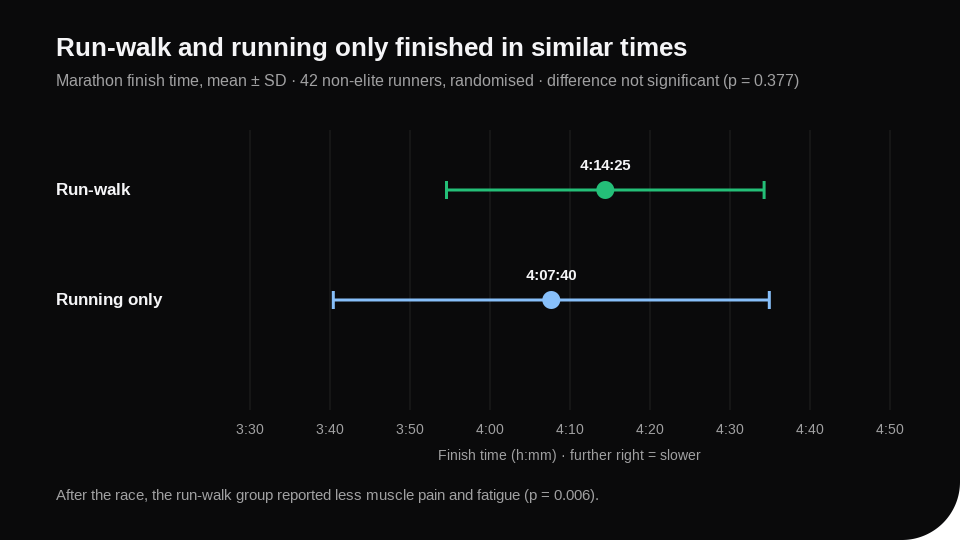
The limits matter. It is one race, in runners of around four hours. The abstract doesn’t give the ratio, but according to press coverage the run-walk group walked for one minute every 1.5 miles (about 2.4 km), much less walking than Galloway’s typical ratios [41, 42]. No other peer-reviewed run-walk race or training trial was found. For a first marathon, or a runner at four hours or more who wants to finish comfortably, it is a reasonable choice with a small evidence base.
Endure: is the limit in your head?
Partly, and the research on that part is solid. Alex Hutchinson’s Endure (William Morrow, 2018) [43] is not a training book. It argues that limits which seem purely physical are shaped by the brain, while being clear there is no quick mental trick to move them, and it presents scientists who disagree about how much the brain decides [44].
The well-supported half is that perceived effort limits endurance. In a crossover study, 16 people cycled to exhaustion at a set power after 90 minutes of a demanding mental task, and lasted 640 seconds on average instead of 754, with higher perceived effort but largely unchanged cardiorespiratory and metabolic responses [45]. A 2017 systematic review of 11 studies [46] and a 2023 meta-analysis of 23 studies (average effect g = −0.32, with high risk of bias) [47] confirm that mental fatigue reduces endurance performance. In 24 participants, two weeks of motivational self-talk training extended cycling time to exhaustion and lowered perceived effort [48]. The two single studies were lab cycling tests.
The contested half is the “central governor”: Tim Noakes’s idea that the brain regulates exercise to protect the body, and that fatigue is a brain-made emotion [49]. Shephard argued in 2009 that convincing experimental evidence for a governor was lacking [50]. Endure is the best way in to that argument. Its practical lesson: pay attention to how a run felt, not just its numbers.
Born to Run: should you go barefoot?
Christopher McDougall’s Born to Run (Knopf, 2009) [51] is a story about the Tarahumara runners of Mexico and a race, not a training programme, so there’s no method to test. If it leaves you wanting to try barefoot or minimalist running, here is what the research found.
Habitually barefoot runners often land on the forefoot or midfoot, and barefoot forefoot strikers generate smaller collision forces than shod heel strikers [52]. But that study measured forces, not injuries. A 2021 review of 13 studies found low evidence for any link between foot strike and injury [53]. In a 12-week randomised trial of 99 recreational runners, those in partial minimalist shoes had more injuries than those in neutral shoes, and those in fully minimalist shoes reported more shin and calf pain [54]. A small recent meta-analysis (seven studies, 313 runners) linked switching to minimalist footwear with more injuries and recommended a supervised transition of at least 12 weeks [55].
What to do with this
Pick the book that fits your situation, then borrow the best-supported ideas from the others.
- If you mostly run too hard, start with 80/20 Running. MAF’s heart-rate cap is a blunter route to the same end.
- If you want one manual that covers more than running, Build Your Running Body gives you the strength and power work the evidence favours. Don’t expect it to keep you injury-free.
- If you race regularly and want precise sessions, Daniels’ Running Formula. Treat its marathon pace as optimistic.
- If the marathon is your goal, choose by how much you can run: Pfitzinger if you can handle structured mileage bands, Hansons if you prefer spreading the load across the week to one very long run [29], Run Less Run Faster only if time or injury limits you to three runs and you’ll genuinely do the cross-training.
- If you’re new, returning or aiming to finish, Galloway’s run-walk costs little time in the one trial.
- Whatever you choose, keep most running easy, lift two or three times a week [3], and judge a plan by how you respond over months, not by its promises.
How Metamorf uses this
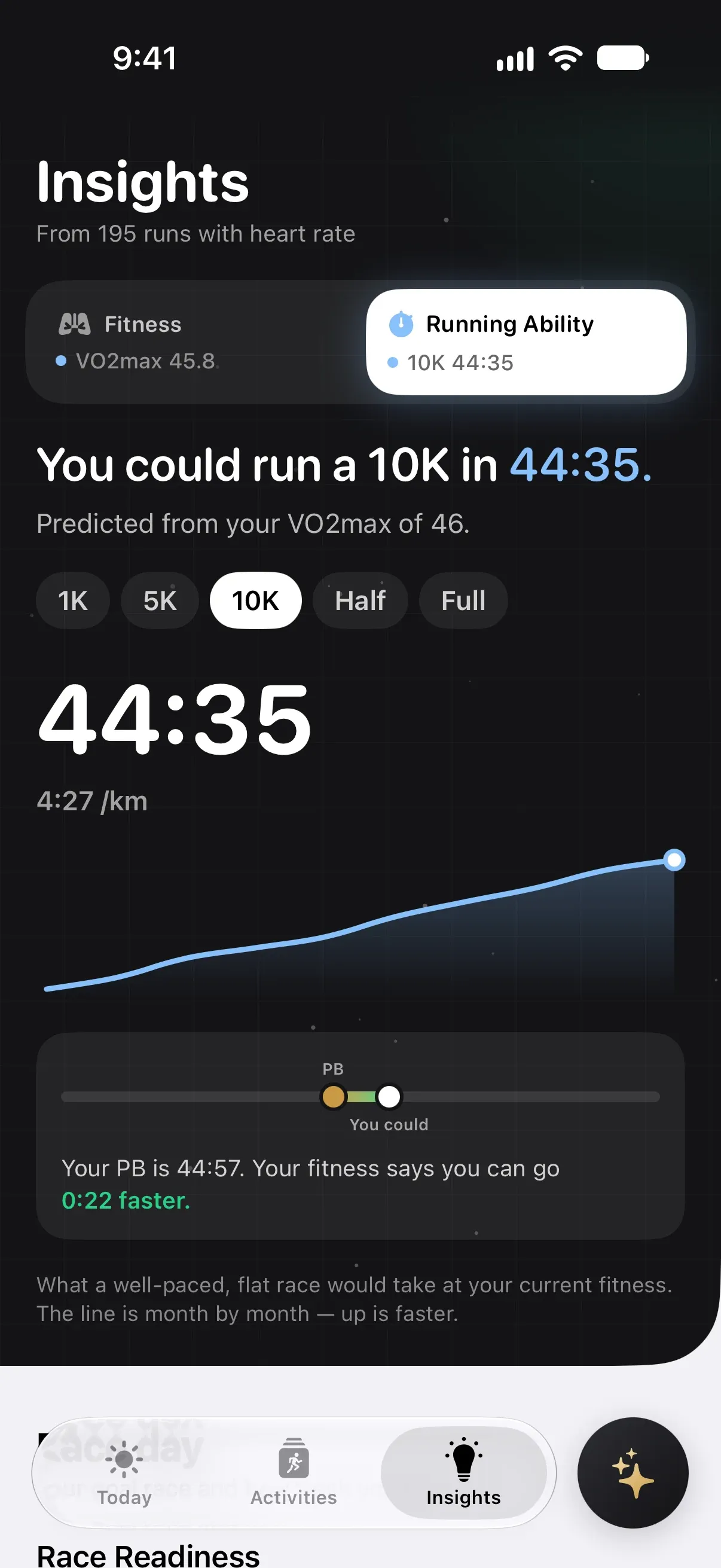
Metamorf’s Intensity Balance counts the heart-rate time recorded in your workouts (only those with a heart-rate series) over the last eight calendar weeks, with time below 82% of your maximum heart rate counted as easy, below 87% as moderate and 87% or more as hard, and shows your easy share of the last four weeks against an 80% target. Running Ability predicts 1K, 5K, 10K, half marathon and marathon times by solving the Daniels and Gilbert equations for a VO2max Metamorf estimates from your runs with heart rate. Every workout with heart rate counts towards your training load, whatever its type, so the strength and cross-training sessions these books recommend are included, not just your runs.
Sources
- The Experiment. Build Your Running Body by Pete Magill, Thomas Schwartz and Melissa Breyer. 2014. Publisher page. theexperimentpublishing.com
- Outside. Shave a minute off your 5K (on Build Your Running Body). 14 August 2014. outsideonline.com
- Magill P. When should I schedule resistance training in my running routine? Outside. 22 June 2020. outsideonline.com
- Runner’s World Australia. A runner’s guide to connective tissue (excerpted and adapted from Build Your Running Body). 23 February 2018. runnersworldonline.com.au
- Llanos-Lagos C, Ramirez-Campillo R, Moran J, Sáez de Villarreal E. The effect of strength training methods on middle-distance and long-distance runners’ athletic performance: a systematic review with meta-analysis. Sports Medicine. 2024;54(7):1801–1833. doi:10.1007/s40279-024-02018-z
- Ramirez-Campillo R, Andrade DC, García-Pinillos F, Negra Y, Boullosa D, Moran J. Effects of jump training on physical fitness and athletic performance in endurance runners: a meta-analysis. Journal of Sports Sciences. 2021;39(18):2030–2050. doi:10.1080/02640414.2021.1916261
- Paavolainen L, Häkkinen K, Hämäläinen I, Nummela A, Rusko H. Explosive-strength training improves 5-km running time by improving running economy and muscle power. Journal of Applied Physiology. 1999;86(5):1527–1533. doi:10.1152/jappl.1999.86.5.1527
- Barnes KR, Hopkins WG, McGuigan MR, Kilding AE. Effects of different uphill interval-training programs on running economy and performance. International Journal of Sports Physiology and Performance. 2013;8(6):639–647. doi:10.1123/ijspp.8.6.639
- Bohm S, Mersmann F, Arampatzis A. Human tendon adaptation in response to mechanical loading: a systematic review and meta-analysis of exercise intervention studies on healthy adults. Sports Medicine – Open. 2015;1:7. doi:10.1186/s40798-015-0009-9
- Mersmann F, Bohm S, Arampatzis A. Imbalances in the development of muscle and tendon as risk factor for tendinopathies in youth athletes: a review of current evidence and concepts of prevention. Frontiers in Physiology. 2017;8:987. doi:10.3389/fphys.2017.00987
- Lauersen JB, Bertelsen DM, Andersen LB. The effectiveness of exercise interventions to prevent sports injuries: a systematic review and meta-analysis of randomised controlled trials. British Journal of Sports Medicine. 2014;48(11):871–877. doi:10.1136/bjsports-2013-092538
- Wu H, Brooke-Wavell K, Fong DTP, Paquette MR, Blagrove RC. Do exercise-based prevention programs reduce injury in endurance runners? A systematic review and meta-analysis. Sports Medicine. 2024;54(5):1249–1267. doi:10.1007/s40279-024-01993-7
- Penguin Random House. 80/20 Running: Run Stronger and Race Faster by Training Slower by Matt Fitzgerald. Berkley, 2014. Publisher page. penguinrandomhouse.com
- Fitzgerald M. If I only had room in my suitcase, I would pack the ventilatory threshold: here’s why. 80/20 Endurance. 22 October 2018. Author’s coaching site. 8020endurance.com
- Esteve-Lanao J, Foster C, Seiler S, Lucia A. Impact of training intensity distribution on performance in endurance athletes. Journal of Strength and Conditioning Research. 2007;21(3):943–949. doi:10.1519/R-19725.1
- Muñoz I, Seiler S, Bautista J, España J, Larumbe E, Esteve-Lanao J. Does polarized training improve performance in recreational runners? International Journal of Sports Physiology and Performance. 2014;9(2):265–272. doi:10.1123/ijspp.2012-0350
- Silva Oliveira P, Boppre G, Fonseca H. Comparison of polarized versus other types of endurance training intensity distribution on athletes’ endurance performance: a systematic review with meta-analysis. Sports Medicine. 2024;54(8):2071–2095. doi:10.1007/s40279-024-02034-z
- Rosenblat MA, Watt JA, Arnold JI, et al. Which training intensity distribution intervention will produce the greatest improvements in maximal oxygen uptake and time-trial performance in endurance athletes? A systematic review and network meta-analysis of individual participant data. Sports Medicine. 2025;55(3):655–673. doi:10.1007/s40279-024-02149-3
- Skyhorse Publishing. The Big Book of Endurance Training and Racing by Philip Maffetone. 2010. Publisher page. skyhorsepublishing.com
- Maffetone P, Laursen PB. Maximum aerobic function: clinical relevance, physiological underpinnings, and practical application. Frontiers in Physiology. 2020;11:296. doi:10.3389/fphys.2020.00296
- Iannetta D, Inglis EC, Mattu AT, et al. A critical evaluation of current methods for exercise prescription in women and men. Medicine and Science in Sports and Exercise. 2020;52(2):466–473. doi:10.1249/MSS.0000000000002147
- Human Kinetics. Daniels’ Running Formula, 4th edition, by Jack Daniels. ©2022. Publisher page. humankinetics.com
- Mulligan M, Adam G, Emig T. A minimal power model for human running performance. PLoS ONE. 2018;13(11):e0206645. doi:10.1371/journal.pone.0206645
- Human Kinetics. Sample running program from Daniels’ Running Formula (4th edition). Book excerpt. humankinetics.com
- Scudamore EM, Barry VW, Coons JM. An evaluation of time-trial-based predictions of VO2max and recommended training paces for collegiate and recreational runners. Journal of Strength and Conditioning Research. 2018;32(4):1137–1143. doi:10.1519/JSC.0000000000001942
- Human Kinetics. Advanced Marathoning, 4th edition, by Pete Pfitzinger and Scott Douglas. ©2026. Publisher page. humankinetics.com
- Human Kinetics. How to avoid overtraining for marathons (Advanced Marathoning, 4th edition). Book excerpt. humankinetics.com
- Open Library. Hansons Marathon Method by Luke Humphrey with Keith and Kevin Hanson. VeloPress, revised edition 2016 (ISBN 9781937716769). Catalogue record. openlibrary.org
- Humphrey L. Hanson’s Marathon Method: the 16 miler. 6 July 2011. Author’s site. lukehumphreyrunning.com
- Penguin Random House. Runner’s World Run Less, Run Faster by Bill Pierce and Scott Murr (full credits add Ray Moss and the Editors of Runner’s World). Rodale, revised third edition, 2021. Publisher page. penguinrandomhouse.com
- Open Library. Run Less, Run Faster by Bill Pierce, Scott Murr and Ray Moss. 2007; revised third edition 2021. Catalogue record. openlibrary.org
- Furman University. FIRST: services and training programs. University page. furman.edu
- Doherty C, Keogh A, Davenport J, Lawlor A, Smyth B, Caulfield B. An evaluation of the training determinants of marathon performance: a meta-analysis with meta-regression. Journal of Science and Medicine in Sport. 2020;23(2):182–188. doi:10.1016/j.jsams.2019.09.013
- Tanda G, Knechtle B. Marathon performance in relation to body fat percentage and training indices in recreational male runners. Open Access Journal of Sports Medicine. 2013;4:141–149. doi:10.2147/OAJSM.S44945
- Casado A, González-Mohíno F, González-Ravé JM, Foster C. Training periodization, methods, intensity distribution, and volume in highly trained and elite distance runners: a systematic review. International Journal of Sports Physiology and Performance. 2022;17(6):820–833. doi:10.1123/ijspp.2021-0435
- Wilber RL, Moffatt RJ, Scott BE, Lee DT, Cucuzzo NA. Influence of water run training on the maintenance of aerobic performance. Medicine and Science in Sports and Exercise. 1996;28(8):1056–1062. doi:10.1097/00005768-199608000-00017
- Klein IE, White JB, Rana SR. Comparison of physiological variables between the elliptical bicycle and run training in experienced runners. Journal of Strength and Conditioning Research. 2016;30(11):2998–3006. doi:10.1519/JSC.0000000000001398
- Pizza FX, Flynn MG, Starling RD, et al. Run training vs cross training: influence of increased training on running economy, foot impact shock and run performance. International Journal of Sports Medicine. 1995;16(3):180–184. doi:10.1055/s-2007-972988
- Open Library. The Run Walk Run Method, third edition, by Jeff Galloway. Meyer & Meyer Sport, 2024. Catalogue record. openlibrary.org
- Twiggs C. All about that pace. Guest post, Galloway Training Programs. jeffgalloway.com
- Hottenrott K, Ludyga S, Schulze S, Gronwald T, Jäger FS. Does a run/walk strategy decrease cardiac stress during a marathon in non-elite runners? Journal of Science and Medicine in Sport. 2016;19(1):64–68. doi:10.1016/j.jsams.2014.11.010
- Rettner R. A bit of walking takes strain out of running a marathon. Live Science. 14 January 2015. livescience.com
- Open Library. Endure: Mind, Body, and the Curiously Elastic Limits of Human Performance by Alex Hutchinson. William Morrow, 2018. Catalogue record. openlibrary.org
- Barss P. Does the brain get in the way of superhuman feats? McGill News. March 2018. mcgillnews.mcgill.ca
- Marcora SM, Staiano W, Manning V. Mental fatigue impairs physical performance in humans. Journal of Applied Physiology. 2009;106(3):857–864. doi:10.1152/japplphysiol.91324.2008
- Van Cutsem J, Marcora S, De Pauw K, Bailey S, Meeusen R, Roelands B. The effects of mental fatigue on physical performance: a systematic review. Sports Medicine. 2017;47(8):1569–1588. doi:10.1007/s40279-016-0672-0
- Habay J, Uylenbroeck R, Van Droogenbroeck R, et al. Interindividual variability in mental fatigue-related impairments in endurance performance: a systematic review and multiple meta-regression. Sports Medicine – Open. 2023;9:14. doi:10.1186/s40798-023-00559-7
- Blanchfield AW, Hardy J, De Morree HM, Staiano W, Marcora SM. Talking yourself out of exhaustion: the effects of self-talk on endurance performance. Medicine and Science in Sports and Exercise. 2014;46(5):998–1007. doi:10.1249/MSS.0000000000000184
- Noakes TD. Fatigue is a brain-derived emotion that regulates the exercise behavior to ensure the protection of whole body homeostasis. Frontiers in Physiology. 2012;3:82. doi:10.3389/fphys.2012.00082
- Shephard RJ. Is it time to retire the “central governor”? Sports Medicine. 2009;39(9):709–721. doi:10.2165/11315130-000000000-00000
- Open Library. Born to Run: A Hidden Tribe, Superathletes, and the Greatest Race the World Has Never Seen by Christopher McDougall. Knopf, 2009. Catalogue record. openlibrary.org
- Lieberman DE, Venkadesan M, Werbel WA, et al. Foot strike patterns and collision forces in habitually barefoot versus shod runners. Nature. 2010;463:531–535. doi:10.1038/nature08723
- Burke A, Dillon S, O’Connor S, Whyte EF, Gore S, Moran KA. Risk factors for injuries in runners: a systematic review of foot strike technique and its classification at impact. Orthopaedic Journal of Sports Medicine. 2021;9(9):23259671211020283. doi:10.1177/23259671211020283
- Ryan M, Elashi M, Newsham-West R, Taunton J. Examining injury risk and pain perception in runners using minimalist footwear. British Journal of Sports Medicine. 2014;48(16):1257–1262. doi:10.1136/bjsports-2012-092061
- Sánchez-del Río E, Galán-Arriero I, Palomo-Fernández I, Marcos-Tejedor F, Martín-Casado L. Injury risk associated with the transition to minimalist footwear in runners: a systematic review and meta-analysis. Gait & Posture. 2027;131:110614. doi:10.1016/j.gaitpost.2026.110614
Metamorf is for fitness guidance, not medical advice. Talk to a doctor before changing how you train if you have a health condition.