How accurate is Apple Watch VO2max, and what does it say about your race times?
Apple Watch gives you a VO2max number, Apple calls it Cardio Fitness, and the internet turns it into race times in seconds. It is one of the most useful numbers your watch produces and one of the most over-read. To use it well you need to know two things: how close it is to what a lab would measure, and how much a VO2max, even a perfect one, can tell you about a race.
What is VO2max, and how is it measured?
VO2max is the highest rate at which your body can take up and use oxygen, in millilitres per kilogram of body weight per minute (ml/kg/min). In a lab it’s measured with a graded exercise test: you run or cycle at increasing intensity to exhaustion while a mask analyses your breathing [1, 2].
Even the lab number isn’t perfectly fixed. In a classic study, five trained people each repeated the treadmill test 8 to 20 times over two to four weeks; their results varied by about ±5.6%, and 90% or more of that was genuine day-to-day biological variation, not equipment error [3]. A 2021 meta-analysis notes that 2–3% is the most commonly used figure for test variability [4]. At a VO2max of 50, that is roughly 1–3 ml/kg/min of noise before any watch is involved.
How does Apple Watch estimate VO2max?
It doesn’t measure it; it predicts it from how your heart rate responds to a known amount of work. During an Outdoor Walk, Outdoor Run or Hiking workout, the watch combines your heart rate with your speed from GPS and motion sensors, along with your age, sex, weight, height and any heart-rate-limiting medications you’ve entered [1, 2]. Apple’s technical paper adds that the workout needs to be on fairly flat ground (a grade under 5%), with a good GPS and heart-rate signal and enough effort to raise your heart rate by about 30% of the way from resting to maximum [1].
A few practical details from Apple:
- Indoor and gym workouts don’t count [2].
- You need to wear the watch for at least 24 hours, then complete several qualifying workouts, before the first estimate appears [2].
- The supported range is 14–65 ml/kg/min [2]. (Apple’s 2021 technical paper gave 14–60 [1].)
The underlying logic is well established for groups of people. Your percentage of heart-rate reserve (the range between resting and maximum heart rate) closely tracks your percentage of oxygen-uptake reserve; in 63 adults on a bike, the two were almost one-to-one [5]. So if the watch knows how fast you’re going, roughly what that costs in oxygen, and what share of your heart-rate reserve it took, it can extrapolate to your maximum. The weak points are the assumptions: your true maximum and resting heart rate, and your individual running economy.
How accurate is it?
On average, not far off. For an individual, often several points out, and for fit runners, usually low.
Apple’s own validation found a mean error of +1.4 ± 4.7 ml/kg/min in 221 people [1]. But the comparison wasn’t a measured maximum: Apple’s reference value was itself projected from submaximal heart rate and oxygen uptake to an age-predicted maximum heart rate [1]. The group was also older and less fit than most runners (average age 55, average VO2max 29.7) [1].
Independent studies in younger, fitter people paint a different picture:
- In a 2025 study of 28 adults, mostly in the “excellent” or “superior” fitness categories, using mostly recent Apple Watch models and a maximal treadmill test, the watch read 6.07 ml/kg/min low on average (43.3 against 49.4). The mean absolute percentage error was 13.3%, and for 95% of people the error fell somewhere between 18.3 low and 6.1 high [6].
- In a 2024 study of 19 adults with an Apple Watch Series 7 and a cycling test, the watch read 4.51 low on average, with a mean absolute percentage error of 15.8% [7].
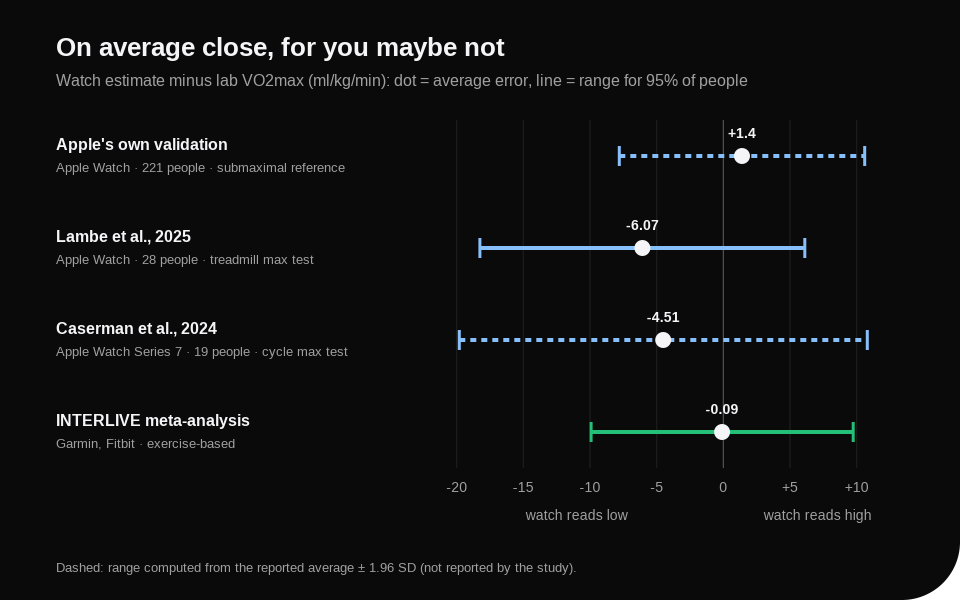
A 2022 meta-analysis of other brands’ watches (Garmin, Polar and Fitbit; Apple wasn’t included) found the same split between average and individual accuracy. Estimates made during exercise, which came from Garmin and Fitbit devices, were almost unbiased on average (−0.09 ml/kg/min), but individual errors spanned roughly ±10 [8]. The authors concluded that exercise-based estimates are the best approach for groups, but not precise enough for sport or clinical decisions about one person [8].
Why does it tend to read low for fit runners?
The pattern so far suggests the error depends on fitness, although the evidence is thin. In the Series 7 study, the watch overestimated VO2max in the three least fit participants (+3.8), underestimated it modestly in the 11 in the middle (−3.4), and badly underestimated it in the five fittest (−12.0) [7]. A study of a Garmin watch in 35 endurance athletes found the same shape: small errors in moderately trained athletes, and an underestimate of 6.3 ml/kg/min in those with a VO2max above 59.8 [9]. The Apple subgroups are very small, so treat this as a likely pattern rather than a settled one.
There is also a hard ceiling: Apple supports values up to 65 [2], so anyone fitter than that can’t be shown correctly.
Day-to-day conditions matter too. Apple lists extreme heat, dehydration, caffeine and a recent move to high altitude as factors that can push estimates down, because they raise your heart rate at a given pace; carrying a heavy load or running on sand can push them down as well [1]. Heart-rate-limiting medications you haven’t entered in the Health app, or conditions that limit how high your heart rate can go, can push them up [1, 2]. Apple notes that accuracy improves with frequent outdoor workouts, higher effort and all-day wear [1].
What does your VO2max say about your race times?
Less than the calculators suggest. VO2max is one of three things that set endurance performance, along with your lactate threshold (how much of that maximum you can sustain) and your running economy (how much oxygen a given pace costs you) [10]. Among runners of similar fitness, VO2max can stop predicting anything: in 12 elite men with an average VO2max of 71.7, it had no relationship with 10 km time (r = −0.12), while running economy explained 65.4% of the differences in their times [11].
Still, VO2max sets the ceiling, and the coach Jack Daniels and the physiologist Jimmy Gilbert turned it into race-time tables in 1979 [12]. Their “VDOT” is an effective VO2max worked out from race performances, not a lab value [12]. Here is what their equations predict:
| VDOT | 5K | 10K | Half marathon | Marathon |
|---|---|---|---|---|
| 40 | 24:06 | 50:01 | 1:50:54 | 3:49:37 |
| 45 | 21:49 | 45:13 | 1:40:14 | 3:28:16 |
| 50 | 19:56 | 41:20 | 1:31:31 | 3:10:40 |
| 55 | 18:22 | 38:06 | 1:24:16 | 2:55:55 |
Times computed from the Daniels–Gilbert equations. Where Mulligan and colleagues reproduce Daniels’ published paces (VDOT 40, 60 and 80), the equations match them to within about 3 seconds per km [12].
Two caveats apply. First, these tables assume what one analysis called “rather superior” long-distance endurance; with more conservative assumptions, marathon pace can be up to about 15 seconds per km slower, even for elite runners [12]. Second, simple race-time formulas tend to be optimistic at the marathon. In a survey of 2,303 recreational runners, Riegel’s widely used formula predicted 10K and half-marathon times well, but predicted marathon times 10 minutes or more too fast for about half of them [13]. Adding weekly mileage to the prediction improved it [13].
Now stack the two uncertainties. In the 2025 study the watch read about 6 ml/kg/min low; in the table, even a 5-point gap, VDOT 45 against 50, is about 18 minutes over a marathon. That’s only an illustration, because a watch VO2max and a VDOT aren’t the same quantity [12], but it shows why a predicted race time from a watch number deserves wide error bars.
What to do with this
- Read your VO2max as a trend. A steady rise over months says your aerobic fitness is improving, whether or not the absolute number matches a lab.
- Give the watch good data: regular outdoor runs and walks, on flattish ground, with some properly brisk efforts, and the watch worn all day. Keep your age, weight and medications up to date in the Health app.
- Expect a fit runner’s number to be on the low side, and a low number after a hot or high-altitude week to bounce back.
- Use predicted race times as a starting point. Your recent race results are better evidence than any formula, and for the marathon, your long runs and weekly mileage matter as much as your VO2max.
- If you want a precise number, a lab test is still the reference.
How Metamorf uses this
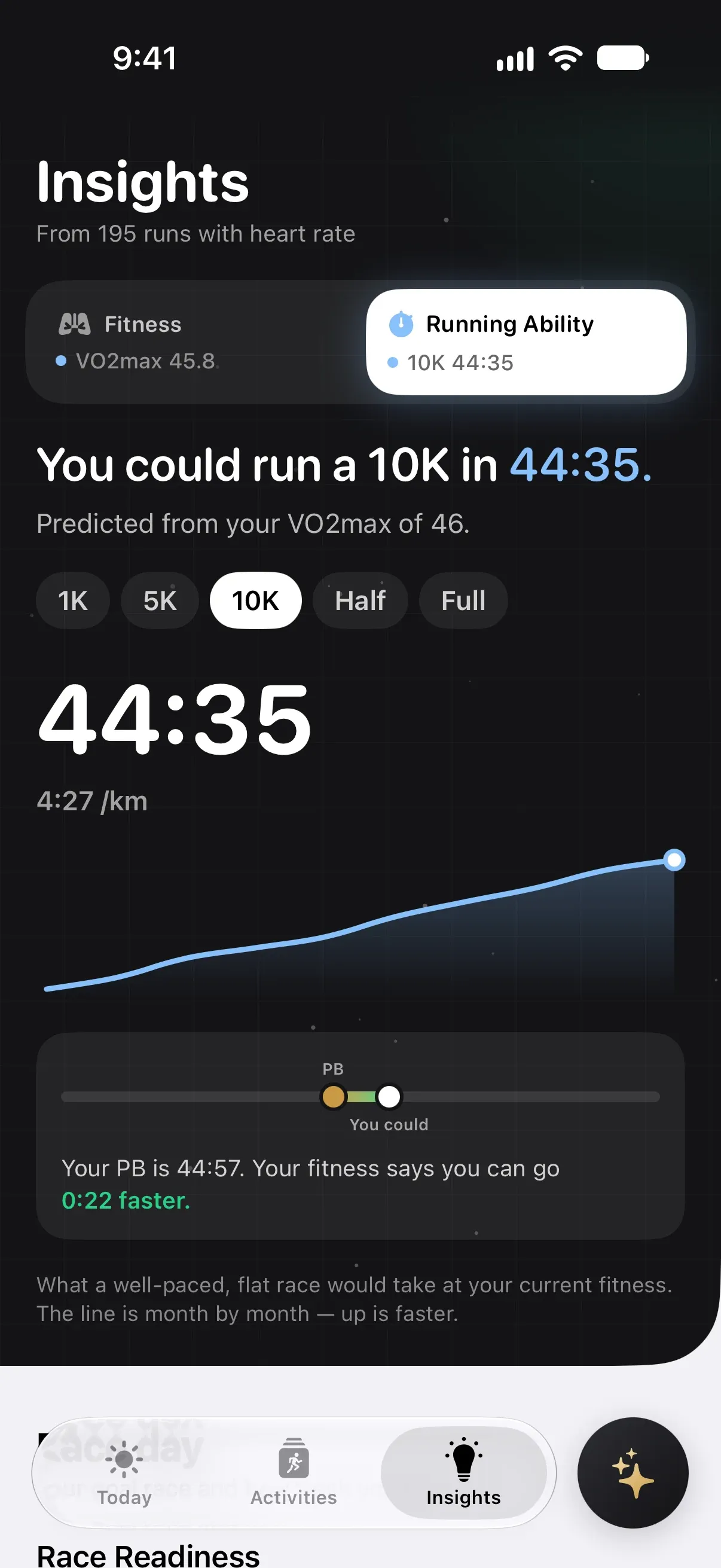
Metamorf makes its own VO2max estimate from your runs rather than relying on Apple’s. For each run of at least 15 minutes and 2 km that used between 50% and 92% of your heart-rate reserve, it turns your hill-adjusted pace into an oxygen cost with the Daniels–Gilbert running-economy equation and scales it by the share of heart-rate reserve you used; “Now” is the median of those estimates over the last six weeks (or your latest month with enough runs, if you’ve done fewer than three qualifying runs recently), and Apple’s own value appears alongside as a tile and a dashed line; Metamorf falls back to Apple’s value only when none of your runs qualify. Running Ability then predicts what a well-paced, flat 1K, 5K, 10K, half marathon and marathon would take at that VO2max, and compares each prediction with your best effort at that distance.
Sources
- Apple. Using Apple Watch to estimate cardio fitness with VO2 max. White paper, May 2021. apple.com
- Apple. Track your cardio fitness levels. Apple Support. support.apple.com
- Katch VL, Sady SS, Freedson P. Biological variability in maximum aerobic power. Medicine and Science in Sports and Exercise. 1982;14(1):21–25. doi:10.1249/00005768-198201000-00004
- Costa VAB, Midgley AW, Carroll S, et al. Is a verification phase useful for confirming maximal oxygen uptake in apparently healthy adults? A systematic review and meta-analysis. PLoS ONE. 2021;16(2):e0247057. doi:10.1371/journal.pone.0247057
- Swain DP, Leutholtz BC. Heart rate reserve is equivalent to %VO2 reserve, not to %VO2max. Medicine and Science in Sports and Exercise. 1997;29(3):410–414. doi:10.1097/00005768-199703000-00018
- Lambe R, O’Grady B, Baldwin M, Doherty C. Investigating the accuracy of Apple Watch VO2 max measurements: a validation study. PLoS ONE. 2025;20(5):e0323741. doi:10.1371/journal.pone.0323741
- Caserman P, Yum S, Göbel S, Reif A, Matura S. Assessing the accuracy of smartwatch-based estimation of maximum oxygen uptake using the Apple Watch Series 7: validation study. JMIR Biomedical Engineering. 2024;9:e59459. doi:10.2196/59459
- Molina-Garcia P, Notbohm HL, Schumann M, et al. Validity of estimating the maximal oxygen consumption by consumer wearables: a systematic review with meta-analysis and expert statement of the INTERLIVE network. Sports Medicine. 2022;52(7):1577–1597. doi:10.1007/s40279-021-01639-y
- Engel FA, Masur L, Sperlich B, Düking P. Validity of V̇O2max estimates from the Forerunner 245 smartwatch in highly vs. moderately trained endurance athletes. European Journal of Applied Physiology. 2026;126(1):591–603. doi:10.1007/s00421-025-05923-x
- Joyner MJ, Coyle EF. Endurance exercise performance: the physiology of champions. Journal of Physiology. 2008;586(1):35–44. doi:10.1113/jphysiol.2007.143834
- Conley DL, Krahenbuhl GS. Running economy and distance running performance of highly trained athletes. Medicine and Science in Sports and Exercise. 1980;12(5):357–360. doi:10.1249/00005768-198012050-00010
- Mulligan M, Adam G, Emig T. A minimal power model for human running performance. PLoS ONE. 2018;13(11):e0206645. doi:10.1371/journal.pone.0206645
- Vickers AJ, Vertosick EA. An empirical study of race times in recreational endurance runners. BMC Sports Science, Medicine and Rehabilitation. 2016;8:26. doi:10.1186/s13102-016-0052-y
Metamorf is for fitness guidance, not medical advice. Talk to a doctor before changing how you train if you have a health condition.