How accurate is Apple Watch heart rate on a run?
Almost everything a training app tells you about a run starts from heart rate: your zones, your training load, your easy-day discipline, even your VO2max estimate. So it’s fair to ask how good the number on your wrist actually is. Anyone who has watched it sit far too high during an easy jog, or lag behind on the first rep of a session, has wondered whether they should be wearing a chest strap instead.
The research gives a clear answer for the average and a more careful one for the moment-to-moment reading. Here is what it shows.
How does Apple Watch measure heart rate?
It measures it with light. The optical sensor on the back of the watch uses photoplethysmography (PPG): green LEDs shine into the skin and light-sensitive photodiodes measure how much comes back. Blood absorbs green light, and each heartbeat briefly increases the blood in your wrist, so the reflected light rises and falls with your pulse. Apple says the LEDs flash hundreds of times per second, the sensor covers 30–210 bpm, and it raises LED brightness and sampling rate when the signal is weak [1]. On the newest models, Apple says it measures as often as every five seconds, even when you’re moving [1].
A chest strap works differently. It uses electrodes to pick up the heart’s electrical signal, the same signal an ECG records, which is why validation studies use a chest strap or a clinical ECG as the reference [2, 3].
The optical method has a built-in handicap: the pulsing arterial blood it looks for is only a minority of the blood in the tissue at your wrist [4]. Anything that weakens that pulse or adds noise on top of it makes the watch’s job harder.
Why does optical heart rate struggle on a run?
Mainly because of movement, and sometimes because of you. The main culprits:
- Motion. Movement shifts the sensor over the skin and changes blood flow beneath it, which adds noise to the signal [4, 5]. Apple says rhythmic movement such as running gives better results than irregular movement such as tennis or boxing [6].
- Cadence lock. Researchers call it “signal crossover”: during repetitive movement such as walking and jogging, an optical sensor can lock on to the rhythm of the movement and mistake it for the heartbeat [5] (in that study, the Apple Watch 4 was the exception). Apple’s own 2026 accuracy study chose running partly to test “cadence lock associated with running” [2].
- Fit. Apple’s advice is a snug but comfortable fit, tighter for workouts, worn above the wrist bone towards the elbow. If the back of the watch loses contact with your skin when you shake your wrist, the band is too loose [6, 7].
- Cold. Apple says that when you exercise in the cold, skin perfusion (blood flow through the skin) at the wrist “might be too low” for a reading [6]. The evidence is mixed: a 2026 study that tested 10 devices on 45 adults found no significant effect of a 10 °C room on accuracy, though the tasks were walking, the phases lasted only 4–6 minutes, and the authors suggested 10 °C may not be cold enough to matter [8].
- Tattoos. The ink, pattern and saturation of some tattoos can block the sensor’s light, according to Apple [6]. We found no study that measures how much.
- Skin tone. Here the research disagrees. In a 60-person study, darker skin tone was associated with higher error across the wrist devices tested [9], and a small 2024 study found the Series 9 more variable in darker skin [10]. But a 53-person study spanning all skin tones found no significant difference [5], and a 2026 study that measured pigmentation with a colorimeter found it didn’t predict the Series 8’s error, although a disproportionate share of its missing readings came from participants with dark skin [11]. A 2023 systematic review of 10 studies called the evidence inconclusive: four found lower accuracy in darker skin, four found no effect and two were mixed [12].
How close is it on a steady run?
Close, on average. The best summary is a 2026 living systematic review by Rory Lambe and colleagues at University College Dublin, which searched for every Apple Watch validation study published up to September 2025 [4]. Across 22 studies and 1,247 people, the watch’s heart rate differed from the reference by −0.27 bpm on average. During exercise it read 0.63 bpm low on average, and 95% of differences fell between −6.86 and +5.60 bpm [4]. At rest the range was slightly wider, −8.14 to +8.56 [4].
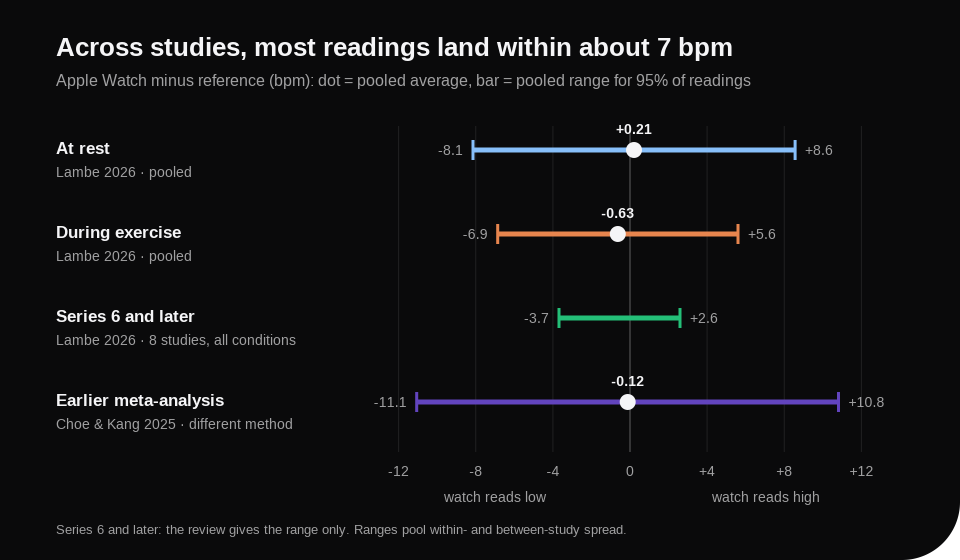
Newer watches appear to do better. When the reviewers split studies by sensor generation, the third generation (Series 6 onwards, including Ultra) had limits of agreement of −3.68 to +2.59 bpm, from eight studies [4]. Not everyone’s numbers are this tight: an earlier meta-analysis found a similar average but a wider range, about ±11 bpm [13]. The 2026 reviewers point out that it pooled several results from the same study and included studies they judged ineligible [4].
Individual studies point the same way. In a Stanford study of 60 people, the Apple Watch had the lowest heart-rate error of seven wrist devices across sitting, walking, running and cycling, a median of 2.0%, measured in the last minute of each stage [9]. In a 2017 US study of 50 adults, the Apple Watch agreed with an ECG at a concordance of 0.92 across treadmill, bike and elliptical; the Polar chest strap scored 0.996 [3]. A meta-analysis across 15 brands found wrist devices about half a beat low during treadmill walking and running [14].
Two cautions. Many of these numbers come from steady treadmill stages, sometimes only the last minute of a stage [9] or a single reading at its end [15], when heart rate has settled: close to the best case. And “within 7 bpm for 95% of readings” is a group result. Even then, any single reading can be several beats off.
Does it get worse when you run harder?
Usually, yes, though not in every study. The review found that error, as a percentage, tended to rise with intensity, but fell in three of the studies [4].
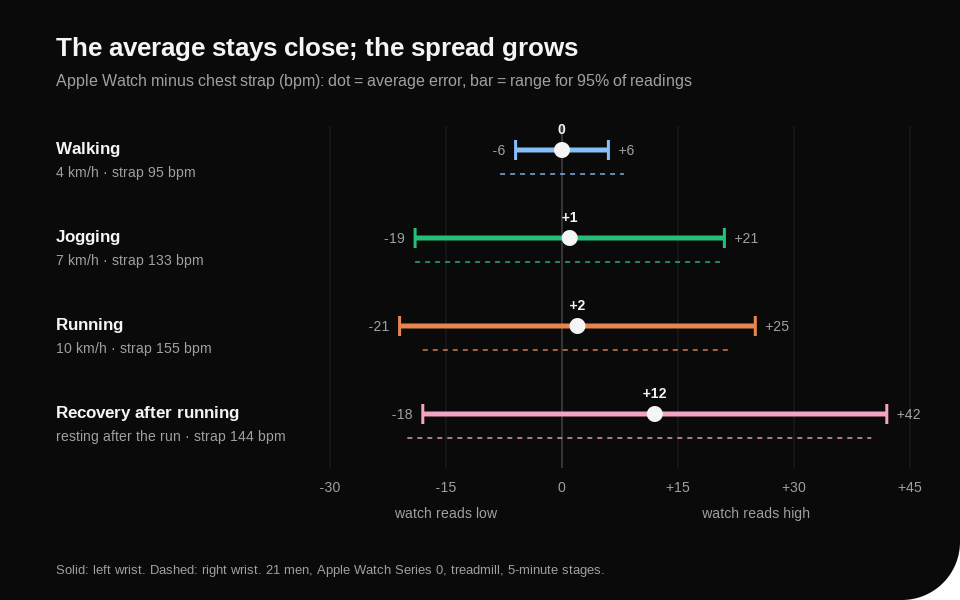
The clearest picture comes from a 2017 UK study of 21 recreationally active men, each wearing an Apple Watch on both wrists and a Polar chest strap, walking at 4 km/h, jogging at 7 km/h and running at 10 km/h for five minutes each [16]. The average error stayed within 2 bpm at every speed. The spread did not: 95% of walking readings were within 6 bpm of the strap, but running readings ranged from 21 bpm too low to 25 bpm too high on the left wrist [16].
That was the original Apple Watch, and sensors have improved since [4]. But later studies point the same way. In 30 young adults on a treadmill test, the watch’s agreement with an ECG declined as intensity rose, with relative errors of 2.4–5.1% [17]. In 50 athletic adults running at 4–9 mph, the Apple Watch III was the most accurate wrist device overall, yet at 8 and 9 mph none of the wrist devices reached acceptable agreement; in that study, runners held the handrail while readings were taken [18]. A 2023 study of the Series 6 and 7 found good validity overall but increasing error as running speed rose [19].
The exception: a 2026 study of 37 young adults found the Apple Watch SE’s error stayed under 2 bpm on average at every treadmill intensity and, as a percentage, fell as intensity rose; it was among the two most accurate of four optical devices [20]. So “harder means worse” is the usual pattern, not a law.
What about intervals and recoveries?
This is where optical heart rate is weakest. When heart rate changes quickly, optical readings can lag behind the chest strap [5, 21].
In the 2017 study, during the rest after the 10 km/h run, the watch read 10–12 bpm higher than the chest strap on average, and 95% of differences fell between about 20 bpm too low and 40 bpm too high [16]. Lag may play a part, though for the Apple Watch probably a small one: a 2020 study of the Apple Watch 2 and a Garmin found that measurement delay explained 2% of the Apple Watch’s error and 15% of the Garmin’s, and that the delay depended on the type and intensity of exercise [21]. A 2020 study of six devices concluded they were reasonably accurate at rest and at steady elevated heart rates, but differed in how they responded to changes in activity [5]. And in the 2026 climate study, stop-start walking raised errors in several devices compared with steady walking [8].
For a runner, that means three things. In the opening part of a hard rep, the reading may still be catching up. In short recoveries, it may stay high. And on rolling trails with constant changes of pace, optical devices in general struggle: a study of 21 people on a 3.2 km hilly trail run found poor agreement for every optical device tested. No Apple Watch was in that study, so it shows the problem for the technology rather than for Apple specifically [22].
Apple’s own 2026 study, with 1,254 people analysed, included outdoor runs, treadmill intervals and HIIT, and found the Series 12 more accurate than six competing wearables in each [2]. It is a manufacturer’s study, it excluded people with tattoos at the sensor site, and it reports only how much smaller Apple’s errors were than its rivals’, not how close the watch came to the chest strap [2].
When is a chest strap worth it?
When you need each reading to be right, rather than the average over a run. Chest straps are the field reference for a reason: a Polar H7 agreed with an ECG at 0.996 [3], and a Polar H10 correctly detected 99.4% of beat-to-beat intervals even in high-intensity activity, in a small study of 10 people [23]. Apple’s own accuracy study used a Polar H10 as its reference [2]. Two early US studies concluded that an electrode chest strap should be used when accurate heart rate is essential [3, 15], and one found that no wrist device matched it [15].
Apple’s advice is simple: if you can’t get consistent readings, you can connect your Apple Watch to an external heart-rate monitor such as a Bluetooth chest strap [6].
It is most worth it for:
- Intervals and short efforts, where heart rate changes fast: in one study the largest errors came in the rest after running [16], and optical readings can lag behind [5].
- Testing or setting zones, such as a threshold run or a maximum heart rate effort, where the exact number matters.
- When the watch has given you reason to doubt it: readings that jump, seem stuck to your running rhythm, or don’t match how the run felt.
For easy and steady runs, which should be most of your running anyway (see the 80/20 rule), the evidence says a well-fitted Apple Watch is close enough.
What to do with this
- Wear the watch snug and above the wrist bone, and tighten the band before you run [6, 7].
- Trust the watch most on steady runs, and its average for a whole run more than any single number.
- Treat readings early in a hard rep and in short recoveries with caution [5, 16]; judge those by pace or effort instead.
- If the reading jumps and stays implausibly high or low for how the run feels, suspect a sensor error such as cadence lock before your heart.
- Use a Bluetooth chest strap for interval sessions, zone tests and any run where you need exact numbers.
- A heart rate that is genuinely unusual for you, together with symptoms such as chest pain, dizziness or fainting, is a reason to see a doctor, not a data question.
How Metamorf uses this
Metamorf builds each workout’s training load from the heart-rate readings in Apple Health, counting a gap between readings as at most 30 seconds and scaling readings that cover at least 60 seconds and at least 25% of the workout up to its full duration (otherwise it uses the average heart rate); a workout from the last 3 days is read again if heart rate covers less than 80% of it, because Watch samples often reach the iPhone late. When it estimates your maximum heart rate from your workouts, it counts only the highest heart rate with at least 15 seconds in total at or above it, ignoring readings above 225 bpm, so for workouts with a heart-rate series a one-second optical spike doesn’t count. It has no check for longer errors such as cadence lock: a wrong reading held for 15 seconds or more counts like a real one, so if you think that has happened, set your maximum heart rate yourself in Profile › Heart rate & zones.
Sources
- Apple. Monitor your heart rate with Apple Watch. Apple Support, September 2026. support.apple.com
- Apple. Apple Watch heart rate accuracy study. White paper, September 2026. apple.com
- Gillinov S, Etiwy M, Wang R, et al. Variable accuracy of wearable heart rate monitors during aerobic exercise. Medicine and Science in Sports and Exercise. 2017;49(8):1697–1703. doi:10.1249/MSS.0000000000001284
- Lambe R, Baldwin M, O’Grady B, Schumann M, Caulfield B, Doherty C. The accuracy of Apple Watch measurements: a living systematic review and meta-analysis. NPJ Digital Medicine. 2026;9(1):63. doi:10.1038/s41746-025-02238-1
- Bent B, Goldstein BA, Kibbe WA, Dunn JP. Investigating sources of inaccuracy in wearable optical heart rate sensors. NPJ Digital Medicine. 2020;3:18. doi:10.1038/s41746-020-0226-6
- Apple. Get the most accurate measurements using your Apple Watch. Apple Support, March 2026. support.apple.com
- Apple. Wearing your Apple Watch. Apple Support, September 2026. support.apple.com
- Gielen J, Van Oost CN, Debard G, et al. Accuracy of optical heart rate measurements for 10 commercial wearables in different climate conditions and activities: instrument validation study. JMIR Formative Research. 2026;10:e85186. doi:10.2196/85186
- Shcherbina A, Mattsson CM, Waggott D, et al. Accuracy in wrist-worn, sensor-based measurements of heart rate and energy expenditure in a diverse cohort. Journal of Personalized Medicine. 2017;7(2):3. doi:10.3390/jpm7020003
- Chase SE, Liddell RG, McGonagle CL, Ives SJ. Accuracy of the Apple Watch Series 9 for measures of energy expenditure and heart rate at rest and during exercise: impact of skin pigmentation. Journal of Functional Morphology and Kinesiology. 2024;9(4):275. doi:10.3390/jfmk9040275
- Mulholland AM, MacDonald HV, Aguiar EJ, Wingo JE. Influence of skin pigmentation on the accuracy and data quality of photoplethysmographic heart rate measurement during exercise. European Journal of Applied Physiology. 2026;126(2):1057–1066. doi:10.1007/s00421-025-05977-x
- Koerber D, Khan S, Shamsheri T, Kirubarajan A, Mehta S. Accuracy of heart rate measurement with wrist-worn wearable devices in various skin tones: a systematic review. Journal of Racial and Ethnic Health Disparities. 2023;10(6):2676–2684. doi:10.1007/s40615-022-01446-9
- Choe JP, Kang M. Apple Watch accuracy in monitoring health metrics: a systematic review and meta-analysis. Physiological Measurement. 2025;46(4):04TR01. doi:10.1088/1361-6579/adca82
- Zhang Y, Weaver RG, Armstrong B, Burkart S, Zhang S, Beets MW. Validity of wrist-worn photoplethysmography devices to measure heart rate: a systematic review and meta-analysis. Journal of Sports Sciences. 2020;38(17):2021–2034. doi:10.1080/02640414.2020.1767348
- Wang R, Blackburn G, Desai M, et al. Accuracy of wrist-worn heart rate monitors. JAMA Cardiology. 2017;2(1):104–106. doi:10.1001/jamacardio.2016.3340
- Khushhal A, Nichols S, Evans W, et al. Validity and reliability of the Apple Watch for measuring heart rate during exercise. Sports Medicine International Open. 2017;1(6):E206–E211. doi:10.1055/s-0043-120195
- Thomson EA, Nuss K, Comstock A, et al. Heart rate measures from the Apple Watch, Fitbit Charge HR 2, and electrocardiogram across different exercise intensities. Journal of Sports Sciences. 2019;37(12):1411–1419. doi:10.1080/02640414.2018.1560644
- Pasadyn SR, Soudan M, Gillinov M, et al. Accuracy of commercially available heart rate monitors in athletes: a prospective study. Cardiovascular Diagnosis and Therapy. 2019;9(4):379–385. doi:10.21037/cdt.2019.06.05
- Montalvo S, Martinez A, Arias S, et al. Commercial smart watches and heart rate monitors: a concurrent validity analysis. Journal of Strength and Conditioning Research. 2023;37(9):1802–1808. doi:10.1519/JSC.0000000000004482
- Jeong Y, Yoon S, Lee J, Jeong WM, Ha MS. Comparison of heart rate measurement accuracy among commercially available photoplethysmography-based wearable devices across exercise intensities. Physical Activity and Nutrition. 2026;30(2):142–150. doi:10.20463/pan.2026.0032
- Støve MP, Holm RS, Kjaersgaard AS, Duncker K, Jensen MR, Larsen BT. Measurement latency significantly contributes to reduced heart rate measurement accuracy in wearable devices. Journal of Medical Engineering & Technology. 2020;44(3):125–132. doi:10.1080/03091902.2020.1753836
- Navalta JW, Montes J, Bodell NG, Salatto RW, Manning JW, DeBeliso M. Concurrent heart rate validity of wearable technology devices during trail running. PLoS ONE. 2020;15(8):e0238569. doi:10.1371/journal.pone.0238569
- Gilgen-Ammann R, Schweizer T, Wyss T. RR interval signal quality of a heart rate monitor and an ECG Holter at rest and during exercise. European Journal of Applied Physiology. 2019;119(7):1525–1532. doi:10.1007/s00421-019-04142-5
Metamorf is for fitness guidance, not medical advice. Talk to a doctor before changing how you train if you have a health condition.