The 80/20 rule: why most of your running should feel easy
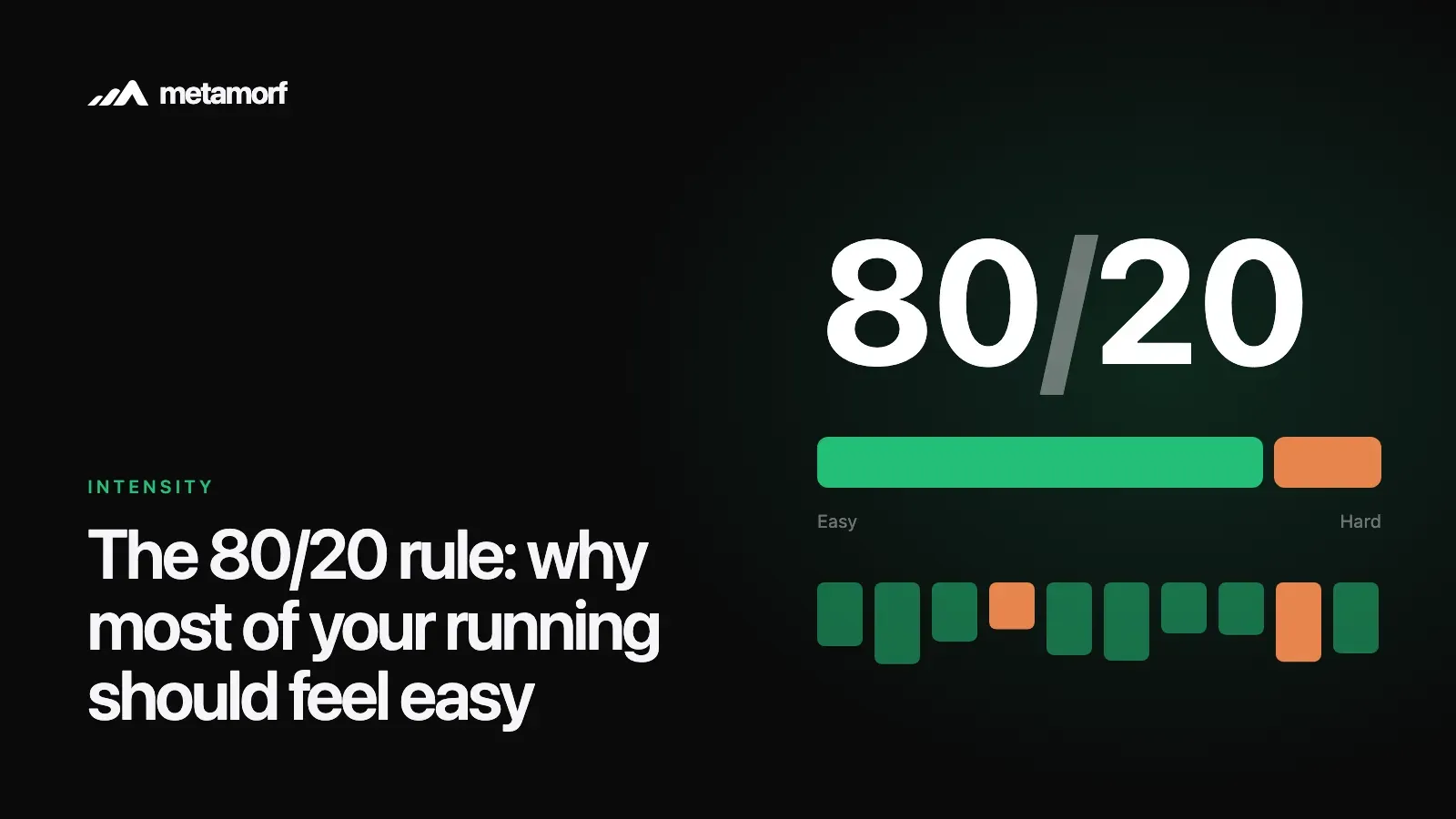
Most runners know the rule by now: run 80% of your training easy and 20% hard. Fewer know where the numbers come from, what “easy” means, or whether it applies to someone running four times a week rather than twelve. The short version is that the principle is solid and the percentages are softer than they sound. Here is what the research actually supports.
Where does the 80/20 rule come from?
It comes from watching what successful endurance athletes do, not from an experiment. In 2006, the exercise physiologist Stephen Seiler and a colleague recorded every session of 11 nationally competitive junior cross-country skiers for 32 days. Using heart-rate zones set from their lab tests, 75% of sessions were easy, 8% were at threshold and 17% were hard [1]. Their conclusion was that elite athletes “train surprisingly little at the lactate threshold intensity” [1].
In a 2010 review, Seiler found the same pattern across descriptive studies of national and international athletes training 10 to 13 times a week: about 80% of sessions at low intensity and about 20% dominated by high-intensity work [2]. Runners also train mostly easy, though with more threshold than hard work. Eight well-trained sub-elite runners, monitored with heart-rate straps for six months, spent about 71% of their training time easy, 21% between thresholds and 8% hard. Those who did the most easy running ran the 10.1 km cross-country race fastest (r = −0.97) [3].
Two cautions before going further. These are observations of very fit athletes training far more than most of us, and a correlation between easy volume and race times doesn’t prove the easy running caused the speed.
What counts as “easy”?
Easy means below your first threshold: the intensity where blood lactate first rises above resting levels and breathing starts to deepen, around 2 mmol/L of lactate [2]. Researchers divide training into three zones around two thresholds: zone 1 below the first, zone 2 between the first and the second (often called threshold or “tempo”), and zone 3 above the second [1, 3].
Without a lab, you have two practical anchors:
- Heart rate. In a simplified five-zone scale from the Norwegian Olympic federation, the easiest zone covers about 55–75% of maximum heart rate, and the first threshold (about 2 mmol/L) falls in the second zone, at roughly 75–85% [4]. Individual thresholds vary, so treat this as a starting point.
- The talk test. If you can talk in full sentences, you’re very likely below the first threshold. A 2022 review found that the point where talking first becomes slightly uncomfortable, or an effort of about 10–11 on the 6–20 Borg scale, reflects that first threshold [5].
For most runners, easy feels too slow at first. That is usually the point.
80% of what: sessions or minutes?
This is the detail most articles skip, and it changes the number a lot. Seiler’s 80/20 counts sessions: about eight in ten sessions are easy [2]. Count minutes instead, and the same athletes look far easier, because even a hard session is mostly warm-up, recoveries and cool-down.
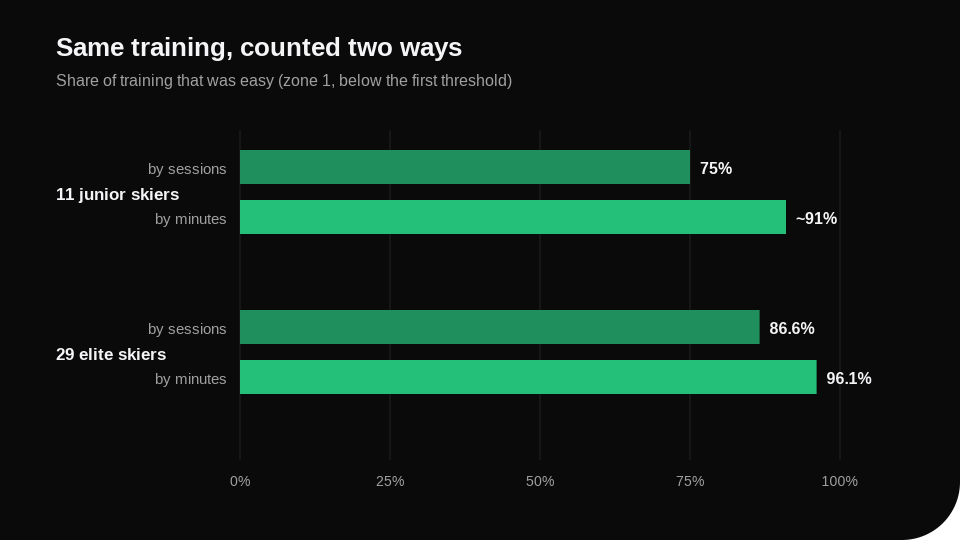
The junior skiers with 75% easy sessions spent about 91% of their training time below the first threshold [4]. In 29 elite skiers over 570 sessions, 86.6% of sessions were easy, but 96.1% of minutes were [6]. So if your watch reports time in heart-rate zones, a week that is 80/20 by sessions may well show more than 80% of minutes easy.
Does running mostly easy actually make you faster?
The randomised trials in runners point that way, but they are small.
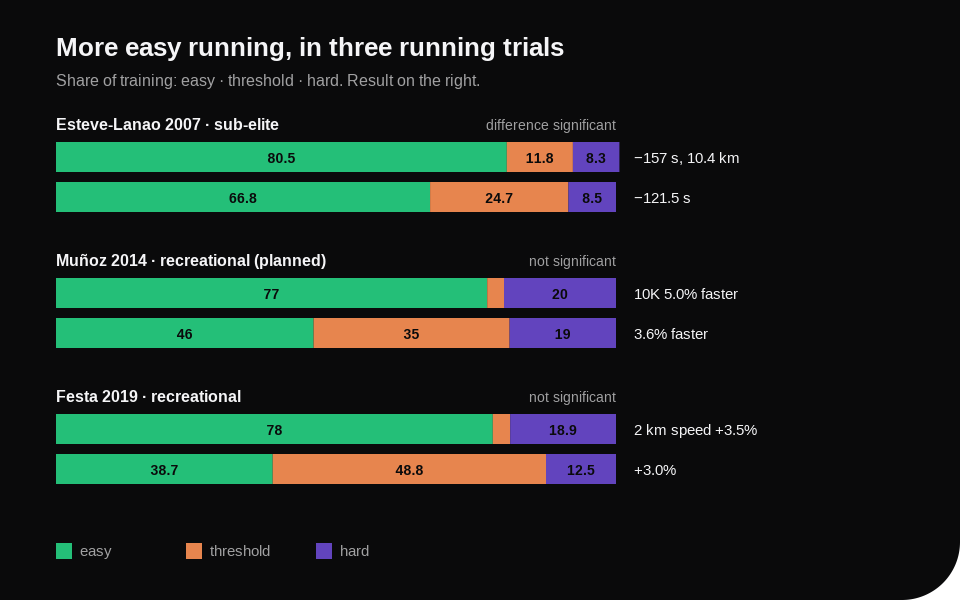
- Sub-elite runners. In a five-month trial, 12 runners did the same amount of hard running but split the rest differently: one group trained about 81% easy and 12% at threshold, the other about 67% easy and 25% at threshold. The mostly-easy group improved a 10.4 km cross-country race by 157 seconds, the other by 121.5 seconds (p = 0.03) [7].
- Recreational runners. In a 10-week trial, 30 recreational runners following a polarized plan (about 77% easy, 3% threshold, 20% hard) improved their 10K by 5.0%, against 3.6% on a plan with much more threshold running. The difference was not statistically significant for the whole group; it reached significance only among the runners who stuck most closely to their plans [8].
- Another recreational trial. In 38 recreational runners over eight weeks, a polarized plan and a threshold-heavy plan, matched for total heart-rate load, improved their average speed over a 2 km time trial by a similar amount (3.5% against 3.0%). The threshold-heavy group trained 17% fewer hours to get there [9].
Mixed-sport trials add a useful twist. In a nine-week study of 48 well-trained endurance athletes, a polarized group (itself only about 68% easy by time) improved VO2peak by 11.7% and time to exhaustion by 17.4%, the biggest gains of the four groups [10]. But the high-volume group, which trained 83% easy with almost no hard work, showed no further improvement in its endurance measures [10]. “Mostly easy” isn’t “only easy”. The hard sessions matter too.
Is polarized training better than other mixes?
Probably not by much, if at all. This is where the research has moved in the last few years.
A 2019 meta-analysis pooled three small trials and found that polarized training beat threshold-focused training on time trials, with a moderate effect, but the trials were few and of low quality [11]. A larger 2024 meta-analysis of 17 studies and 437 athletes found polarized training slightly better for VO2peak, and no different for time-trial performance [12]. And a 2025 analysis of individual participants’ data from 13 studies, co-written by several of the researchers behind the original trials, found no difference between polarized and pyramidal training (most easy, less threshold, least hard) for either VO2max or time trials [13]. In a subgroup analysis, recreational athletes appeared to gain more VO2max from pyramidal training, and competitive athletes from polarized [13].
What elite distance runners do supports the same reading. A systematic review found they mostly train pyramidally, with threshold sessions and harder sessions each at least once a week, and the authors recommend shifting towards polarized as races approach [14]. The question was important enough that Medicine & Science in Sports & Exercise ran a formal debate in 2022, with leading researchers arguing that polarized training is, and is not, optimal [15, 16].
The common ground is the useful part: a large majority of easy running, plus a small, regular dose of harder work. Whether that harder work sits at threshold or above it is a genuine open question.
Why would easy running work?
Two lines of evidence suggest why. First, easy running seems cheap to recover from. In highly trained runners, heart-rate variability (a marker of the nervous system’s recovery) returned to its pre-run level within 5–10 minutes after 60 or even 120 minutes below the first threshold, but took about 30 minutes after threshold or interval sessions; in less highly trained men, 90 minutes or more after intervals [17]. The authors suggested the first threshold may work almost like a switch for recovery cost [17].
Second, easy running is how runners build volume. In Strava data from 119,452 marathon runners, faster runners trained far more, and almost all of their extra training was easy; their time at moderate and hard intensities was much the same as slower runners’ [18]. That is a correlation, and experienced runners can absorb more volume, but it fits the pattern: easy running lets you run more without paying for it the next day.
Do most runners run their easy runs too hard?
Coaches often say so, and Seiler and Tønnessen call it the training-intensity “black hole”: easy runs drift up, hard sessions fall short, and everything ends up in the middle [4]. The evidence for it is thinner than its popularity. The best-known numbers come from an unpublished study reported in a review: recreational runners planned 77% easy and actually did 65% [4]. It appears to be the trial later published by Muñoz and colleagues [8]. In app data from 6,771 marathon finishers, the slowest finishers did only about 28–29% of their running slower than marathon pace, against about 62–66% for the fastest [19], but those zones were based on each runner’s own race pace, not physiology. And a small study of seven recreational marathoners found they spent 76% of their time easy [20].
So it’s worth checking rather than assuming. If your easy runs regularly leave you unable to talk, or your heart-rate data shows most minutes in the middle zones, you may be in the black hole.
What to do with this
- Make most of your running genuinely easy: conversational, below your first threshold. By minutes, that’s typically 75–90% of your week, depending on how your zones are set.
- Keep one or two harder sessions a week. The evidence doesn’t say whether threshold or interval work is better for you, so many runners do some of each.
- Judge “easy” by breathing and talk, then check it against heart rate. Slow down on hills and in heat rather than holding the pace.
- Don’t chase an exact split. “Mostly easy, a little hard, consistently” is what the research supports.
How Metamorf uses this
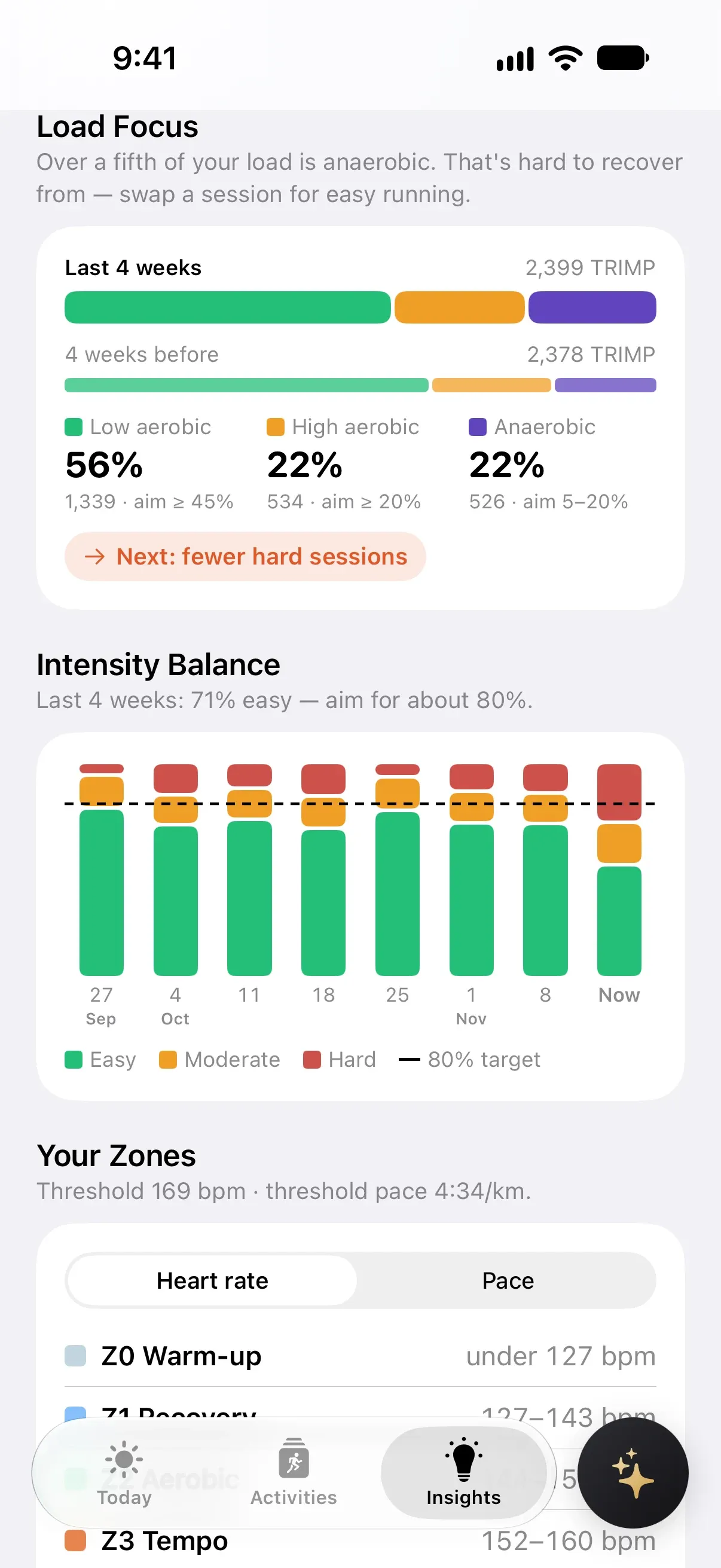
Metamorf’s Intensity Balance card counts the heart-rate time recorded in your workouts over the last eight weeks: below 82% of your maximum heart rate counts as easy, 82–87% as moderate and above that as hard. It shows your easy share of that time over the last four weeks against an 80% line: below 70% it reads “Too much moderate work — slow the easy days down”, and at 77% or more, “A good 80/20 balance”. The Load Focus card then shows how your training load splits between low aerobic, high aerobic and anaerobic work, and what to adjust next.
Sources
- Seiler KS, Kjerland GØ. Quantifying training intensity distribution in elite endurance athletes: is there evidence for an “optimal” distribution? Scandinavian Journal of Medicine & Science in Sports. 2006;16(1):49–56. doi:10.1111/j.1600-0838.2004.00418.x
- Seiler S. What is best practice for training intensity and duration distribution in endurance athletes? International Journal of Sports Physiology and Performance. 2010;5(3):276–291. doi:10.1123/ijspp.5.3.276
- Esteve-Lanao J, San Juan AF, Earnest CP, Foster C, Lucia A. How do endurance runners actually train? Relationship with competition performance. Medicine and Science in Sports and Exercise. 2005;37(3):496–504. doi:10.1249/01.mss.0000155393.78744.86
- Seiler S, Tønnessen E. Intervals, thresholds, and long slow distance: the role of intensity and duration in endurance training. Sportscience. 2009;13:32–53. sportsci.org
- Bok D, Rakovac M, Foster C. An examination and critique of subjective methods to determine exercise intensity: the Talk Test, Feeling Scale, and Rating of Perceived Exertion. Sports Medicine. 2022;52(9):2085–2109. doi:10.1007/s40279-022-01690-3
- Sylta Ø, Tønnessen E, Seiler S. From heart-rate data to training quantification: a comparison of 3 methods of training-intensity analysis. International Journal of Sports Physiology and Performance. 2014;9(1):100–107. doi:10.1123/IJSPP.2013-0298
- Esteve-Lanao J, Foster C, Seiler S, Lucia A. Impact of training intensity distribution on performance in endurance athletes. Journal of Strength and Conditioning Research. 2007;21(3):943–949. doi:10.1519/R-19725.1
- Muñoz I, Seiler S, Bautista J, España J, Larumbe E, Esteve-Lanao J. Does polarized training improve performance in recreational runners? International Journal of Sports Physiology and Performance. 2014;9(2):265–272. doi:10.1123/ijspp.2012-0350
- Festa L, Tarperi C, Skroce K, La Torre A, Schena F. Effects of different training intensity distribution in recreational runners. Frontiers in Sports and Active Living. 2019;1:70. doi:10.3389/fspor.2019.00070
- Stöggl T, Sperlich B. Polarized training has greater impact on key endurance variables than threshold, high intensity, or high volume training. Frontiers in Physiology. 2014;5:33. doi:10.3389/fphys.2014.00033
- Rosenblat MA, Perrotta AS, Vicenzino B. Polarized vs. threshold training intensity distribution on endurance sport performance: a systematic review and meta-analysis of randomized controlled trials. Journal of Strength and Conditioning Research. 2019;33(12):3491–3500. doi:10.1519/JSC.0000000000002618
- Silva Oliveira P, Boppre G, Fonseca H. Comparison of polarized versus other types of endurance training intensity distribution on athletes’ endurance performance: a systematic review with meta-analysis. Sports Medicine. 2024;54(8):2071–2095. doi:10.1007/s40279-024-02034-z
- Rosenblat MA, Watt JA, Arnold JI, et al. Which training intensity distribution intervention will produce the greatest improvements in maximal oxygen uptake and time-trial performance in endurance athletes? A systematic review and network meta-analysis of individual participant data. Sports Medicine. 2025;55(3):655–673. doi:10.1007/s40279-024-02149-3
- Casado A, González-Mohíno F, González-Ravé JM, Foster C. Training periodization, methods, intensity distribution, and volume in highly trained and elite distance runners: a systematic review. International Journal of Sports Physiology and Performance. 2022;17(6):820–833. doi:10.1123/ijspp.2021-0435
- Foster C, Casado A, Esteve-Lanao J, Haugen T, Seiler S. Polarized training is optimal for endurance athletes. Medicine and Science in Sports and Exercise. 2022;54(6):1028–1031. doi:10.1249/MSS.0000000000002871
- Burnley M, Bearden SE, Jones AM. Polarized training is not optimal for endurance athletes. Medicine and Science in Sports and Exercise. 2022;54(6):1032–1034. doi:10.1249/MSS.0000000000002869
- Seiler S, Haugen O, Kuffel E. Autonomic recovery after exercise in trained athletes: intensity and duration effects. Medicine and Science in Sports and Exercise. 2007;39(8):1366–1373. doi:10.1249/mss.0b013e318060f17d
- Muniz-Pumares D, Hunter B, Meyler S, Maunder E, Smyth B. The training intensity distribution of marathon runners across performance levels. Sports Medicine. 2025;55(4):1023–1035. doi:10.1007/s40279-024-02137-7
- Zrenner M, Heyde C, Duemler B, Dykman S, Roecker K, Eskofier BM. Retrospective analysis of training and its response in marathon finishers based on fitness app data. Frontiers in Physiology. 2021;12:669884. doi:10.3389/fphys.2021.669884
- Manzi V, Bovenzi A, Castagna C, Sinibaldi Salimei P, Volterrani M, Iellamo F. Training-load distribution in endurance runners: objective versus subjective assessment. International Journal of Sports Physiology and Performance. 2015;10(8):1023–1028. doi:10.1123/ijspp.2014-0557
Metamorf is for fitness guidance, not medical advice. Talk to a doctor before changing how you train if you have a health condition.